

Your general liability insurance policy has a major blind spot. It doesn’t protect you when your professional advice or services cause financial harm to a client.
At Brooks Insurance, we see this gap hurt Texas businesses every year. That’s where errors and omissions coverage steps in-filling the protection your standard policy leaves behind.
What Errors and Omissions Insurance Actually Covers
Errors and omissions insurance protects you when your professional work causes a client to lose money. Unlike general liability, which covers bodily injury and property damage, E&O addresses the financial fallout from mistakes, oversights, or negligence in the advice or services you provide. The policy pays for legal defense costs, settlements, and judgments when a client sues over your professional performance.
In Texas, small businesses pay an average of $88 per month, or $1,051 annually, for errors and omissions insurance, making it affordable protection against claims that could drain your savings. The coverage applies even if you did nothing wrong-simply being named in a lawsuit triggers defense coverage. An attorney handles the case while the policy covers legal fees and court costs up to your limit.
How E&O Protects Different Professional Mistakes
E&O covers real scenarios that happen in Texas professional services. An IT consultant who deploys software that causes client downtime, an architect whose design error forces a project restart, or a marketing agency whose campaign underperforms and costs the client revenue-all face financial liability claims that E&O addresses.
The policy typically operates on a claims-made basis, meaning coverage applies only to claims reported during the active policy period. This structure makes the retroactive date critical; it determines how far back your coverage extends for past work.
The Retroactive Date and Tail Coverage
When you switch insurers or retire, tail coverage becomes essential to protect against claims discovered after your policy expires. Without tail coverage, you risk gaps where late-discovered problems go uninsured. The retroactive date determines how far back your coverage extends for past work, so maintaining continuous coverage prevents exposure.
Policy Limits and Client Requirements
Policy limits commonly start at $1 million per occurrence and $2 million aggregate for small practices, though your actual needs depend on project size and client contracts. Many clients now require proof of E&O before engagement, making the coverage not just protective but also a business requirement. This shift means that without E&O, you may lose opportunities to work with larger or more sophisticated clients who demand proof of professional liability protection.
Why General Liability Won’t Protect Your Professional Work
General liability insurance was designed for one purpose: protecting you when your business operations cause bodily injury or property damage to someone else. A customer slips on your office floor. A delivery truck hits a parked car. Your signage falls and damages a storefront. General liability handles these scenarios. But the moment your professional advice or services cause financial loss, your general liability policy stops working. This is not a minor gap-it’s a fundamental mismatch between what the policy covers and the actual risks professionals face in Texas.
What General Liability Actually Excludes
The exclusions built into general liability policies specifically carve out professional liability exposure. Most general liability policies exclude claims arising from errors, omissions, or negligence in professional services. An accountant who miscalculates tax deductions costs a client thousands in penalties. A consultant whose flawed strategic advice derails a company’s expansion faces a lawsuit. A software developer whose code fails and disrupts client operations for weeks receives a demand letter. None of these scenarios trigger general liability coverage because they stem from the quality of professional work, not from bodily injury or property damage.
Contractual Liability Gaps
Contractual liability exclusions in general liability policies mean you lack coverage when a client sues you for breaching a service agreement or failing to deliver promised results. Many professional service contracts now include liability indemnification clauses requiring you to cover damages from your own negligence-a direct hit that general liability explicitly excludes. Without errors and omissions insurance, you face these claims entirely out of pocket, potentially losing six figures or more depending on the client’s losses.
The Hidden Cost of Reputational Risk
General liability also provides no protection for the financial damage to your reputation when mistakes become public. If your professional error leads to negative publicity, lost client relationships, or difficulty winning new contracts, general liability won’t help you recover those losses. A Texas real estate agent whose documentation error causes a closing to fail results in lost commission and damaged relationships with referral partners. That agent faces financial consequences that general liability ignores. Errors and omissions insurance covers these financial losses from professional failures, whereas general liability remains silent.
Reputational recovery often costs more than the original claim-clients leave, referrals dry up, and rebuilding trust takes years. E&O insurance addresses the financial fallout from these professional mistakes directly, paying defense costs and settlements when clients sue over your work performance. This protection becomes especially important as you consider which industries face the highest exposure to these gaps.
Who Needs Errors and Omissions Coverage Most
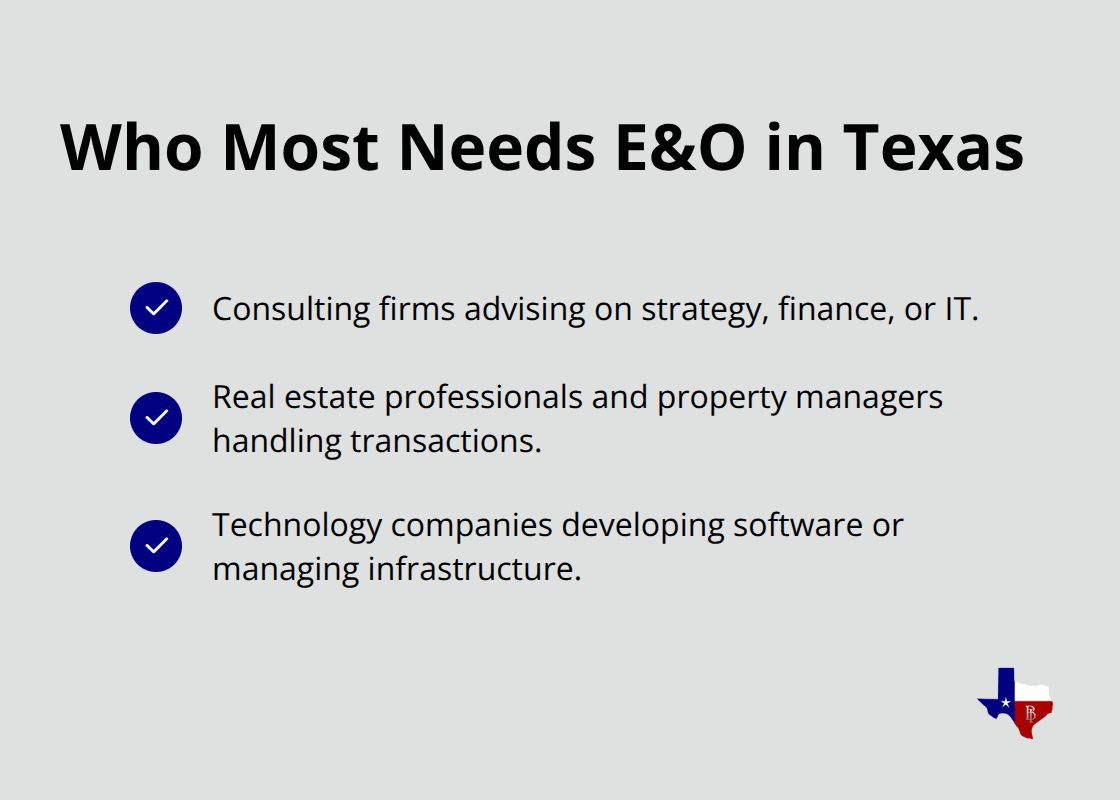
Errors and omissions insurance isn’t optional for certain Texas professions-it’s survival. Consulting firms, real estate professionals, and technology companies face the highest financial exposure when their work goes wrong, and clients increasingly demand proof of E&O coverage before signing contracts. If your income depends on professional expertise rather than physical products, E&O protects your business from claims that could eliminate years of profit in a single lawsuit.
Consultants and Advisory Firms Face High-Risk Exposure
Consultants and advisory firms operate in a high-risk zone because their entire value proposition centers on the quality of their recommendations. A management consultant whose strategic advice causes a client to make a poor acquisition decision, losing millions in the process, faces a professional liability claim that general liability completely ignores. Financial advisors who recommend unsuitable investments, IT consultants who deploy systems that disrupt operations for weeks, and marketing strategists whose campaigns underperform all encounter clients demanding compensation for financial losses. These aren’t edge cases-they’re routine business disputes in Texas.
Coverage limits starting at $1 million per occurrence and $2 million aggregate provide the baseline protection these professionals need, though larger firms handling enterprise clients often require $2 million or higher per occurrence. Without E&O, a single claim can force you to liquidate business assets or declare bankruptcy, which is why most sophisticated clients now require consultants to carry documented coverage before engagement.
Real Estate and Property Management Professionals
Real estate professionals and property managers face equally severe exposure because transaction errors have immediate financial consequences. A real estate agent whose documentation mistake delays a closing costs the buyer thousands in carrying costs and damages the agent’s reputation with referral partners. A property manager who fails to properly screen a tenant, resulting in property damage or lease violations, faces liability claims from property owners. Title agents who miss lien searches expose themselves to claims from buyers and lenders. These scenarios happen regularly in Texas real estate, and E&O coverage addresses the financial fallout directly.
Technology Companies and Software Developers
Technology companies developing software, creating websites, or managing IT infrastructure operate in an environment where code failures, data breaches, or system downtime cause measurable financial harm to clients. A developer whose application failure costs a client revenue during peak business hours faces a direct claim for lost profits. Cloud infrastructure providers whose service interruptions shut down client operations incur liability for business interruption losses. Software companies selling to enterprise clients routinely encounter service-level agreements that include liquidated damages clauses (contractual penalties E&O insurance covers when performance failures occur).
Final Thoughts
General liability insurance and errors and omissions coverage protect fundamentally different business risks, and Texas professionals need both working together. General liability addresses bodily injury and property damage from your operations, while E&O protects your finances when your advice or services cause client losses. A consultant, real estate agent, or software developer who carries only general liability insurance leaves a dangerous gap in protection that a single professional mistake can expose.
Your policy limits should reflect the actual financial exposure your clients face when your work underperforms. Most small professional service firms start with $1 million per occurrence and $2 million aggregate, though larger projects and enterprise clients often demand higher limits. The retroactive date matters equally-when you switch insurers, gaps emerge if your new policy doesn’t cover past work, which is why tail coverage protects you against claims discovered years after a project ends.
Contact Brooks Insurance to discuss your specific coverage needs and build a protection strategy that matches your actual risk. Our licensed agents represent multiple top-rated insurers and work with consultants, real estate professionals, and technology companies across Texas to ensure they carry the right combination of general liability insurance and errors and omissions protection.
Disclaimer: The information provided in this blog is for general informational purposes only and does not constitute legal, financial, or insurance advice. Coverage options, terms, and availability may vary. Please consult with a licensed professional for advice specific to your situation