

Choosing the right flood insurance deductible in Texas directly shapes what you pay each month and what comes out of your pocket when disaster strikes. A higher deductible lowers your premium, but it means bigger out-of-pocket costs if you file a claim.
At Brooks Insurance, we help Texas homeowners understand this trade-off so you can make a choice that fits your finances and protects your home.
How Deductibles Impact Your Flood Insurance Premium
What a Deductible Means in Practice
A deductible is the amount you pay out of your own pocket before your flood insurance kicks in. In Texas, the National Flood Insurance Program sets standard deductible options at $1,000, $2,500, $5,000, and $10,000. When a flood damages your home, you cover that deductible first, and your insurance pays the rest up to your policy limit. This direct relationship between deductible size and premium cost confuses most Texas homeowners. The math is straightforward though: lower your deductible, your annual premium goes up. Raise your deductible, your premium drops.
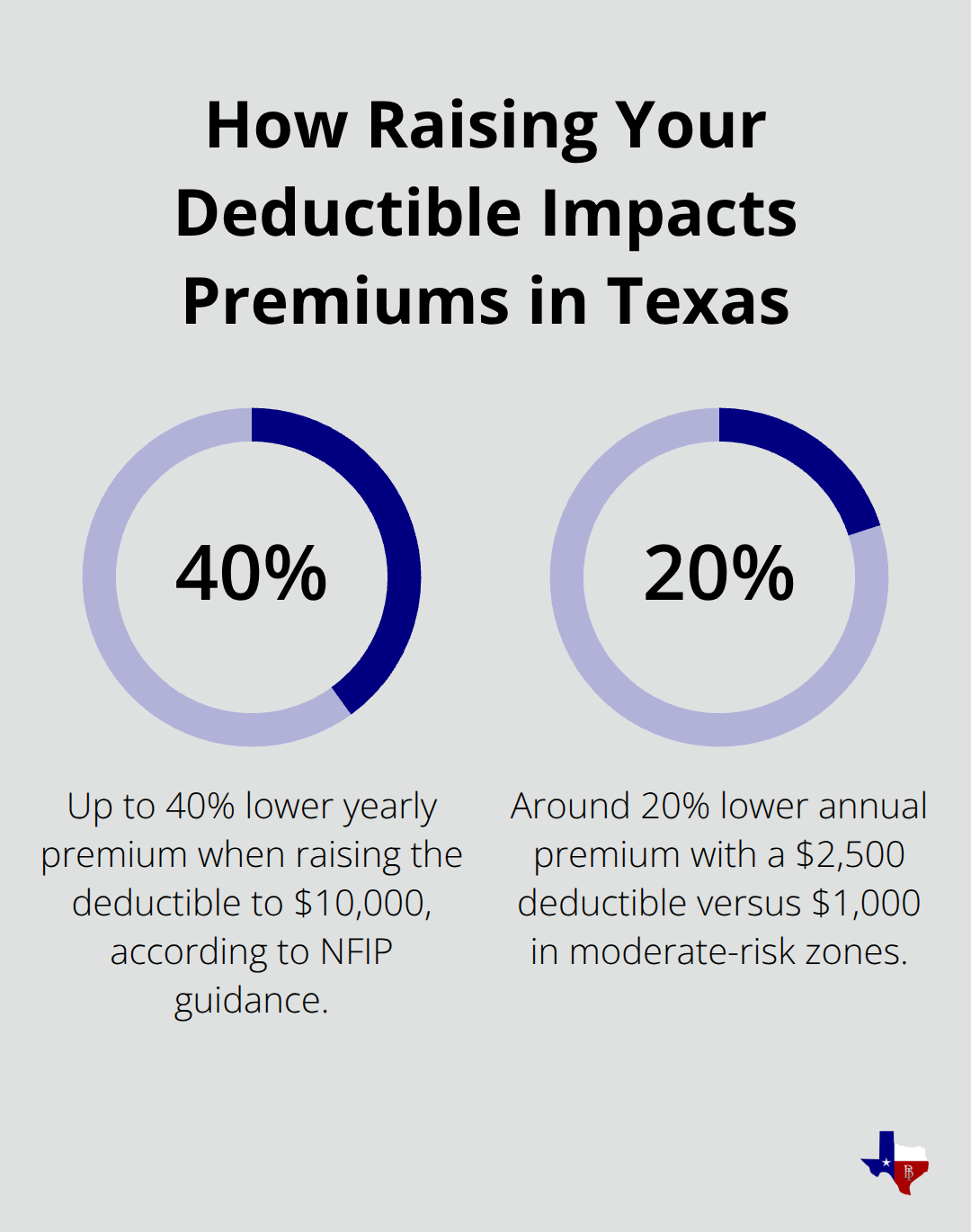
Raising the deductible to the $10,000 maximum could lower the yearly cost by up to 40%.
Lower Deductibles Cost More Each Year
Picking a $1,000 deductible sounds protective until you see the premium impact. In high-risk flood zones across Texas, you could pay $800 to $1,200 more per year compared to a $10,000 deductible. Over five years, that adds up to $4,000 to $6,000 in extra premiums. Most Texas homeowners in moderate flood zones find the $2,500 deductible strikes a workable balance, sitting between full protection and affordability. The trap many people fall into assumes lower deductibles always mean better coverage. They don’t. A low deductible with insufficient coverage limits leaves you exposed if a major flood occurs. You need both adequate deductibles and adequate limits to actually protect your home’s replacement value.
Higher Deductibles Require Emergency Savings
The higher your deductible, the more emergency cash you need on hand. If you choose a $10,000 deductible and a flood hits, you must have $10,000 ready to pay your contractor or restoration company before insurance reimburses you. Many Texas homeowners underestimate this liquidity requirement. Financial advisors recommend maintaining an emergency fund equal to three to six months of living expenses anyway, so you should factor your flood deductible into that fund. A practical approach works best: calculate your deductible choice, then verify you actually have that amount available in savings. If you don’t, a higher deductible creates financial hardship when you need help most. Your deductible choice should reflect what you can genuinely afford to pay immediately after a flood, not just what saves money on premiums today.
Matching Your Deductible to Your Financial Reality
Your financial situation determines which deductible makes sense for your household. If you have substantial savings and can cover a $10,000 deductible without stress, the premium savings justify the higher out-of-pocket risk. If your emergency fund sits below $5,000, a lower deductible protects you from financial crisis when water damage strikes. The key is honest assessment: don’t choose a deductible you can’t actually afford to pay. Flood damage doesn’t wait for you to save up the money. Contractors and restoration companies expect payment quickly, and your insurance company won’t reimburse you until you’ve paid your deductible first. This timing matters more than most homeowners realize.
Moving Forward with Your Coverage Decision
Once you understand how deductibles affect both your monthly costs and your out-of-pocket risk, you’re ready to explore which coverage limits actually protect your home’s replacement value.
How Deductibles Shape What You Pay
The premium you pay each month moves in the opposite direction of your deductible. Choose a $1,000 deductible in a Texas high-risk flood zone, and you’ll pay significantly more annually than someone with a $10,000 deductible on the same home. The National Flood Insurance Program reports that raising your deductible from $1,000 to $10,000 can reduce your yearly premium by up to 40 percent. In practical terms, a homeowner in Harris County might pay $1,800 annually with a $1,000 deductible versus $1,100 with a $10,000 deductible. That $700 yearly difference compounds fast. Over a decade without a claim, you spend $7,000 more for the lower deductible.
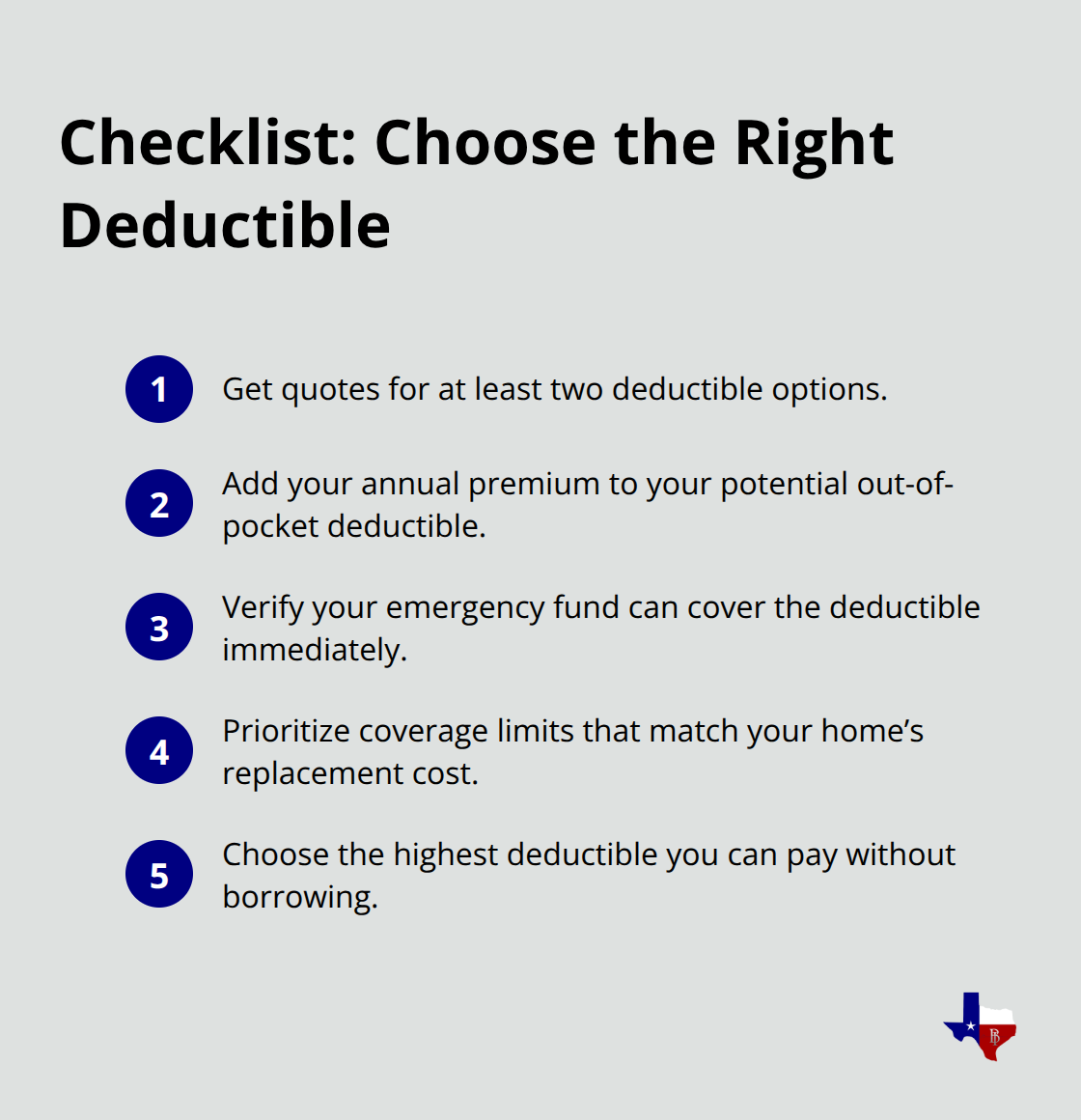
The catch most Texas homeowners miss is that this math only works if you actually stay claim-free. One flood claim wipes out years of premium savings if your deductible is too high for your finances to handle.
What Your Emergency Fund Should Cover
Your flood deductible needs to sit within your emergency savings, not strain it. Financial experts recommend keeping three to six months of living expenses in reserve, and your deductible should fit comfortably inside that amount. If a flood hits and you’ve chosen a $10,000 deductible but only have $8,000 saved, you face a real problem. Contractors and restoration companies demand payment before they finish work, and your insurance company won’t reimburse you until you’ve paid the full deductible. This timing creates a cash flow crisis that forces many Texas homeowners into debt they didn’t anticipate. The right deductible is the highest amount you can pay immediately without borrowing money or depleting your entire emergency fund. That’s not a theoretical number-it’s a specific dollar amount you should calculate before selecting coverage.
The False Economy of Low Deductibles
Choosing a low deductible to feel secure is a trap. You’re paying extra premiums for peace of mind rather than actual protection. A homeowner with a $1,000 deductible and a $250,000 coverage limit doesn’t have better protection than someone with a $5,000 deductible and a $300,000 coverage limit if their home’s replacement cost runs $350,000. The real protection comes from adequate coverage limits matched to your home’s actual replacement value, not from a low deductible. Many Texas homeowners in moderate flood zones find the $2,500 deductible hits the practical sweet spot, reducing premiums meaningfully while staying within what most households can pay from savings. Your deductible choice matters only when a flood actually occurs. Until then, you’re simply paying more each month for a choice that doesn’t protect you any better.
Finding Your Deductible Sweet Spot
The deductible that works for your household depends on what you can actually afford to pay when water damage strikes. If you have substantial savings and can cover a $10,000 deductible without stress, the premium savings justify the higher out-of-pocket risk. If your emergency fund sits below $5,000, a lower deductible protects you from financial crisis when a flood hits. The key is honest assessment: don’t select a deductible you can’t actually afford to pay. Flood damage doesn’t wait for you to save up the money. Contractors and restoration companies expect payment quickly, and your insurance company won’t reimburse you until you’ve paid your deductible first. This timing matters more than most homeowners realize. Once you’ve matched your deductible to your actual financial capacity, the next step involves comparing how different coverage limits protect your home’s replacement value.
Selecting Your Deductible Based on What You Can Actually Pay
Your deductible choice comes down to one hard question: what amount can you pay from savings the day after a flood damages your home? This isn’t about what sounds good or what saves the most on premiums. It’s about financial reality. Pull up your bank account and see what sits in checking and savings combined. This number matters because contractors and restoration companies in Texas expect payment within days of starting work, not weeks. Your insurance company reimburses you only after you pay the full deductible first.
If you have $12,000 in accessible savings and your home’s replacement value sits around $350,000, a $10,000 deductible works because you can pay it without financial strain. You’ll keep $2,000 as an emergency cushion, which financial advisors recommend anyway. If you have $6,000 total in savings, a $5,000 deductible is smarter because it leaves you $1,000 for unexpected post-flood expenses like temporary housing or equipment rental. A $10,000 deductible in this scenario forces you to choose between paying contractors and covering other disaster costs.
The National Flood Insurance Program offers four standard deductible levels in Texas: $1,000, $2,500, $5,000, and $10,000. Most homeowners in moderate flood zones find the $2,500 deductible hits the practical middle ground, reducing annual premiums by roughly 15 to 20 percent compared to a $1,000 deductible while staying within what typical Texas households can cover from savings.
Coverage Limits Matter More Than Deductible Size
Your deductible choice only protects you if your coverage limits actually match your home’s replacement cost. This is where many Texas homeowners make a critical mistake. They pick a low $1,000 deductible for psychological comfort, then pair it with a $200,000 coverage limit on a home that costs $320,000 to rebuild. When a major flood hits, they’re underinsured by $120,000 regardless of how low their deductible is. The deductible becomes irrelevant because the coverage limit is the real problem.
Get your home professionally appraised or use the Texas Department of Insurance’s replacement cost estimator to find your actual rebuild cost, then match your coverage limit to that number. A $5,000 deductible with a $350,000 limit provides far better protection than a $1,000 deductible with a $250,000 limit. Work backwards from your coverage needs. Calculate what your home would cost to rebuild today, add 10 to 15 percent for inflation and unforeseen expenses, then select a deductible that fits comfortably within your savings while keeping your premium affordable.
How Flood Risk Changes Your Deductible Strategy
Your flood risk level dramatically changes which deductible makes financial sense. A homeowner in a high-risk flood zone paying $2,400 annually with a $1,000 deductible might reduce that to $1,650 with a $5,000 deductible, saving $750 yearly. Over ten claim-free years, that’s $7,500 in premium savings. But if a flood occurs in year three, a $5,000 deductible means you pay $5,000 out of pocket instead of $1,000, wiping out four years of savings immediately.
High-risk homeowners benefit from lower deductibles if their savings can absorb the premium cost. Moderate-risk homeowners usually find higher deductibles worthwhile because floods are less frequent. Your specific risk depends on your property’s elevation, proximity to rivers or storm surge zones, and local drainage patterns. An insurance agent pulls your flood zone data from FEMA maps and can show you exactly how different deductible choices affect your annual premium in your specific location.
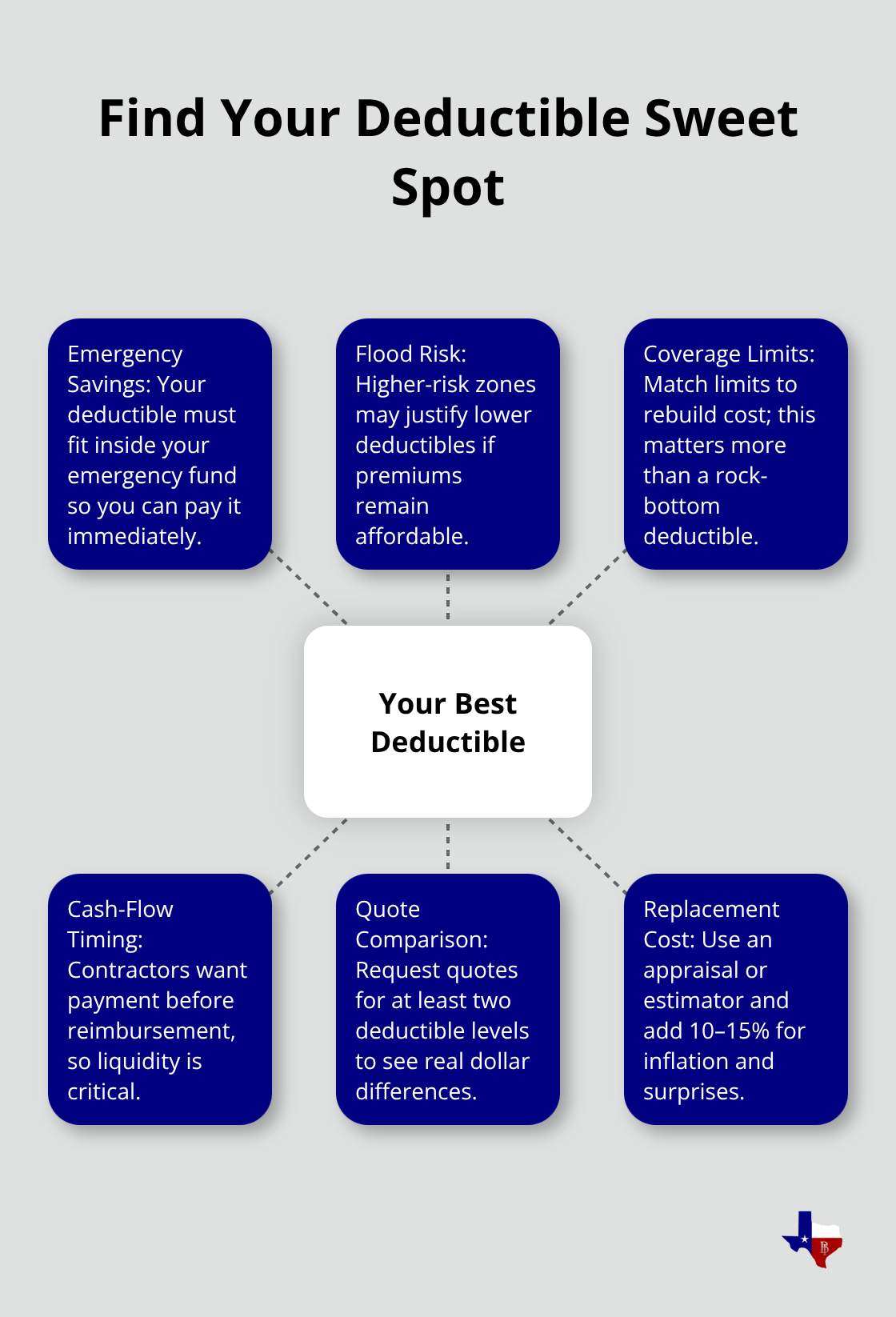
This personalized analysis beats generic advice because your neighborhood’s flood history and infrastructure matter.
Comparing Deductible Options for Your Home
Texas homeowners should request premium quotes for at least two deductible options-often $2,500 and $5,000-to see the actual dollar difference before committing. This comparison takes the guesswork out of the decision and grounds your choice in real numbers for your home, not theoretical examples. When you receive quotes, look at the total annual cost for each deductible level, then calculate what you’d pay out of pocket if a flood occurred. Add these two numbers together to understand your true financial exposure under each scenario.
Some homeowners find that a $2,500 deductible costs only $200 to $300 more annually than a $5,000 deductible in their specific location. In that case, the lower deductible makes sense because the premium difference is minimal. Other homeowners see a $500 to $700 annual savings with a higher deductible, which justifies the increased out-of-pocket risk if they have adequate savings. Your actual numbers determine the right choice, not industry averages or what your neighbor selected.
Final Thoughts
Your flood insurance deductible in Texas shapes both your monthly budget and your financial security when water damage strikes. The right choice balances premium savings against what you can genuinely afford to pay immediately after a flood. Most Texas homeowners find the $2,500 or $5,000 deductible hits the practical middle ground, reducing annual costs by 15 to 20 percent while staying within what typical households can cover from savings.
The deductible matters far less than your coverage limit. A low deductible paired with insufficient coverage leaves you underinsured when a major flood occurs, so your real protection comes from matching your coverage limit to your home’s actual replacement cost, then selecting a deductible that fits your financial capacity. Request quotes for at least two deductible options to see the real dollar difference for your specific home and location.
We at Brooks Insurance help Texas homeowners navigate this decision with personalized analysis based on your flood risk, financial situation, and home’s replacement value. Our licensed agents represent multiple top-rated insurance companies, giving you a larger selection of coverage and pricing options than you’d find working with a single insurer. Visit brooksinstx.com to request a personalized quote or call us to discuss which deductible strategy works best for your household.
Disclaimer: The information provided in this blog is for general informational purposes only and does not constitute legal, financial, or insurance advice. Coverage options, terms, and availability may vary. Please consult with a licensed professional for advice specific to your situation