

Running a fleet in Texas means navigating state requirements while keeping costs manageable. The gap between adequate protection and overspending on coverage is narrower than most business owners think.
At Brooks Insurance, we’ve helped countless Texas fleet operators find that balance. This guide walks you through Texas commercial auto insurance options, cost-saving strategies, and the coverage decisions that actually matter for your business.
Texas Commercial Auto Insurance Requirements
State Minimums Fall Short of Real-World Claims
Texas imposes strict minimum liability coverage limits for commercial vehicles that you cannot negotiate around. The state requires at least 30/60/25 coverage-$30,000 per person for bodily injury, $60,000 per accident for bodily injury to multiple people, and $25,000 for property damage. These minimums apply to single delivery vans and 50-truck fleets alike. However, Texas courts award settlements far exceeding these limits. According to the National Association of Insurance Commissioners, the average commercial auto liability claim in Texas reaches $75,000 to $150,000, making state minimums dangerously inadequate for most operations. We recommend 100/300/100 coverage or higher for any fleet operation, particularly if your vehicles carry cargo, transport clients, or operate in high-traffic areas.
Personal Policies Leave Your Fleet Unprotected
Many Texas business owners make costly mistakes by assuming personal auto policies cover fleet operations. Your personal auto policy explicitly excludes commercial use, and filing a claim for fleet-related incidents results in denial. Insurance companies define commercial use as any vehicle used for business purposes, including transporting products, visiting client sites, or making deliveries. Commercial policies cost more upfront but provide specific protections your business needs. These include coverage for hired and non-owned vehicles, uninsured motorist protection that applies across your fleet, and medical payments coverage that protects your drivers and passengers. A standard personal policy offers none of these features.
Fleet Coverage Options Extend Beyond Basic Liability
Comprehensive and collision coverage protect your vehicles against theft, weather, accidents, and vandalism, with deductibles typically ranging from $500 to $2,500. Texas experiences significant hail damage annually, particularly in the Dallas-Fort Worth and San Antonio areas, making comprehensive coverage practical rather than optional for fleet operations. Uninsured and underinsured motorist coverage protects your drivers when they’re hit by drivers carrying insufficient insurance-15.4 percent of motorists in 2023 were uninsured according to the Insurance Research Council. Hired and non-owned auto coverage extends protection to rental vehicles or employee-owned cars used for business purposes, eliminating coverage gaps that catch many fleet managers off guard. Physical damage coverage specifically protects your investment in vehicles, equipment, and cargo, while general liability covers incidents occurring during business operations that aren’t directly vehicle-related.
Understanding these requirements and coverage types forms the foundation for protecting your fleet. The next step involves assessing which of these options actually fit your specific business operations and risk profile.
What Coverage Limits Actually Protect Your Fleet
Document Your Fleet’s Unique Risk Profile
Your fleet’s risk profile differs fundamentally from a single vehicle operation, and generic coverage limits won’t protect your business adequately. Start by documenting your vehicle types, annual mileage per vehicle, routes your fleet travels, cargo value, and number of drivers. A delivery service operating in urban Dallas faces different risks than a construction company moving equipment across rural Texas.
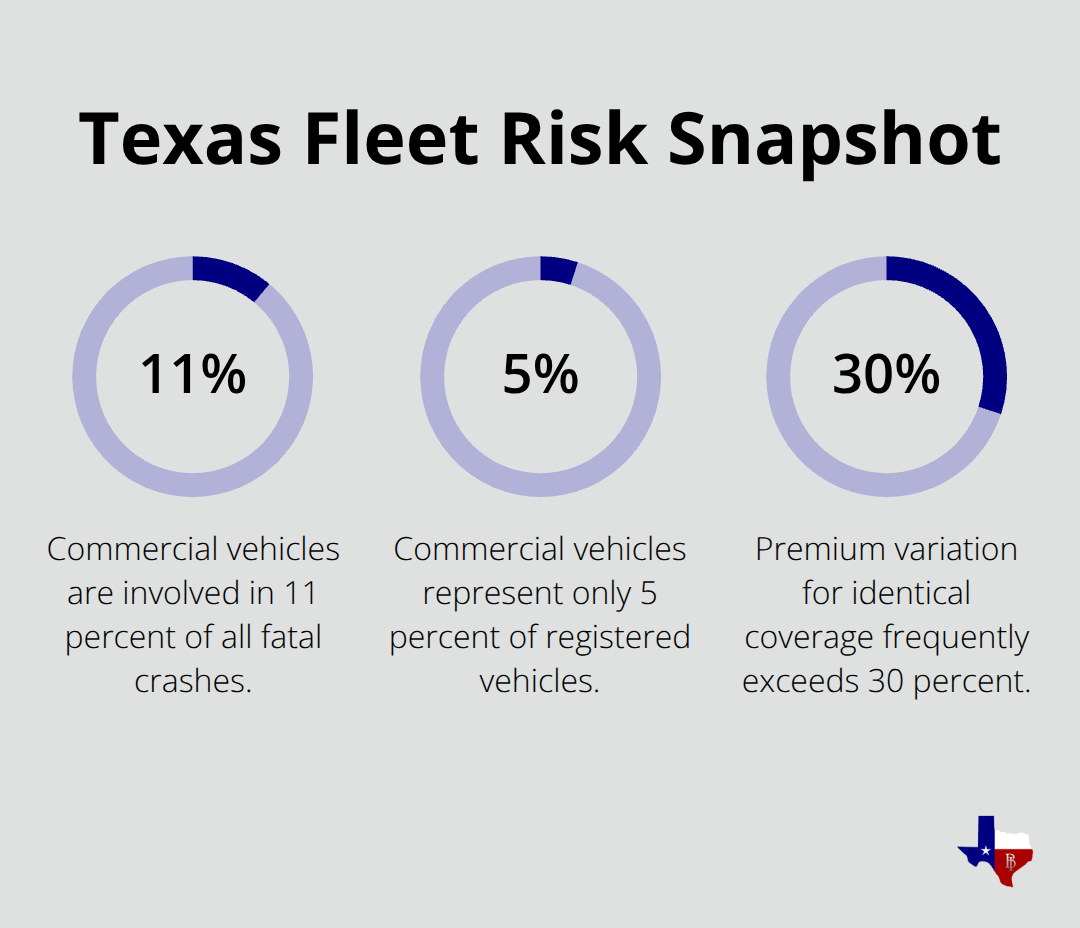
The Insurance Institute for Highway Safety reports that commercial vehicles are involved in 11 percent of all fatal crashes despite representing only 5 percent of registered vehicles, underscoring why your liability limits need serious consideration. This data reveals that fleet operators cannot afford to choose limits based on what sounds reasonable rather than what their actual operations demand.
Liability Limits Must Match Your Exposure
If your fleet transports high-value cargo or operates primarily on congested highways, state minimums of 30/60/25 leave you exposed to settlements that could exceed $200,000 based on Texas court records. Most established fleets should carry 250/500/100 coverage, with larger operations considering 500/1000/500 limits. These higher limits cost roughly 15 to 25 percent more than minimums but protect your business from catastrophic loss. Physical damage coverage should reflect your actual fleet value plus equipment investments. If you operate a 10-vehicle fleet valued at $300,000 total, comprehensive and collision coverage with $1,000 deductibles typically runs $200 to $400 monthly depending on vehicle ages and driver records. This expense directly correlates to your fleet’s replacement cost and your financial capacity to absorb damage without operational disruption.
Uninsured Motorist Coverage Addresses Real-World Gaps
Uninsured and underinsured motorist coverage becomes non-negotiable when you examine real-world accident data. The Insurance Research Council found that 15.4 percent of Texas motorists carry no insurance, meaning roughly one in six vehicles your fleet encounters daily presents collision risk without compensation potential. When an uninsured driver hits your vehicle, your uninsured motorist coverage compensates you for medical expenses, lost wages, and vehicle damage up to your selected limit. Liability coverage only protects damage your drivers cause to others, not damage your fleet sustains. Try matching your uninsured motorist limits to your liability coverage, so a 250/500 liability policy pairs with 250/500 uninsured motorist protection.
Hired and Non-Owned Vehicle Coverage Prevents Costly Gaps
Hired and non-owned auto coverage extends protection when employees use personal vehicles for business purposes or when you rent vehicles during peak seasons. This coverage costs $30 to $50 monthly but prevents gaps that otherwise leave your business liable for accidents involving non-owned vehicles. Texas businesses using seasonal workers or occasional rental vehicles consistently underestimate this coverage’s importance until an accident forces expensive out-of-pocket payments. Your actual coverage needs depend on how frequently your operation relies on vehicles outside your owned fleet.
The next step involves identifying which cost-saving strategies align with your coverage decisions without sacrificing the protection your fleet genuinely requires.
How to Cut Fleet Insurance Costs Without Sacrificing Protection
Reducing fleet insurance premiums requires strategic decisions rather than simply accepting the first quote you receive. The top 10 groups write more than half the commercial auto premium in Texas, but the commercial auto market is considered competitive. The most effective cost-reduction strategies involve combining coverage, investing in driver safety programs, and conducting regular competitive reviews. These aren’t one-time actions but ongoing practices that compound savings over multiple policy years.
Combine Your Policies and Stack Discounts Aggressively
Combining your commercial auto insurance with general liability, property, or workers compensation through the same carrier produces multi-policy discounts ranging from 10 to 25 percent according to National Association of Insurance Commissioners data. A fleet with $2,000 monthly premiums could save $200 to $500 monthly through combining alone. However, combining only works if you compare bundled quotes against other carriers’ bundled offerings, not against your current fragmented policies. Request quotes from at least three carriers for your complete coverage package, not individual policies. Multi-vehicle discounts apply additional savings when you insure multiple fleet vehicles under one policy, typically reducing per-vehicle costs by 5 to 15 percent.
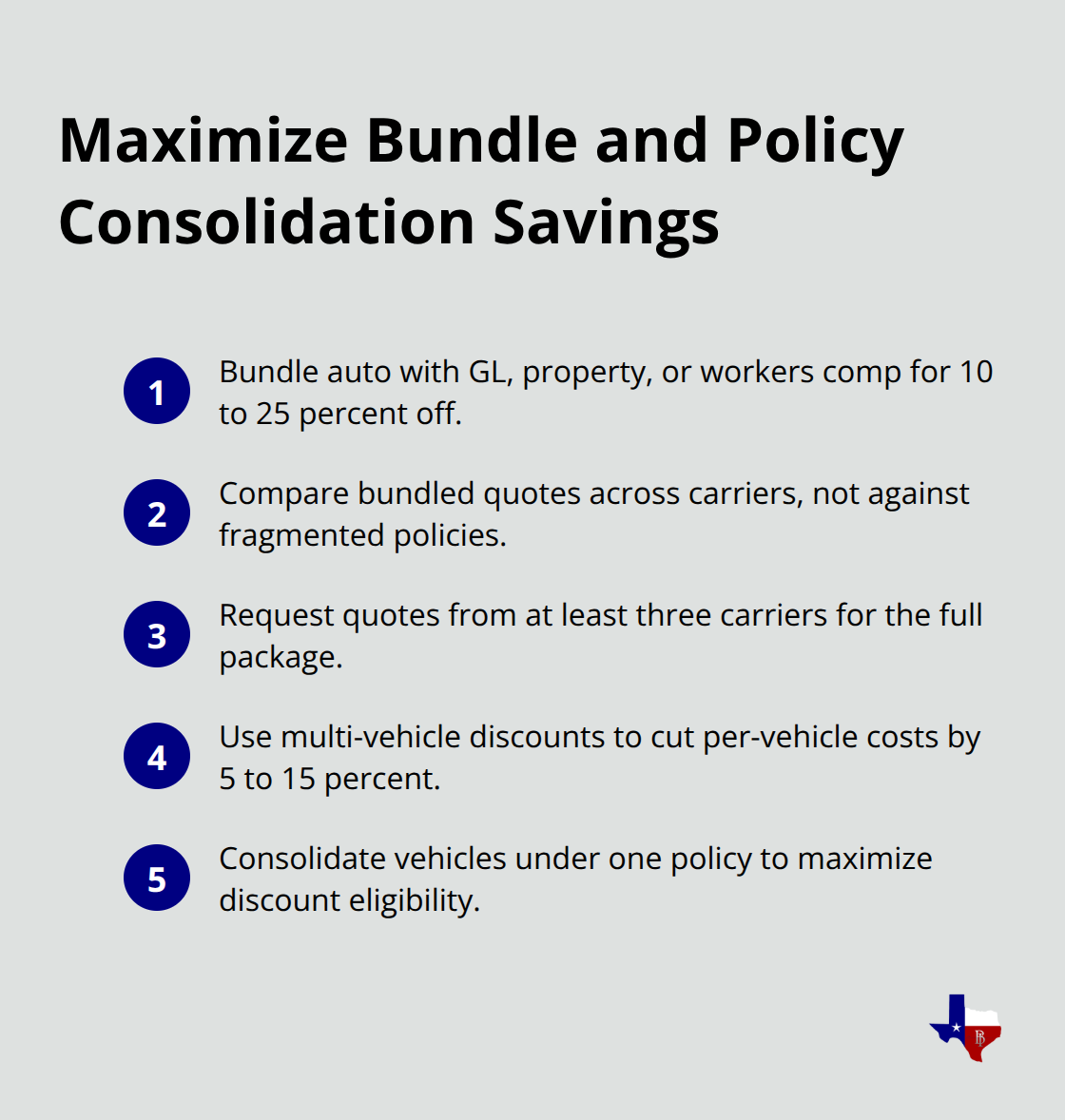
A 10-vehicle fleet qualifies for substantially better rates than insuring those vehicles individually, yet some operators still maintain separate policies for different business divisions. Consolidating your fleet under single commercial auto policies maximizes discount eligibility.
Driver Safety Programs Deliver Measurable Premium Reductions
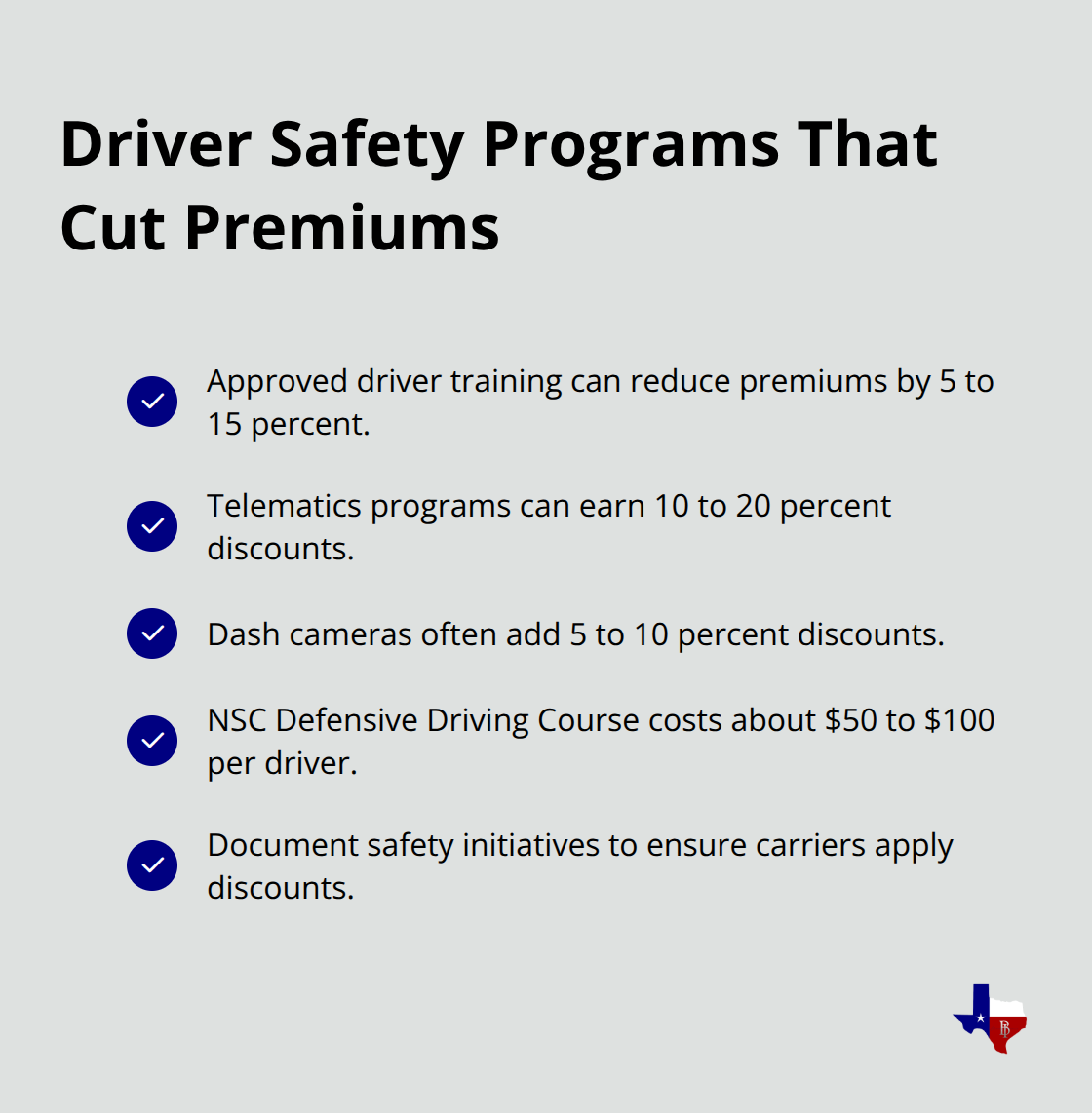
Insurance carriers offer premium reductions of 5 to 15 percent when your fleet completes approved driver safety training programs. The National Safety Council’s Defensive Driving Course costs approximately $50 to $100 per driver and reduces accident frequency enough that carriers pass savings back to your business. Texas fleet operators in construction and delivery services particularly benefit from formal training because these industries experience higher accident rates. Telematics programs monitor driver behavior through vehicle-installed devices and provide real-time feedback on harsh braking, speeding, and rapid acceleration. Carriers offer telematics discounts of 10 to 20 percent based on actual driving data from your fleet. Installing dash cameras in your vehicles costs $150 to $500 per vehicle but provides legal protection during accident disputes while earning you additional 5 to 10 percent discounts from most carriers. Document your safety initiatives when requesting quotes because many carriers don’t automatically apply these discounts without evidence of your program participation.
Shop Competitively Every Two Years Minimum
Your current rate likely increased 8 to 12 percent annually even if your fleet’s safety record improved, a trend driven by rising medical costs and repair expenses across Texas. Obtaining fresh quotes every 24 months typically reveals 15 to 25 percent savings opportunities compared to your current premium. When you contact carriers for quotes, provide identical information across all quotes including exact vehicle values, annual mileage, driver records, and desired coverage limits. Inconsistent information across quotes makes price comparison impossible and wastes time. Request quotes from at least four different carriers because premium variation for identical coverage frequently exceeds 30 percent. Your current carrier won’t match competitor quotes if you don’t present them with competitive offers. Switching carriers every 2 to 3 years when rate increases exceed 10 percent prevents the gradual premium creep that catches most fleet operators off guard.
Final Thoughts
Balancing coverage and cost in Texas commercial auto insurance requires three core decisions: selecting limits that match your actual risk exposure rather than state minimums, choosing coverage types that address your specific fleet operations, and implementing cost-reduction strategies you maintain over time. State minimums of 30/60/25 leave most fleets dangerously exposed when Texas courts regularly award settlements exceeding $150,000, so moving to 100/300/100 coverage or higher prevents the financial devastation that follows inadequate protection. The most successful fleet operators treat insurance as a strategic business decision requiring regular attention and competitive shopping rather than a fixed expense they endure annually.
Working with an independent agency fundamentally changes how you approach fleet insurance because we at Brooks Insurance represent multiple top-rated carriers instead of pushing you toward a single company’s products. This access to a larger selection of coverage options, pricing structures, and payment arrangements means you receive options that actually differ in meaningful ways rather than minor price variations. Our licensed agents understand Texas-specific risks, from hail damage in Dallas-Fort Worth to highway exposure on rural routes, and we handle the quote comparison work that most business owners lack time to complete themselves.
Getting your fleet properly insured starts with documenting what you actually operate and what risks your business faces daily. Contact us at brooksinstx.com to discuss your specific fleet needs and receive competitive quotes that reflect your actual risk profile.
Disclaimer: The information provided in this blog is for general informational purposes only and does not constitute legal, financial, or insurance advice. Coverage options, terms, and availability may vary. Please consult with a licensed professional for advice specific to your situation