

Running a fleet in Texas means managing costs at every turn. Commercial auto discounts in Texas can significantly reduce what you pay for coverage, but most business owners don’t know where to look.
We at Brooks Insurance help Texas companies find real savings on fleet insurance. This guide shows you exactly how to cut your premiums without cutting corners on protection.
How Commercial Auto Insurance Works in Texas
State Minimum Coverage Requirements
Texas requires all commercial vehicles to carry minimum liability coverage of 30/60/25-$30,000 per person and $60,000 per accident for bodily injury, plus $25,000 for property damage. This baseline protects you legally, but most fleet operators need significantly more. Physical damage coverage for collision and comprehensive protection typically costs 40-60% more than liability alone, yet it protects your investment if you financed or leased your vehicles.
The Texas Department of Insurance reports that underinsured fleets face claim denials. That gap between minimum coverage and actual losses can devastate your business. Adding physical damage coverage to your policy prevents catastrophic out-of-pocket expenses when accidents happen.
How Fleet Size Affects Your Rates
Your fleet size directly impacts what you pay. A five-vehicle fleet costs roughly 15-25% less per vehicle than a single commercial vehicle because insurers reward volume and predictable risk. A twenty-vehicle operation can see 30-40% savings per unit compared to smaller fleets.
This is why scaling matters-adding vehicles to your policy often lowers your overall cost per vehicle, not just your total premium. Insurers view larger fleets as more stable and manageable than scattered single-vehicle operations. The economics work in your favor as you grow.
Policy Structures for Different Business Models
Different policy structures serve different business models. Scheduled policies list each vehicle individually with specific coverage limits, giving you precision but requiring updates whenever you add or remove vehicles. Blanket policies cover unlimited vehicles under one limit, ideal for fleets that frequently rotate equipment or add seasonal vehicles.
Blanket policies work best for most Texas fleets because they eliminate the administrative burden of policy updates and often provide better per-vehicle rates. Your industry and vehicle use determine which approach fits your operation. Delivery services, construction companies, and transportation businesses operate under different risk profiles, so one policy type won’t suit everyone.
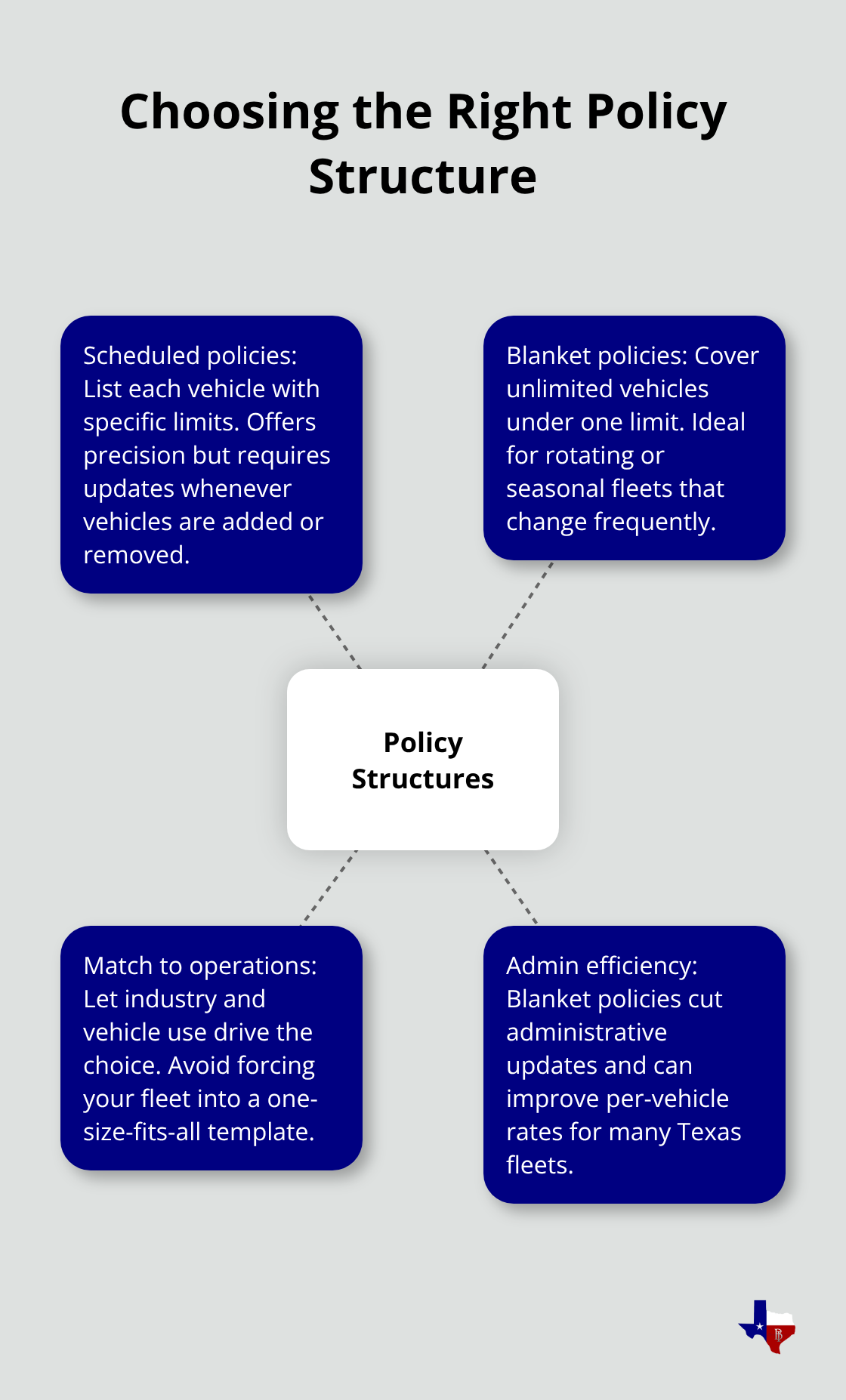
The key is matching your policy structure to how your fleet actually operates (not forcing your operation to fit a generic template). Once you understand these fundamentals, you can identify which discounts and cost-reduction strategies apply to your specific situation.
Ways to Reduce Your Commercial Auto Insurance Costs
Multi-Vehicle and Fleet Discounts
Fleet discounts represent the biggest opportunity most Texas business owners miss. We see companies paying full rates on every vehicle when they could save 30-40% simply by restructuring their policies. The National Association of Insurance Commissioners reports that fleet operators who actively compare discounts save an average of $2,400 annually per vehicle-real money that stays in your business account instead of going to an insurer.
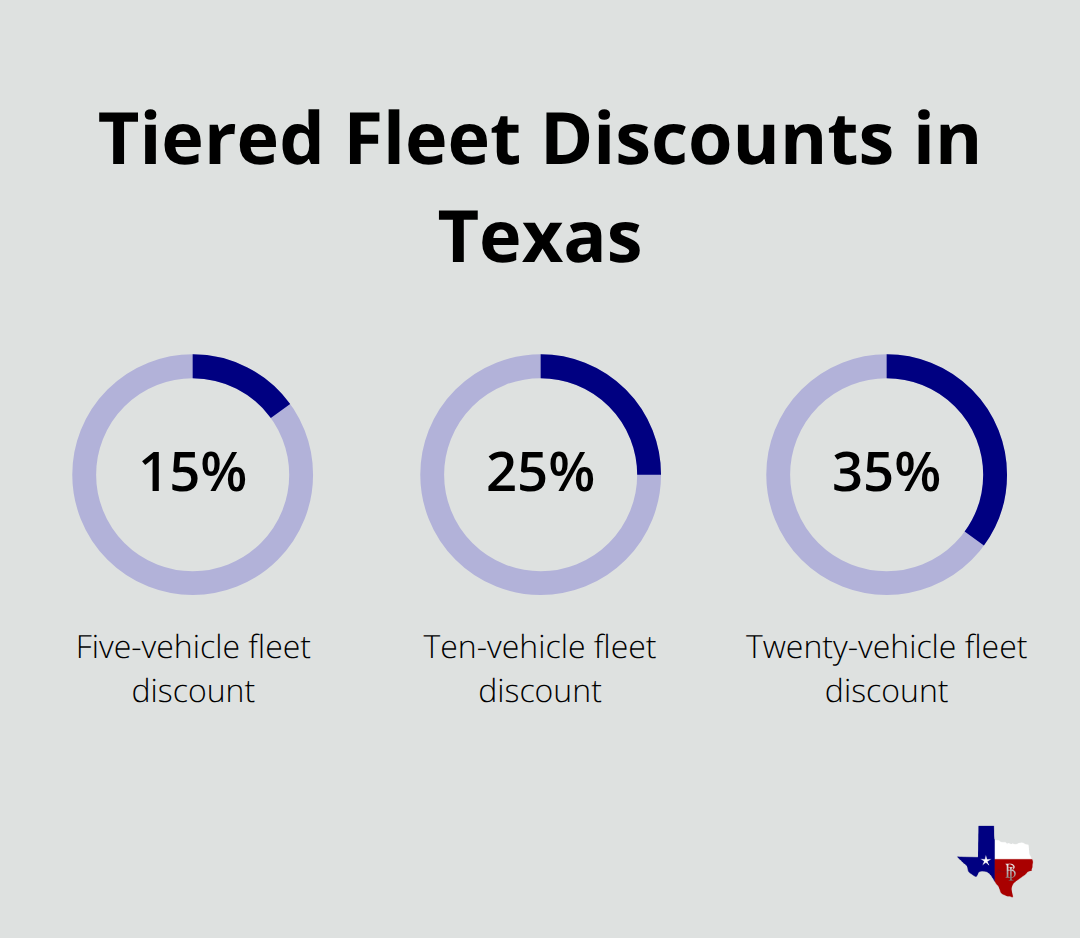
Multi-vehicle discounts activate immediately when you add a second vehicle to your policy, and the savings accelerate as your fleet grows. Some insurers offer tiered discounts where a five-vehicle fleet receives 15% off, a ten-vehicle fleet gets 25% off, and a twenty-vehicle fleet receives 35% off. You need to ask your agent specifically what discount thresholds apply to your situation because not all carriers structure these the same way.
Safety Features and Driver Training Programs
Safety features on your vehicles directly reduce your premiums. Vehicles equipped with anti-theft systems, collision avoidance technology, and telematics devices qualify for discounts ranging from 5-15% per vehicle according to the Insurance Institute for Highway Safety. Telematics proves particularly powerful-it tracks driver behavior and vehicle diagnostics, and insurers reward fleets that implement it because accident rates drop measurably.
Defensive driving courses certified by the Texas Department of Licensing and Regulation generate additional discounts of 3-10% depending on the insurer. These discounts stack with other savings, meaning a fleet with safety-equipped vehicles and trained drivers can easily exceed 40% total savings compared to baseline rates. The investment in driver training pays for itself through premium reductions alone.
Bundling Commercial Policies Together
Bundling your commercial policies generates substantial savings that most fleet owners overlook. When you combine commercial auto insurance with general liability, workers compensation, and property coverage under one insurer, you typically receive 15-25% off your total premium according to data from the Insurance Information Institute. Insurers want to retain your entire business relationship rather than compete for individual policies.
Your industry matters here-construction companies operating fleets benefit differently from bundling than delivery services do, so the actual dollar savings varies. The administrative benefit matters too: managing one renewal date, one agent contact, and one policy portal beats juggling multiple insurers and renewal cycles throughout the year. Some carriers offer additional bundling discounts if you maintain continuous coverage without lapses, rewarding loyalty and reducing their claims risk from newly insured vehicles.
Getting quotes both ways before you decide matters most. Occasionally an insurer excels at auto rates but charges more for liability, making bundling less advantageous than splitting policies between two carriers. Once you understand your discount options and how they combine, you can move forward with confidence toward finding the right coverage structure for your specific fleet.
Finding the Right Commercial Auto Coverage for Your Fleet
Assess Your Fleet’s Actual Risk Profile
Your actual fleet risks separate smart operators from those overpaying for unnecessary coverage. Start by documenting what your vehicles carry, where they operate, and how often they’re on the road. A construction company moving equipment across rural Texas faces different risks than a delivery service operating in urban corridors during peak hours.
The Insurance Information Institute reports that commercial vehicles used for local deliveries average 3.2 accidents per million miles, while long-haul operations experience 1.1 accidents per million miles. This data matters because it directly influences your premium. Review your claims history from the past three years-not just dollar amounts, but frequency and severity patterns.
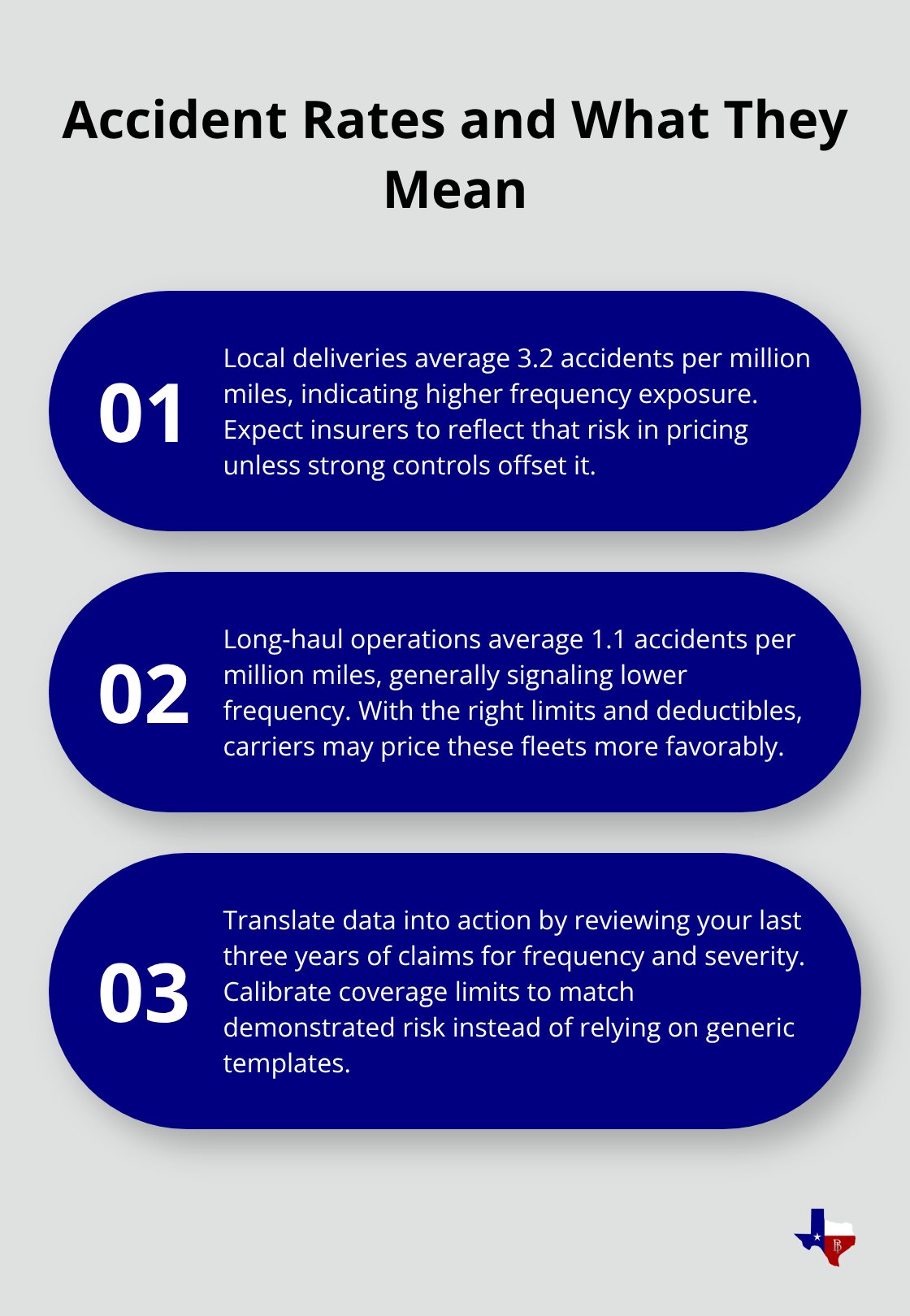
A fleet with one major accident every two years needs different coverage limits than one with no claims.
Document vehicle values, annual mileage, driver experience levels, and whether vehicles sit idle seasonally. Texas insurers weight these factors heavily when calculating rates. If your vehicles transport hazardous materials or operate near populated areas, your risk profile climbs significantly, which means you need higher limits and possibly specialized endorsements that standard policies don’t include.
Compare Quotes Across Multiple Carriers
Comparing quotes from multiple insurers reveals massive price differences that most business owners never discover. Obtain quotes from at least three carriers to identify real savings opportunities.
When requesting quotes, provide identical information to each carrier-same vehicle details, driver records, coverage limits, and deductibles-so comparisons remain apples-to-apples. Ask each insurer specifically about their fleet discount structure, safety feature discounts, and bundling opportunities before accepting their initial quote. Some carriers excel at rating small fleets while others dominate the twenty-plus vehicle segment, so an insurer offering mediocre rates on your five-vehicle operation might provide exceptional pricing once you expand to fifteen vehicles.
Request quotes quarterly even if you’re satisfied with your current coverage-market conditions shift, new discounts emerge, and your risk profile changes as your fleet ages or grows. An insurer offering competitive rates this year might price you out next renewal, making periodic shopping essential for maintaining optimal coverage costs.
Work with an Independent Agent
An independent agency represents multiple top-rated insurance companies, which means you gain access to a larger selection of coverage options and pricing structures than working with a captive agent representing a single carrier. This broader access translates directly into more competitive pricing and customized solutions for your specific operation.
Your agent should understand your industry’s unique risks and help you avoid both underinsurance and unnecessary overage. They handle the comparison work, negotiate with carriers on your behalf, and manage policy updates as your fleet changes. Licensed agents answer questions about your coverage and help you understand what protection actually applies when claims occur.
Final Thoughts
Saving money on commercial auto discounts in Texas requires understanding your fleet’s actual needs and comparing options across multiple carriers. Gather your current policy documents and vehicle information, then request quotes from at least three insurers using identical details. Ask each carrier about fleet discounts, safety feature credits, and bundling opportunities before accepting their pricing.
Review your current coverage limits against your actual fleet risks and examine whether physical damage protection makes sense for your financed or leased vehicles. If your fleet has grown since you last reviewed your policy, you may qualify for higher discount tiers that weren’t available when you initially purchased coverage. This process typically takes two to three hours but often reveals savings of 20-40% compared to your current rates.
We at Brooks Insurance help Texas companies find real savings on commercial auto discounts in Texas and customize coverage that matches your actual business needs. Our licensed agents understand Texas commercial operations and represent multiple top-rated insurance companies, giving you access to a broader range of pricing and coverage options than captive agents can offer. Contact Brooks Insurance today to discuss your fleet’s specific situation.
Disclaimer: The information provided in this blog is for general informational purposes only and does not constitute legal, financial, or insurance advice. Coverage options, terms, and availability may vary. Please consult with a licensed professional for advice specific to your situation