
Running a business with commercial vehicles in Texas means protecting your operation from real financial risk. At Brooks Insurance, we know that commercial auto coverage in Texas isn’t optional-it’s a business necessity that shields you from liability claims, accident costs, and legal penalties.
Your fleet faces unique exposures that personal auto policies simply don’t cover. This guide walks you through the protections you need and how to build a policy that matches your actual business operations.
What Your Commercial Auto Policy Actually Covers
Liability Protection: Meeting Texas Minimums and Going Beyond
Liability coverage forms the foundation of commercial auto insurance, and Texas law sets a baseline you must meet. The state requires a minimum of $30,000 per person and $60,000 per accident for bodily injury liability, plus $25,000 for property damage. That split-limit structure means if you injure multiple people in one crash, the per-person cap applies first, then the total accident cap kicks in.
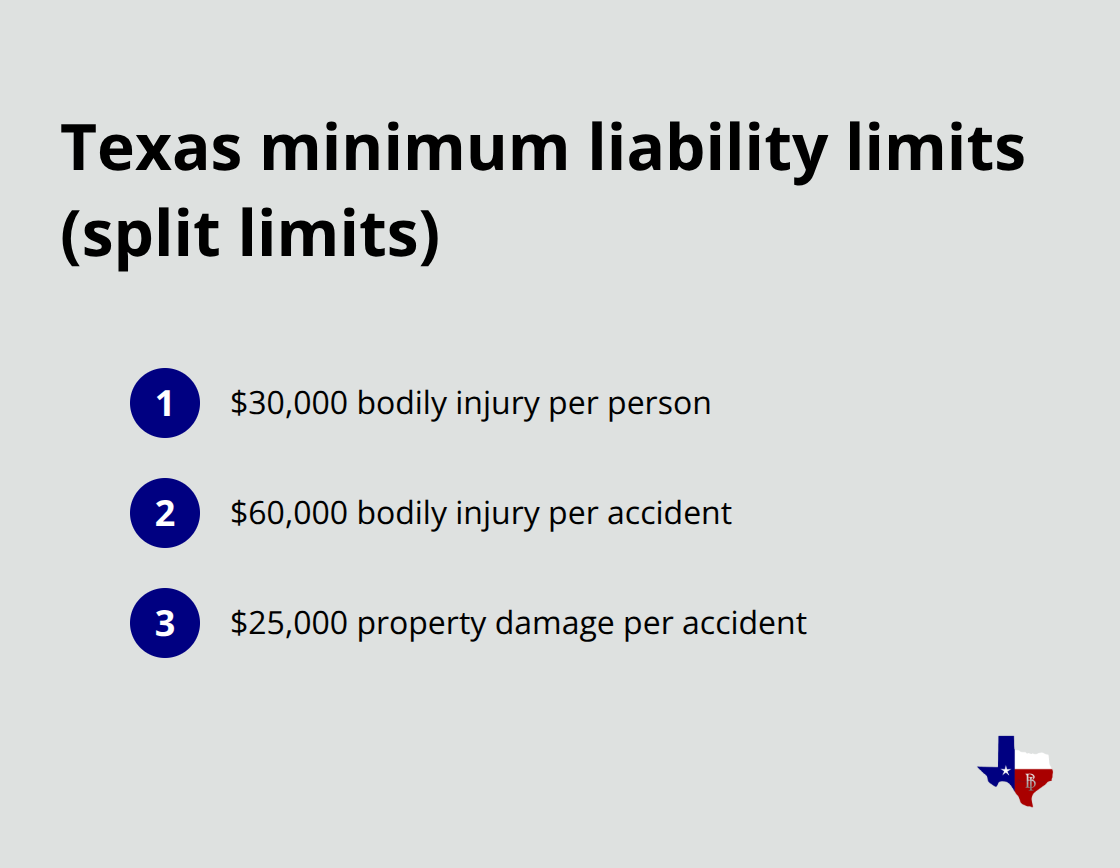
Most Texas businesses should exceed these minimums. A single serious injury can cost far more than $60,000 in medical bills, lost wages, and legal fees. Moving to a $100,000 per person and $300,000 per accident limit costs more upfront but protects your business from catastrophic exposure. Property damage claims from hitting someone’s vehicle or storefront spike quickly, especially in high-traffic Texas cities where accident costs run higher.
Collision and Comprehensive: Protecting Your Fleet
Collision and comprehensive coverage protects damage to your own vehicles, and this is where many business owners make expensive mistakes. Collision pays for crashes regardless of fault, while comprehensive covers theft, weather, vandalism, and non-collision damage. In Texas, hail and flooding cause real damage to commercial fleets, particularly during storm season. If your vehicles are financed or leased, your lender will require both coverages.
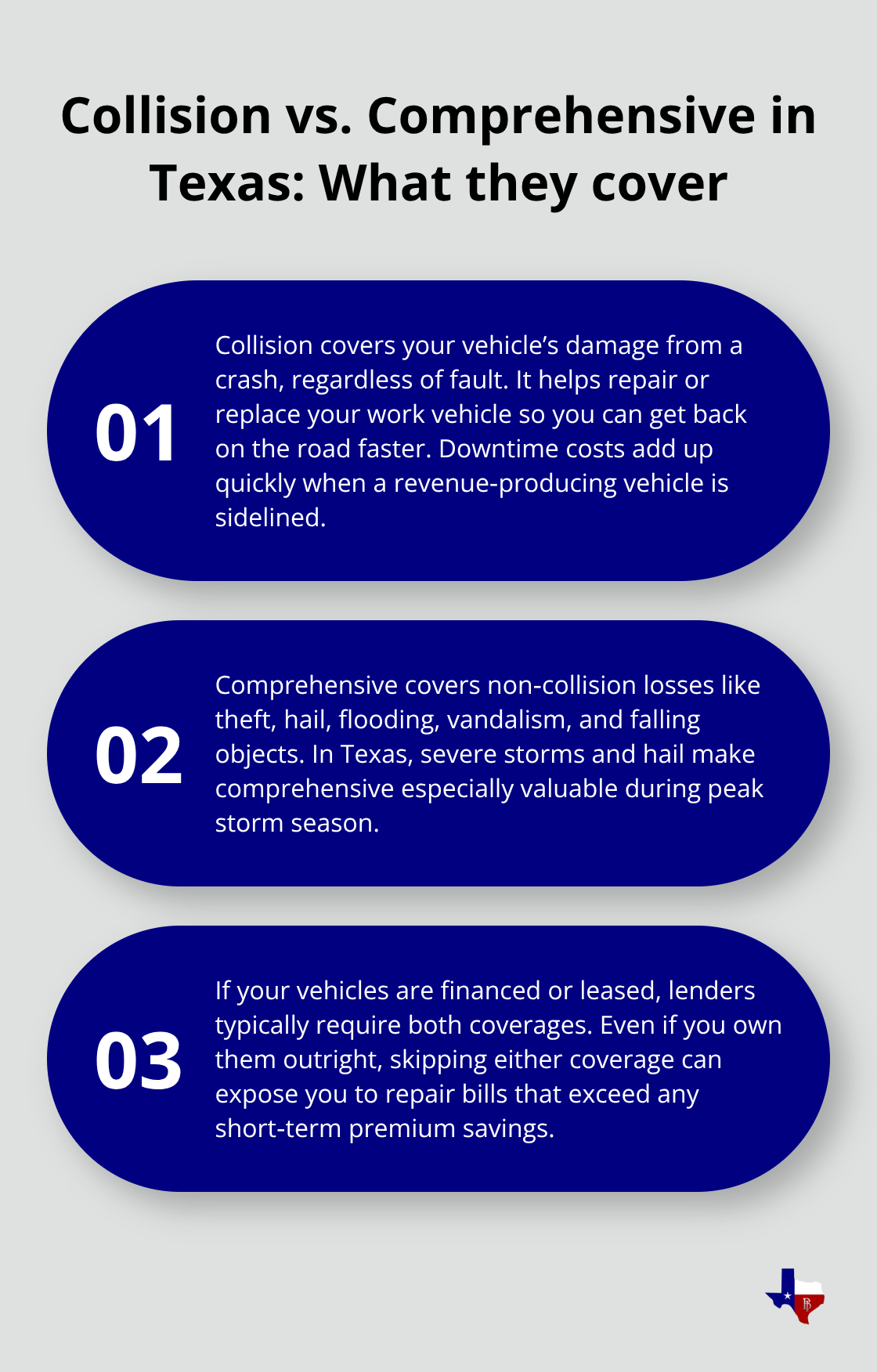
Even if you own them outright, skipping collision or comprehensive to save a few dollars monthly creates risk that exceeds the savings. When your work vehicle sits damaged and out of service, your business income stops.
Your deductible choice matters more than most people realize. A $1,000 deductible costs less than $500, but can you absorb a $1,000 hit when a van needs repairs? The answer depends on your cash flow and fleet size. Smaller operations with one or two vehicles often benefit from lower deductibles, while larger fleets can absorb higher deductibles across multiple vehicles.
Uninsured and Underinsured Motorist Coverage: Filling the Gap
Uninsured and underinsured motorist coverage protects your drivers and passengers when the other driver lacks adequate insurance or carries none. Texas does not require this coverage, but it fills a real gap. Many drivers on Texas roads carry only the state minimum or nothing at all. If an uninsured driver hits your vehicle and injures your employee, UM/UIM coverage pays medical bills and lost wages that the other driver’s policy will not cover. This protection matters most for businesses with multiple drivers or employees who spend significant time on the road.
Your next step involves assessing your specific fleet and operations to determine which coverage limits and options align with your actual business risks.
Why Your Texas Business Needs Commercial Auto Insurance
Legal Requirements You Cannot Ignore
Texas law mandates that any business operating commercial vehicles carry liability coverage with minimums of $30,000 per person and $60,000 per accident for bodily injury, plus $25,000 for property damage. The Texas Department of Insurance enforces these requirements strictly, and operating without proper coverage exposes you to fines, license suspension, and personal liability if an accident occurs. Violations carry real consequences that extend beyond financial penalties-they can shut down your operations entirely.
The True Cost of a Single Accident
The financial reality of a serious accident makes commercial auto insurance non-negotiable. A single crash involving multiple injuries or property damage can easily exceed $100,000 in claims. Without adequate coverage, that liability falls directly on your business and personal assets. Texas sees significant accident costs in major cities like Houston, Dallas, and Austin, where congested roads and higher traffic volumes drive claim expenses upward.
Protecting Your Business Income
Insurance protects your business income when vehicles are damaged and out of service-a risk that grows larger as your fleet expands. When a work vehicle sits in the repair shop, your revenue stops. Collision and comprehensive coverage pays for repairs so your operation can resume quickly, preventing the compounding losses that come from downtime.
Managing Multiple Vehicles and Drivers
Multiple vehicles and drivers compound your exposure exponentially. If you operate two or three vehicles with different drivers, you face multiple daily opportunities for accidents. Texas has approximately 2.7 million small businesses, and many rely on commercial vehicles for daily operations (contractors, landscapers, delivery services, and food trucks among them). Each driver represents a separate liability exposure, and each vehicle can generate collision and comprehensive claims. A single employee’s poor judgment behind the wheel can cost your company tens of thousands in liability, medical bills, and lost productivity.
Building Coverage That Matches Your Fleet
Commercial auto insurance pools these individual risks under one policy structure, protecting your operation from the compounding effect of multiple vehicles and drivers. Your fleet size, driver experience, and actual vehicle usage patterns all shape the protection you need. Understanding these factors helps you avoid overpaying for coverage you don’t need while maintaining protection where exposure is real and significant. The next step involves assessing your specific fleet composition and operations to determine which coverage limits and options align with your business risks.
Building Your Policy Around Real Fleet Needs
Count Your Vehicles and Document Their Use
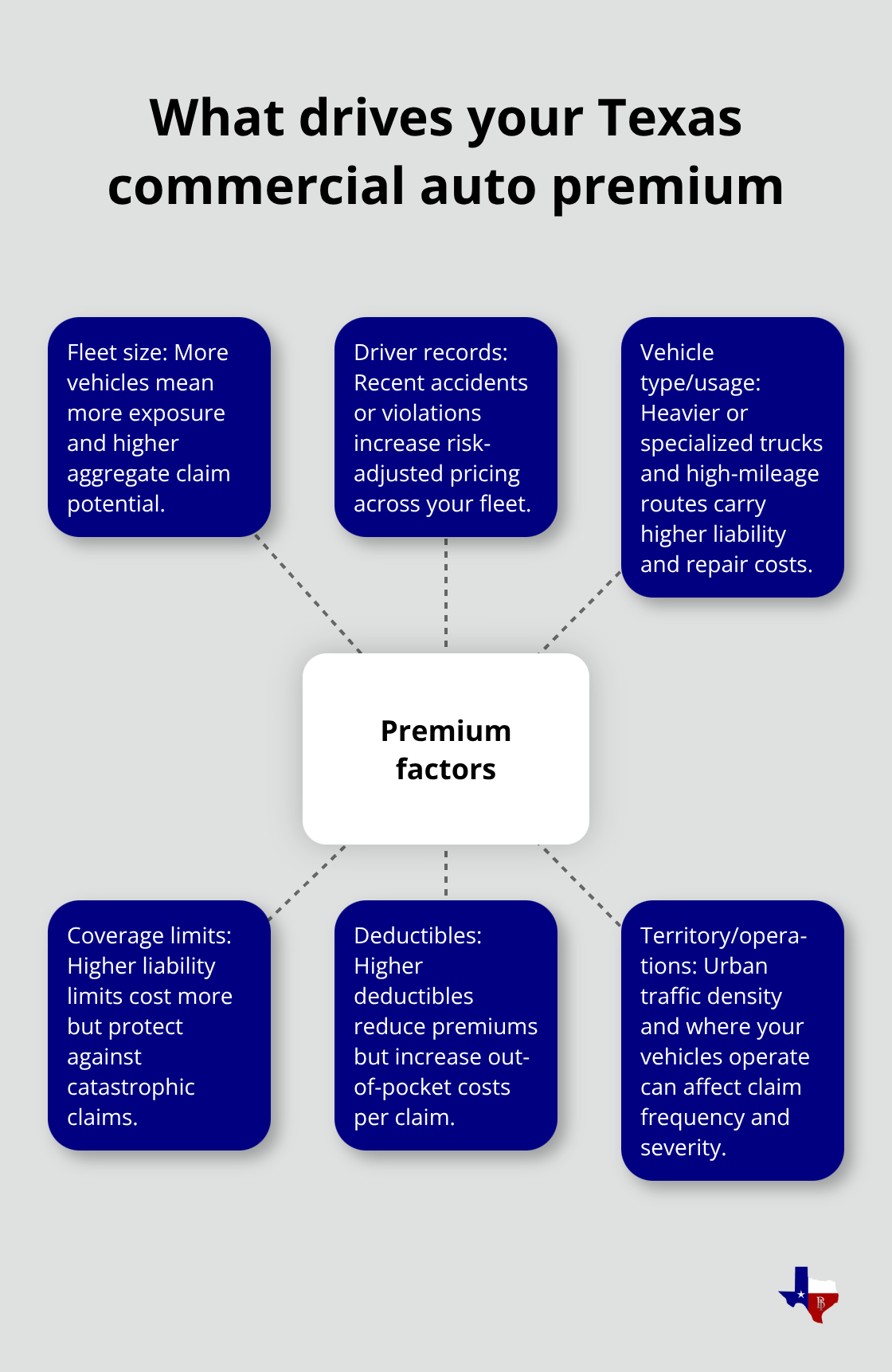
Choosing the right commercial auto policy starts with hard numbers about your actual operation, not industry averages or what competitors carry. Count your vehicles and document what each one does. A contractor with a pickup truck for job site visits faces different risks than a delivery service running five vans across Houston daily. Vehicle type matters enormously because a heavy truck or specialty vehicle like a tow truck commands higher premiums and requires different coverage options.
Progressive reports that contractors typically pay a median of $212 per month and an average of $272 per month for commercial auto coverage, while for-hire transport trucks average $954 per month due to the higher liability exposure and specialized equipment involved. Your specific vehicle types, not general business category, determine what you actually pay. Pull your vehicle registration documents and note the make, model, year, and primary use for each vehicle.
Assess Your Driver Records Honestly
Your driver roster shapes your premiums significantly. How many drivers operate your vehicles, and what do their motor vehicle records look like? A single driver with a clean record costs significantly less than three drivers with accidents or violations. Texas insurers examine the past three years of driving history, so if your team has recent violations, expect higher premiums across your fleet.
Set Coverage Limits Based on Real Exposure
Coverage limits require real thought about your exposure rather than defaulting to the state minimum. Texas requires $30,000 per person and $60,000 per accident for bodily injury, but that baseline leaves your business vulnerable. A serious injury involving multiple people can exhaust $60,000 in medical bills alone, leaving your assets exposed to judgment claims. Moving to $100,000 per person and $300,000 per accident costs more upfront but protects you from catastrophic liability that could threaten your business survival.
Choose Deductibles That Match Your Cash Flow
For collision and comprehensive deductibles, your choice depends on cash flow and fleet size. A $1,000 deductible saves money monthly but requires you to cover that amount out of pocket after every claim. If you operate a single vehicle and cash reserves are tight, a $500 deductible makes sense even though it costs more. Larger fleets with multiple vehicles can absorb higher deductibles because not all vehicles will claim simultaneously.
Get Quotes from Multiple Carriers
Getting quotes from multiple carriers reveals how dramatically prices vary for identical coverage. One insurer might quote $350 monthly for your two-vehicle contractor operation while another quotes $420 for the same limits and deductibles. That $840 annual difference justifies requesting quotes from at least three carriers before deciding. As an independent agency, we represent multiple top-rated insurance companies, which means we can show you how different deductible levels affect your total premium across your specific fleet composition and help you compare options from several carriers at once.
Final Thoughts
Commercial auto coverage in Texas protects your business from financial devastation when accidents happen. The protections we’ve covered-liability limits that exceed state minimums, collision and comprehensive coverage for your fleet, and uninsured motorist protection for your drivers-form a complete defense against the real costs of operating vehicles for business. Skipping any of these layers leaves your operation exposed to claims that can drain your cash reserves or threaten your company’s survival.
Your next step is straightforward: gather your vehicle information, driver records, and current coverage details, then request quotes from multiple carriers. Different insurers price commercial auto coverage in Texas differently based on your specific fleet composition, driver history, and location. A quote that seems expensive from one carrier might be competitive from another, which is why comparing options matters. At Brooks Insurance, we represent multiple top-rated insurance companies, so we can show you how different coverage limits and deductibles affect your total premium and help you find the right balance between protection and cost.
Once you’ve selected a policy, review your coverage annually or whenever your business changes-adding vehicles, hiring new drivers, or expanding into new service areas all affect your exposure and may require adjustments to your limits or deductibles. Staying current with your actual operations keeps your policy aligned with your real risks. Contact us today to discuss your commercial auto insurance needs and get a custom quote tailored to your Texas business.
Disclaimer: The information provided in this blog is for general informational purposes only and does not constitute legal, financial, or insurance advice. Coverage options, terms, and availability may vary. Please consult with a licensed professional for advice specific to your situation