
Living on the Texas coast means facing unique insurance challenges that standard homeowners policies simply don’t address. Wind, hail, and storm surge pose real threats to your home and finances.
A coastal homeowners policy in Texas is specifically designed to protect you against these regional risks. At Brooks Insurance, we help homeowners understand their coverage options so they can make informed decisions about protecting their property.
What Coastal Homeowners Policies Actually Cover
A coastal homeowners policy in Texas protects your home against weather events that standard policies either exclude or severely limit. Standard homeowners insurance typically caps wind damage at 5 to 10 percent of your home’s insured value or excludes it entirely. Coastal policies remove these restrictions and provide full coverage for wind and hail damage, which represents the largest financial threat to homes within 10 miles of the Gulf Coast. Texas experiences an average of 5 to 6 hurricanes per decade according to the National Weather Service, making this coverage difference substantial. If a hurricane damages your roof or siding, a standard policy might leave you with a $10,000 deductible and partial reimbursement, while a coastal policy covers the full replacement cost. The difference between these two policy types isn’t subtle-it’s the difference between recovering from a disaster and facing financial hardship.
Why Standard Policies Fall Short on the Coast
Insurance companies charge dramatically higher premiums in coastal areas because the risk is genuinely different. A home 50 miles inland faces occasional wind damage, while a coastal property faces sustained hurricane-force winds multiple times per decade. Standard homeowners policies were designed for average risk profiles, not concentrated coastal hazards. Hurricane Harvey in 2017 caused over $125 billion in damage across Texas, and many standard policies couldn’t absorb claims at that scale.
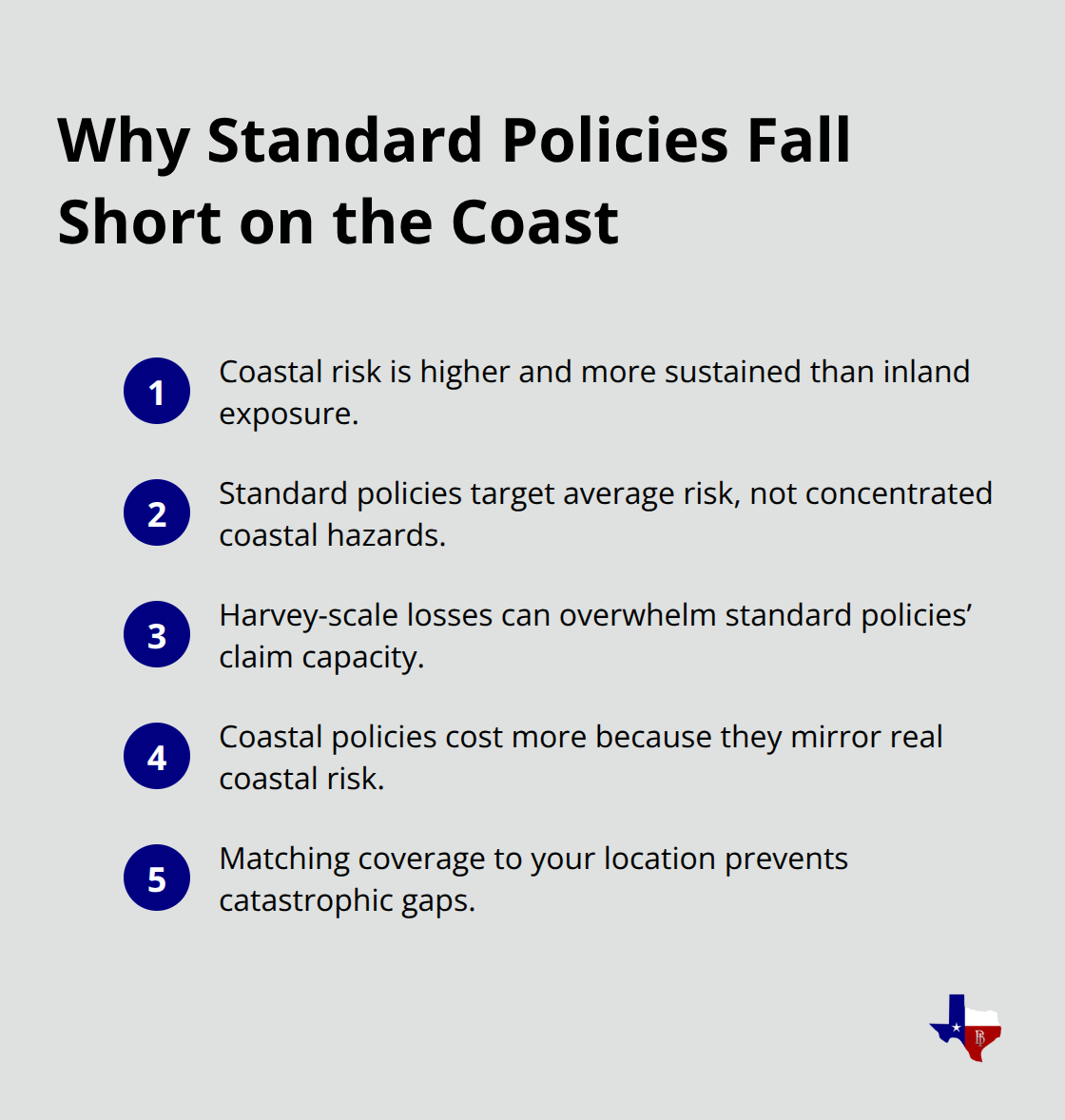
Coastal homeowners policies cost more upfront, but they reflect actual risk rather than forcing you to gamble that your standard policy will cover catastrophic loss. This isn’t about paying for unnecessary coverage; it’s about matching your insurance to the environment where you actually live.
What Makes Coastal Coverage Different
Coastal policies include explicit coverage for storm surge, wind-driven rain, and hail damage that standard policies either exclude or restrict. They also typically offer higher dwelling coverage limits because coastal homes appreciate differently and replacement costs run higher (due to specialized construction requirements). Many coastal policies include coverage for wind mitigation improvements, which means that if you install hurricane shutters or reinforce your roof, your insurer may reduce your premium. Homes with modern wind mitigation features experience reduced damage during major hurricanes. Your policy documents will specify coverage limits for wind damage separately from other perils, giving you transparency about exactly what protection you’re purchasing. This clarity matters because coastal homeowners need to understand their coverage limits before disaster strikes.
How Wind Mitigation Lowers Your Costs
Wind mitigation improvements directly impact your premium because they reduce the likelihood and severity of damage. Installing hurricane shutters, reinforcing roof-to-wall connections, and upgrading to impact-resistant windows all qualify for premium reductions with most coastal insurers. Some policies offer discounts ranging from 5 to 15 percent for homes that meet specific wind mitigation standards (established by the Insurance Institute for Business and Home Safety). These improvements protect your home and your wallet simultaneously. Your insurer will typically require a wind mitigation inspection to verify that your home meets the standards for these discounts.
Understanding Your Coverage Limits and Deductibles
Coastal policies structure deductibles differently than standard homeowners insurance. Many coastal policies use a percentage-based deductible for wind damage rather than a flat dollar amount, meaning your deductible could be 2 to 5 percent of your home’s insured value. A home insured for $300,000 with a 5 percent wind deductible would require you to pay $15,000 out of pocket before coverage kicks in. This structure reflects the higher frequency of wind claims in coastal areas. Understanding these deductible structures helps you make informed decisions about your coverage and financial preparedness.
Understanding what your coastal policy actually covers sets the foundation for protecting your home. The next step involves examining the specific coverage components that address the full range of coastal threats, from wind and hail to flood damage and storm-related losses.
Coverage Components of Coastal Homeowners Policies
Wind and Hail Protection
Wind and hail represent the most immediate threats to Texas coastal homes, and your policy must address them explicitly. Coastal homeowners policies cover full replacement cost for wind damage to your roof, walls, and structural components without the percentage-based caps that standard policies impose. Hail damage coverage works similarly, protecting against the severe hail storms that strike the Texas coast multiple times annually. Texas leads the nation in hail claims, accounting for roughly 30% of all U.S. hail loss. Your coastal policy specifies a separate coverage limit for wind and hail damage, typically ranging from 80 to 100 percent of your home’s insured value. A $400,000 home could have $320,000 to $400,000 in dedicated wind and hail protection. The policy documents outline your deductible for these perils clearly, so you know exactly what you’ll pay out of pocket when a storm strikes.
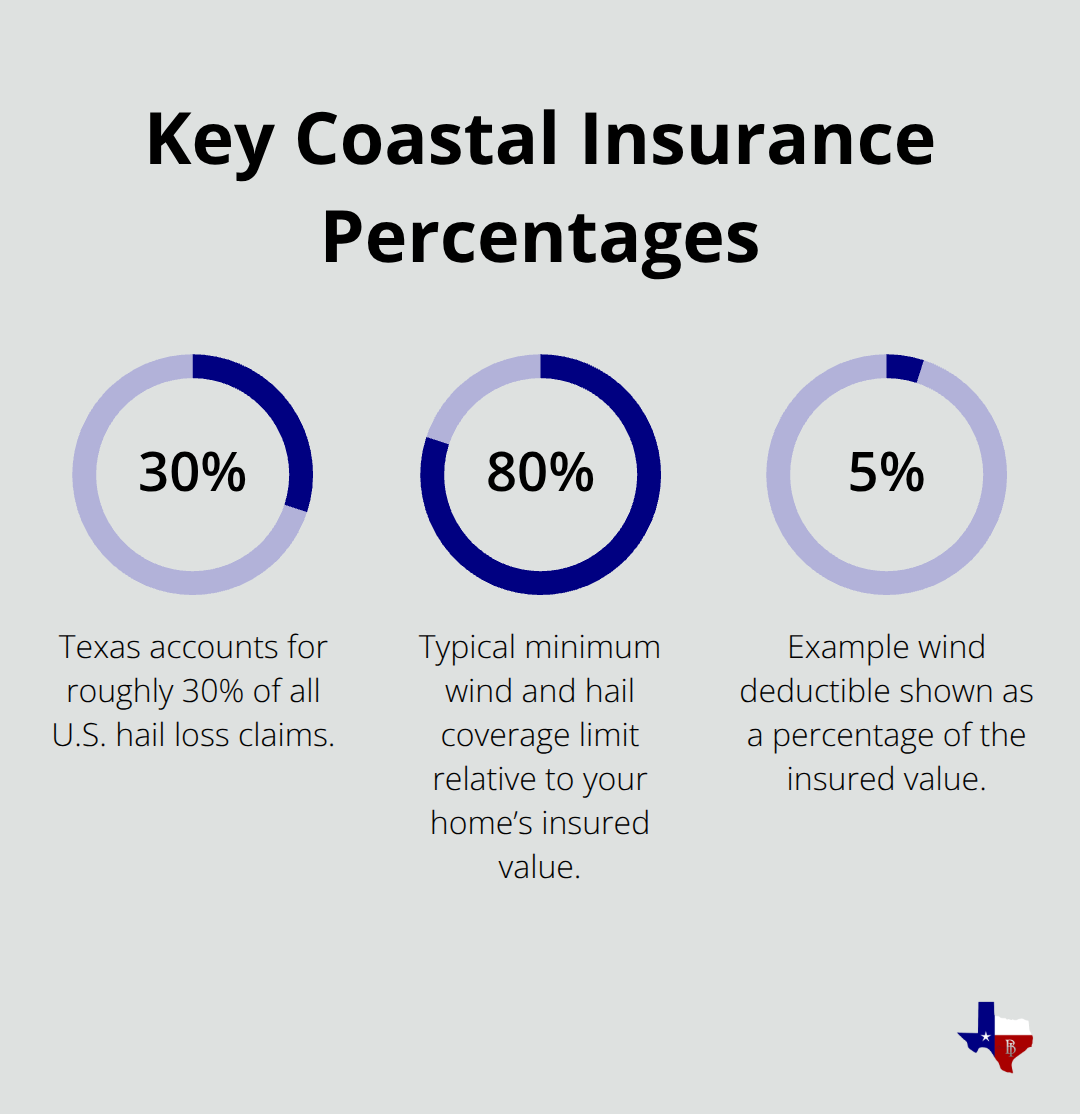
These specific limits directly determine your financial recovery after a hurricane or severe hailstorm.
Flood Insurance Requirements
Flood insurance operates separately from your coastal homeowners policy because standard homeowners policies exclude all flood damage, regardless of location. If your Texas coastal home sits in a high-risk flood zone designated by FEMA, your mortgage lender requires flood insurance as a condition of financing. Even if your lender doesn’t require it, flood coverage protects against one of the costliest perils coastal homeowners face. The National Flood Insurance Program offers coverage up to $250,000 for dwelling protection and $100,000 for personal property, though private flood insurers now compete in Texas markets with higher limits and sometimes better rates. You can purchase flood insurance through the NFIP, private insurers, or some coastal homeowners policies now include limited flood coverage as an endorsement. A standard flood policy costs between $400 and $1,200 annually depending on your flood zone, while a coastal policy with flood endorsement may provide coverage at lower rates. Storm surge, which poses the greatest flood risk to Gulf Coast homes, requires explicit flood coverage because it falls under flood rather than wind protection. When Hurricane Harvey made landfall in 2017, the majority of damage claims in coastal Texas communities involved flood damage that standard homeowners policies rejected outright. Your coastal insurance strategy must address flood as a separate line item, not an afterthought.
Additional Storm-Related Coverages
Additional storm-related coverages extend protection beyond wind, hail, and flood to address the full spectrum of coastal weather events. Many coastal policies include coverage for wind-driven rain damage, which occurs when hurricane-force winds force rain through walls and windows during major storms. Coverage for debris removal helps pay for professional cleanup after a hurricane deposits tree limbs, roofing materials, and other debris across your property.
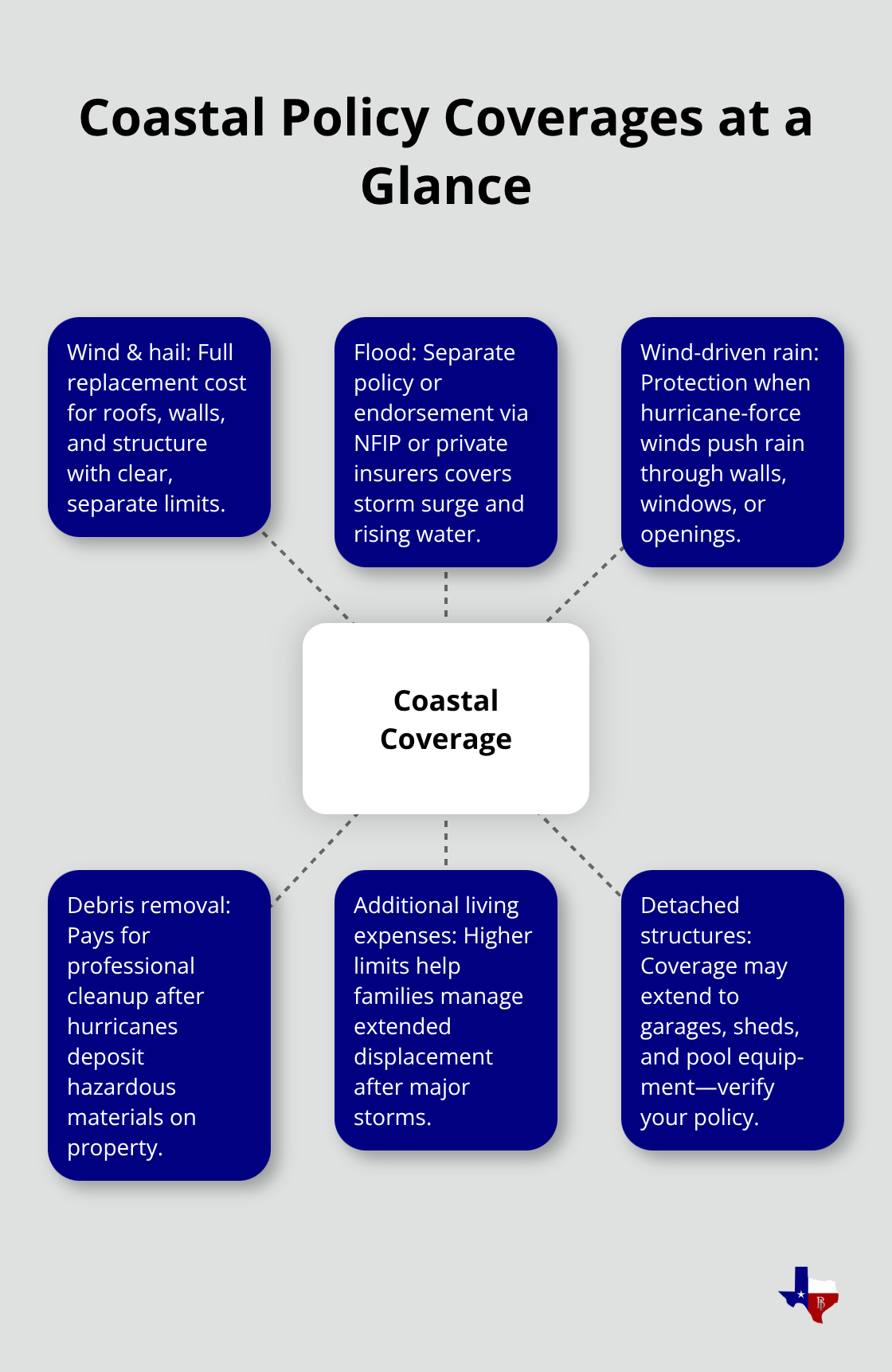
Some policies offer additional living expenses coverage that exceeds standard homeowners limits, recognizing that coastal families may face longer displacement periods after major hurricanes. Loss of use coverage reimburses temporary housing and meals if your home becomes uninhabitable after a covered loss. Windstorm and hail coverage sometimes includes protection for detached structures like garages, sheds, or pool equipment (though you should verify these specifics in your policy documents). The key to maximizing your protection involves reviewing your actual policy language rather than assuming coverage exists. Your insurance agent can walk through your specific policy documents and identify coverage gaps before disaster strikes, helping you understand exactly what protection you’re purchasing for your coastal Texas home. The next step involves examining the specific cost factors that influence your premium and the practical steps you can take to reduce your annual expenses.
Cost Factors and How to Lower Your Premiums
What Determines Your Coastal Policy Rates
Your coastal homeowners premium reflects genuine risk, not arbitrary pricing. Insurance companies calculate rates based on your home’s proximity to the Gulf Coast, local wind speeds during hurricanes, historical claim frequency in your specific zip code, and your property’s age and construction type. Homes within 1 mile of the coast pay substantially more than homes 5 miles inland because storm surge risk drops dramatically with distance. Your home’s year built matters significantly-properties constructed before 2001 lack modern wind resistance standards and face higher premiums than newer homes built to current building codes. Homes built to current hurricane-resistant standards experience less damage during major storms, which translates directly into lower premiums for newer construction. Your roof’s condition and material also drive rates; metal roofs and architectural shingles rated for 130+ mph winds qualify for better rates than aging asphalt shingles. Deductible selection directly impacts your premium-choosing a 5 percent wind deductible instead of 2 percent can reduce your annual cost by 15 to 25 percent, though this shifts more financial responsibility to you after a loss. Claims history matters too; if you filed multiple homeowners claims in the past five years, expect higher rates regardless of coastal location.
How Home Improvements Reduce Your Costs
Wind mitigation improvements offer the most concrete path to premium reduction because they measurably reduce damage likelihood. Installing hurricane shutters typically earns a 5 to 10 percent discount, while upgrading to impact-resistant windows can save 10 to 15 percent annually. Reinforcing roof-to-wall connections through structural upgrades qualifies for discounts ranging from 5 to 20 percent depending on your insurer and the extent of improvements. The Insurance Institute for Business and Home Safety offers a free wind mitigation inspection checklist that documents which improvements your home has completed, and many insurers require this documentation to apply discounts. Upgrading your garage door to a wind-resistant model costs $400 to $800 but often reduces premiums by $200 to $400 annually, creating payback within two to three years. Installing secondary water barriers behind your exterior walls prevents wind-driven rain damage and qualifies for additional discounts with some carriers.
Shopping Multiple Quotes Reveals Real Savings
Shopping quotes across multiple insurers reveals dramatic rate variations for identical homes with identical improvements-one carrier might charge $2,100 annually while another charges $2,800 for the same coverage and deductibles. As an independent agency with over 50 years of experience, we at Brooks Insurance represent multiple top-rated insurance companies, which means you have access to a larger selection of coverage, pricing, and payment options. Our licensed agents can connect you with multiple carriers and verify that you receive all available discounts for your specific improvements, rather than leaving money on the table with a single company that doesn’t recognize your mitigation efforts. The difference between shopping one quote and three quotes often exceeds $500 to $1,000 annually on coastal policies.
Final Thoughts
Coastal homeowners policy Texas coverage protects your home against weather threats that standard insurance simply ignores. Wind and hail damage, flood risk, and storm-related losses require specialized protection that reflects the genuine hazards of Gulf Coast living. Understanding your coverage limits, deductibles, and available discounts transforms insurance from a confusing expense into a practical financial strategy.
Shopping quotes from multiple carriers reveals dramatic rate variations for identical coverage-one insurer might charge significantly less than another for the same home and same improvements. Wind mitigation improvements like hurricane shutters and impact-resistant windows reduce premiums while protecting your property, creating immediate financial benefits alongside long-term protection. We at Brooks Insurance represent multiple top-rated insurance companies, giving you access to a wider selection of coverage options and pricing than you’d find working with a single carrier.
Contact us to discuss your coastal homeowners policy and explore quotes from carriers that recognize your home’s specific risk profile and mitigation efforts. Our licensed agents understand Texas coastal insurance requirements and can identify which discounts apply to your specific home improvements. We’ve served Texas families for over 50 years, and we know that coastal homeowners need straightforward answers about what their policies actually cover before disaster strikes.
Disclaimer: The information provided in this blog is for general informational purposes only and does not constitute legal, financial, or insurance advice. Coverage options, terms, and availability may vary. Please consult with a licensed professional for advice specific to your situation