
One accident on your business property can expose you to significant financial risk. Commercial liability insurance in Texas protects your company from costly claims that could otherwise drain your resources.
We at Brooks Insurance help Texas business owners understand their coverage options so they can make informed decisions. This guide walks you through what’s covered, the types of policies available, and how to select the right protection for your specific situation.
What Your Commercial Liability Policy Actually Covers
Commercial liability insurance protects your Texas business from third-party claims that arise during normal operations. When a customer slips on your floor, a delivery damages someone’s property, or your work causes injury to a client, this coverage pays medical bills, repair costs, and legal fees. Most Texas businesses carrying general liability policies have limits starting at $1 million per occurrence and $2 million aggregate, according to Hartford’s data on small business coverage.
Core Coverage Components
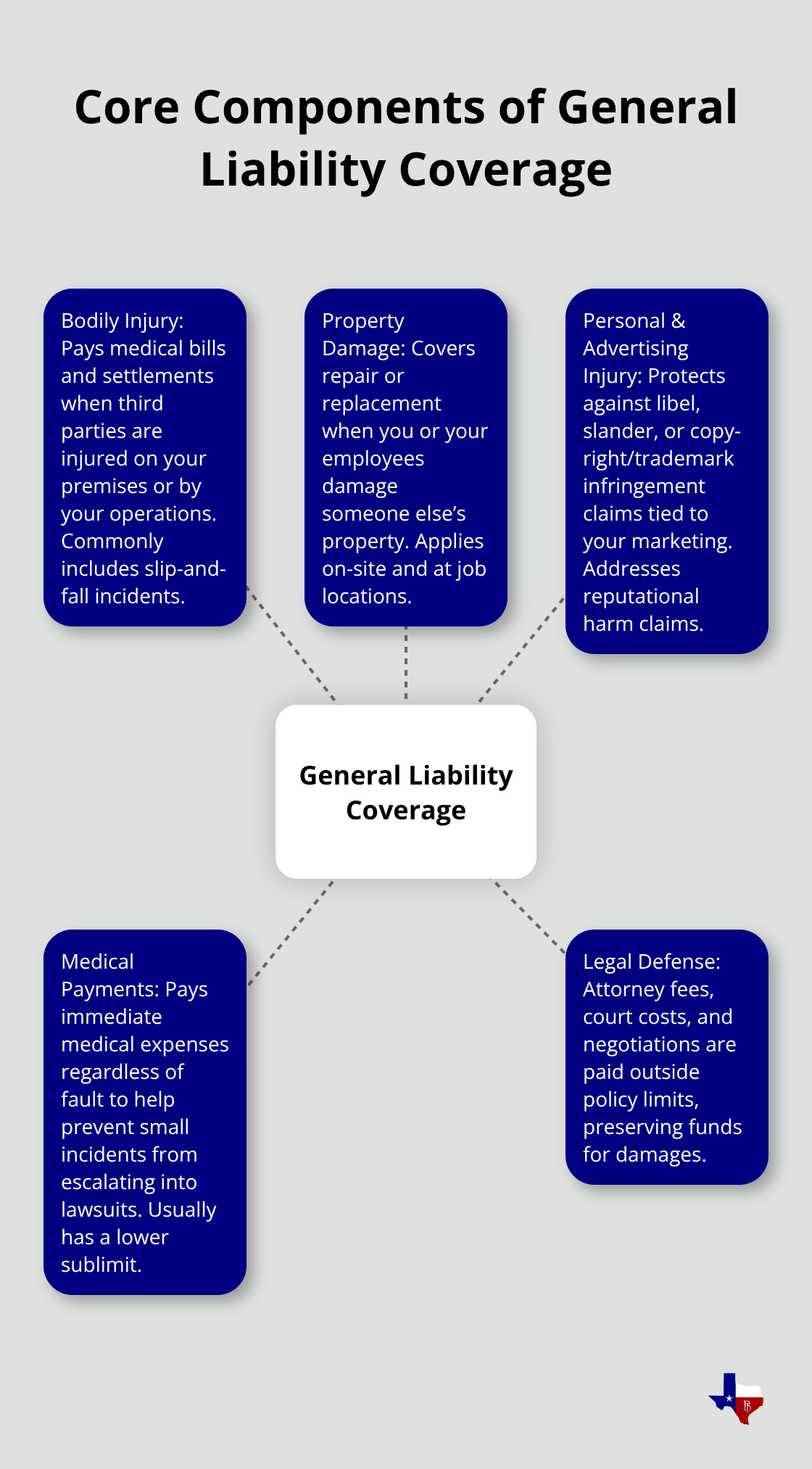
Your policy covers bodily injury claims, property damage liability, and personal and advertising injury (such as defamation or copyright infringement claims). Medical payments coverage, often included with general liability, covers immediate medical expenses for injuries at your business location regardless of fault-a feature that prevents minor incidents from becoming lawsuits. Legal defense costs are paid separately from your policy limits, meaning your insurer covers attorney fees, court costs, and settlement negotiations without reducing the amount available for actual damages. This distinction matters significantly because defense costs can reach tens of thousands of dollars even in cases that don’t result in large payouts.
What Happens When Claims Exceed Your Limits
Understanding what occurs when a claim surpasses your policy limits is critical for Texas business owners. If a claim exceeds your per-occurrence limit of $1 million, you pay the difference out of pocket until reaching the $2 million aggregate limit. Once the aggregate limit is exhausted, you absorb all remaining costs. This is why many growing Texas businesses add excess liability or umbrella policies that provide higher limits and broader coverage. A contractor with a standard $1 million/$2 million policy who faces a $2.5 million claim would absorb $500,000 in costs unless they carried additional coverage.
Premium Audits and Coverage Adjustments
Premium audits affect your actual costs-Hartford and other carriers adjust your initial premium after the policy period based on actual payroll or revenue, potentially resulting in significant charges if your business grew faster than estimated. You should review your coverage limits annually to match your current revenue, number of employees, and asset values, preventing gaps when you need protection most. As your business expands, your liability exposure grows, which means your next step involves assessing the specific risks your industry faces.
Types of Commercial Liability Coverage in Texas
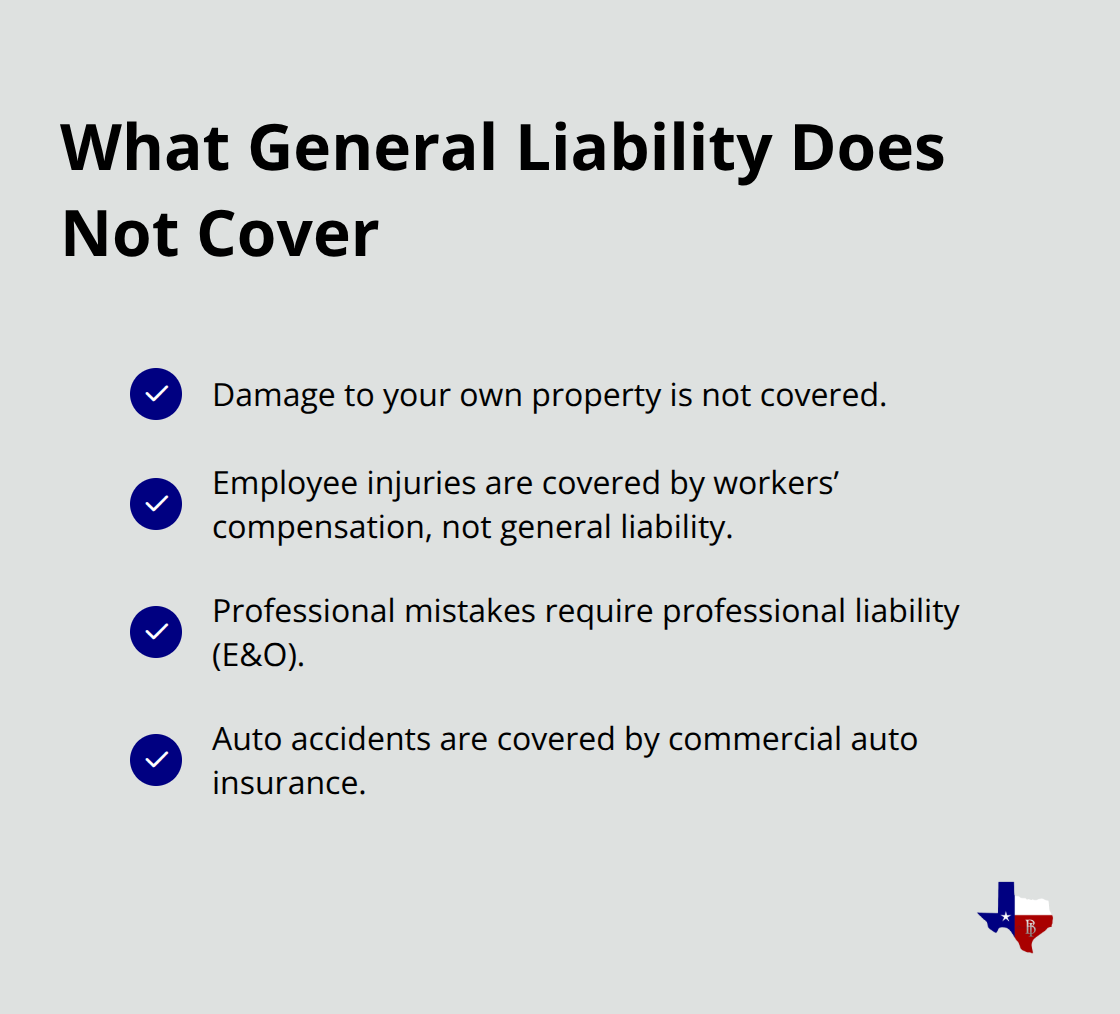
Texas businesses operate under different risk profiles, and your liability coverage must match what you actually do. General liability insurance protects you from third-party bodily injury and property damage claims on your premises or from your operations-this is the foundation most Texas businesses need. If you run a retail store, restaurant, contractor business, or service operation, general liability covers slip-and-fall incidents, property damage you cause during work, and advertising injury claims. On average, small Texas businesses pay about $68 a month for a $1 million general liability policy, though rates vary by industry and claims history. Contractors and manufacturers face higher premiums because their operations involve greater exposure to injuries and property damage. General liability does not cover your own property damage, employee injuries (that’s workers’ compensation), professional mistakes, or damage from auto accidents-understanding these exclusions prevents costly surprises when you file a claim.
When Professional Liability Becomes Essential
Professional liability insurance, also called errors and omissions coverage, protects service-based businesses against negligence claims. If you work as an accountant, consultant, architect, engineer, or real estate agent, this coverage pays for legal defense and damages when a client claims your advice or work caused them financial loss. Professional liability costs typically run $500 to $2,000 per year for Texas small businesses according to industry benchmarks, but this varies significantly based on your profession and revenue. A real estate agent who gives incorrect market advice that causes a buyer financial loss, or an accountant who misses a tax deduction costing a client thousands, both face professional liability exposure. This coverage does not protect against bodily injury or property damage-that’s general liability’s role. Many service professionals bundle professional liability with general liability to cover both client injuries and professional errors, creating comprehensive protection at a lower combined cost than purchasing policies separately.
Product Liability and When You Need It
Product liability coverage protects manufacturers and retailers when a product causes bodily injury or property damage to a customer. If you manufacture goods, sell products you didn’t make, or include product components in your service, product liability applies. A defective tool that injures a customer, contaminated food that causes illness, or faulty equipment that damages property all fall under product liability claims. Product liability is often included within a general liability policy as products and completed operations coverage, so you may already have basic protection. However, if you face significant product risk-particularly in manufacturing or if you handle food products-adding standalone product liability or product recall insurance protects against the costs of recalls, which can reach hundreds of thousands of dollars. Texas businesses in high-risk product categories should review their general liability policy to confirm product coverage limits match your actual exposure, setting the stage for evaluating which specific limits and deductibles work best for your operation.
How to Choose the Right Coverage for Your Texas Business
Match Coverage Limits to Your Industry Exposure
Your industry determines what liability exposure you face, and that exposure dictates your coverage needs. A hair salon dealing with minor injuries and property damage needs fundamentally different limits than a general contractor working on multi-million-dollar projects where a single accident could trigger catastrophic claims. Start by examining your actual operations: What are customers doing on your premises? What products or services do you deliver off-site? Are you handling high-value items or working in environments with elevated injury risk?
Contractors, manufacturers, and businesses in high-density areas face steeper liability exposure than service providers operating from quiet offices. The Texas Department of Insurance and your industry association can help identify typical claims in your sector. Once you understand your exposure level, match it to coverage limits. Standard policies start at $1 million per occurrence and $2 million aggregate, but this baseline fails many growing Texas businesses.
A contractor handling residential projects should consider $2 million per occurrence at minimum, especially if contracts require higher limits. A tech consulting firm might operate safely within $1 million limits. The key is ruthlessly honest assessment rather than assuming industry defaults fit your situation. Your claims history matters enormously here: if you’ve never had a claim, you may sustain lower limits; if you’ve had even one significant incident, higher limits become non-negotiable insurance against future exposure.
Account for Company Size and Revenue Growth
Company size and revenue directly influence both your liability exposure and your ability to absorb losses. A five-person service business with $500,000 annual revenue operates at fundamentally different risk than a 50-person operation generating $5 million. Larger payrolls mean more employees cause potential incidents; higher revenue typically means bigger contracts with higher liability requirements built into the agreement.
If you plan to hire significantly or expand revenue within 12 months, select limits that accommodate that growth rather than facing mid-year adjustments that trigger premium audits and higher rates. Schedule a policy review annually or whenever major business changes occur to ensure your coverage still matches your actual exposure.
Evaluate Total Cost, Not Just Monthly Premium
When comparing quotes across providers, never focus solely on monthly premium. A policy costing $70 per month with a $2,500 deductible and $1 million limits differs dramatically from one at $85 per month with a $500 deductible and $2 million limits. Calculate your true cost by adding potential deductible exposure to annual premiums.
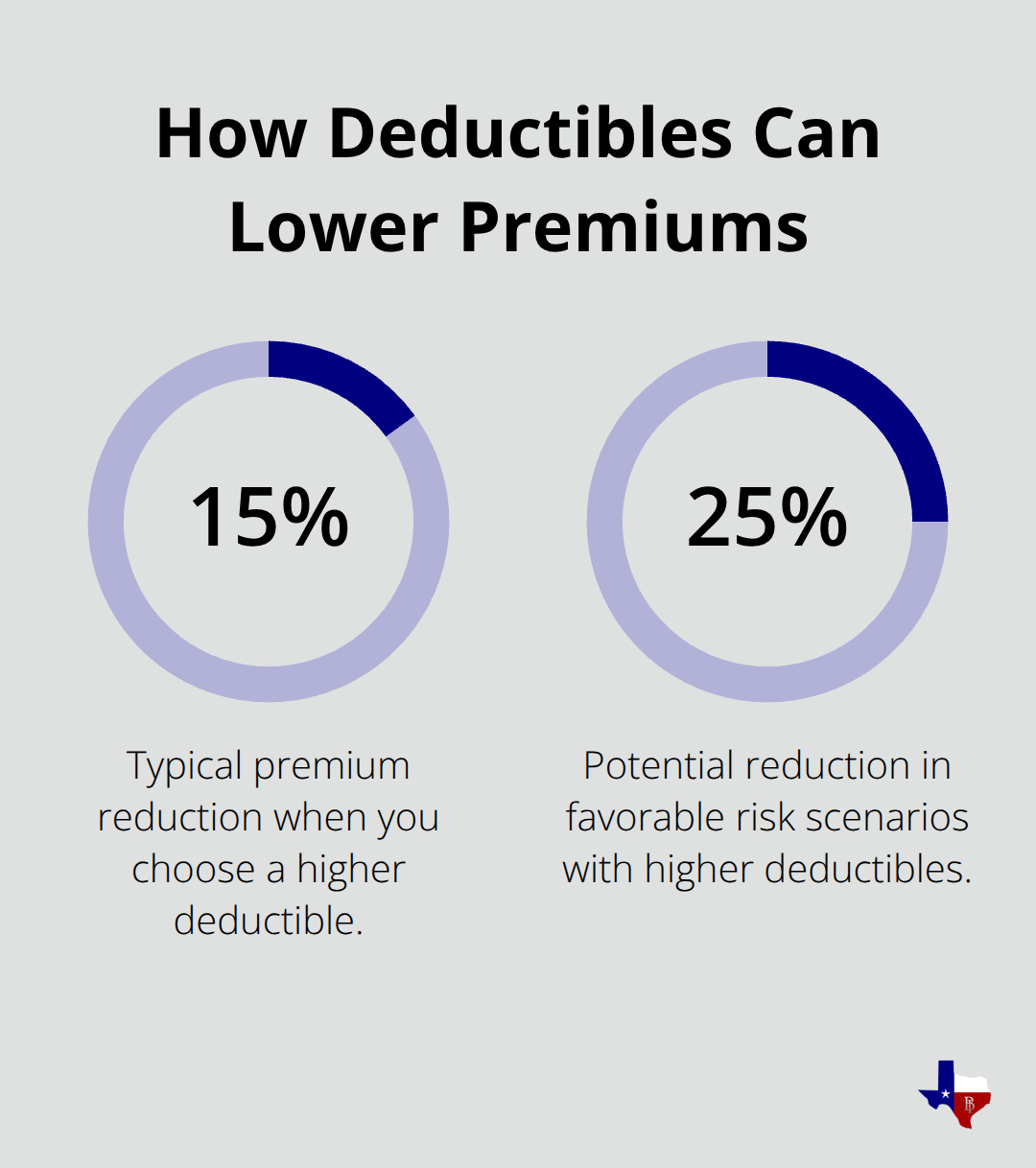
A $2,500 deductible costs you nothing until a claim occurs, then suddenly becomes a real expense. Higher deductibles reduce premiums substantially-sometimes 15 to 25 percent-but only make financial sense if your business can absorb that amount without operational strain.
Many Texas businesses incorrectly assume lower premiums equal better value; instead, evaluate total risk transfer.
An independent agent representing multiple carriers can show you side-by-side comparisons with identical coverage structures at different price points, revealing which insurer genuinely offers the best value rather than simply the cheapest option. Request quotes from at least three carriers with matching limits and deductibles to identify real price differences rather than structural variations.
Final Thoughts
Commercial liability insurance in Texas protects your business from financial devastation, but only when you select the right coverage for your actual operations. Your industry, company size, revenue, and growth trajectory determine whether baseline $1 million per occurrence limits suffice or whether you need higher limits and additional endorsements. Premium audits, deductible choices, and coverage gaps demand attention during the selection process, not after a claim exposes what you didn’t buy.
Working with an independent agent fundamentally changes your outcome because we at Brooks Insurance represent multiple top-rated insurance companies, which means you access a larger selection of coverage options and pricing structures than you would through a single carrier. Our licensed agents compare policies side-by-side with matching limits and deductibles, revealing genuine price differences rather than structural variations that make comparison impossible. An independent agent also reviews your coverage annually as your business evolves, preventing the costly mistake of carrying outdated limits that no longer match your exposure.
Start by gathering your business documentation: your company name and address, year established, number of locations and employees, revenue figures, and any history of liability losses. Contact Brooks Insurance to discuss your specific situation with a licensed agent who understands Texas business risks and can assess your industry-specific exposure. We’ll help you evaluate whether your current coverage matches your actual needs and identify cost-saving opportunities through bundling or deductible adjustments.
Disclaimer: The information provided in this blog is for general informational purposes only and does not constitute legal, financial, or insurance advice. Coverage options, terms, and availability may vary. Please consult with a licensed professional for advice specific to your situation