
Flooding causes more property damage than any other natural disaster in Texas, yet most homeowners don’t realize their standard insurance won’t cover it. We at Brooks Insurance help Texas residents compare flood insurance options so they can protect what matters most.
The right flood coverage depends on your property’s actual risk level and replacement value. This guide walks you through the key differences between policies and providers, plus practical steps to find the best fit for your situation.
Why Your Homeowners Policy Leaves You Unprotected Against Floods
Standard homeowners insurance policies exclude flood damage entirely. This isn’t a loophole or oversight-it’s intentional. Insurance companies classify flooding as a separate peril that requires dedicated coverage, which means water damage from heavy rain, river overflow, or storm surge won’t be paid by your regular home policy. About one in five flood claims come from low- or medium-risk areas according to FEMA data, so the risk exists far beyond what most Texans expect. If you live anywhere near water or in an area prone to heavy rainfall, your homeowners policy will leave you paying repairs out of pocket. The only way to protect yourself is through flood insurance, which covers the structural damage and belongings that homeowners policies won’t touch.
The NFIP versus private flood insurance
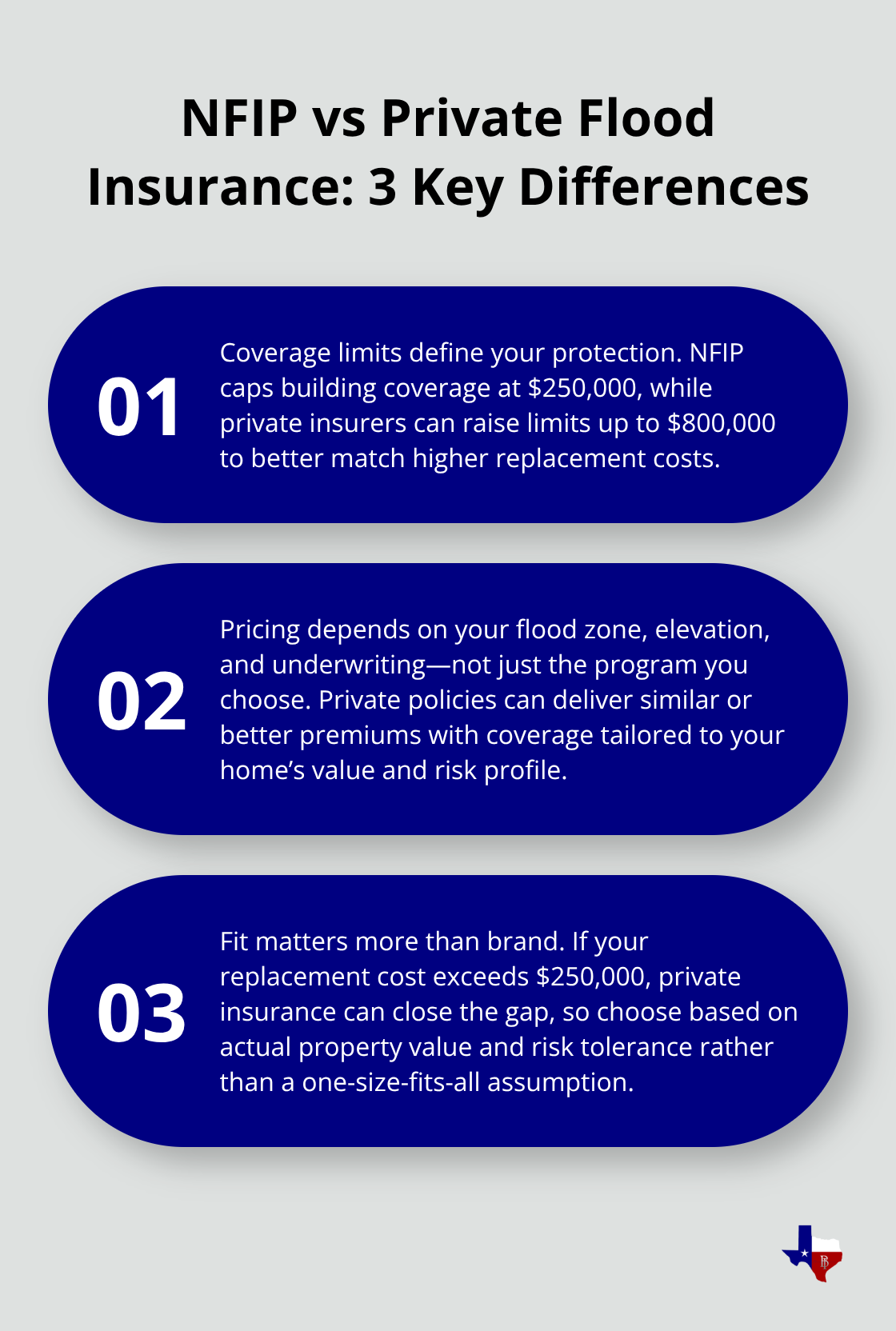
The National Flood Insurance Program, administered by FEMA, is the largest flood insurance provider in the country with 4.7 million policyholders and nearly $1.3 trillion in coverage nationwide. NFIP policies typically max out at $250,000 in building coverage and cost around $1,000 per year on average. However, private flood insurers can offer substantially higher limits-up to $800,000-for similar annual premiums. This matters significantly if you own a valuable home or have high-value belongings. You should compare both options because private carriers often provide better value for homeowners with properties exceeding $250,000 in replacement cost. The choice between NFIP and private flood insurance should depend on your actual property value and risk tolerance, not on the assumption that one option fits everyone.
How flood maps shape your coverage requirements
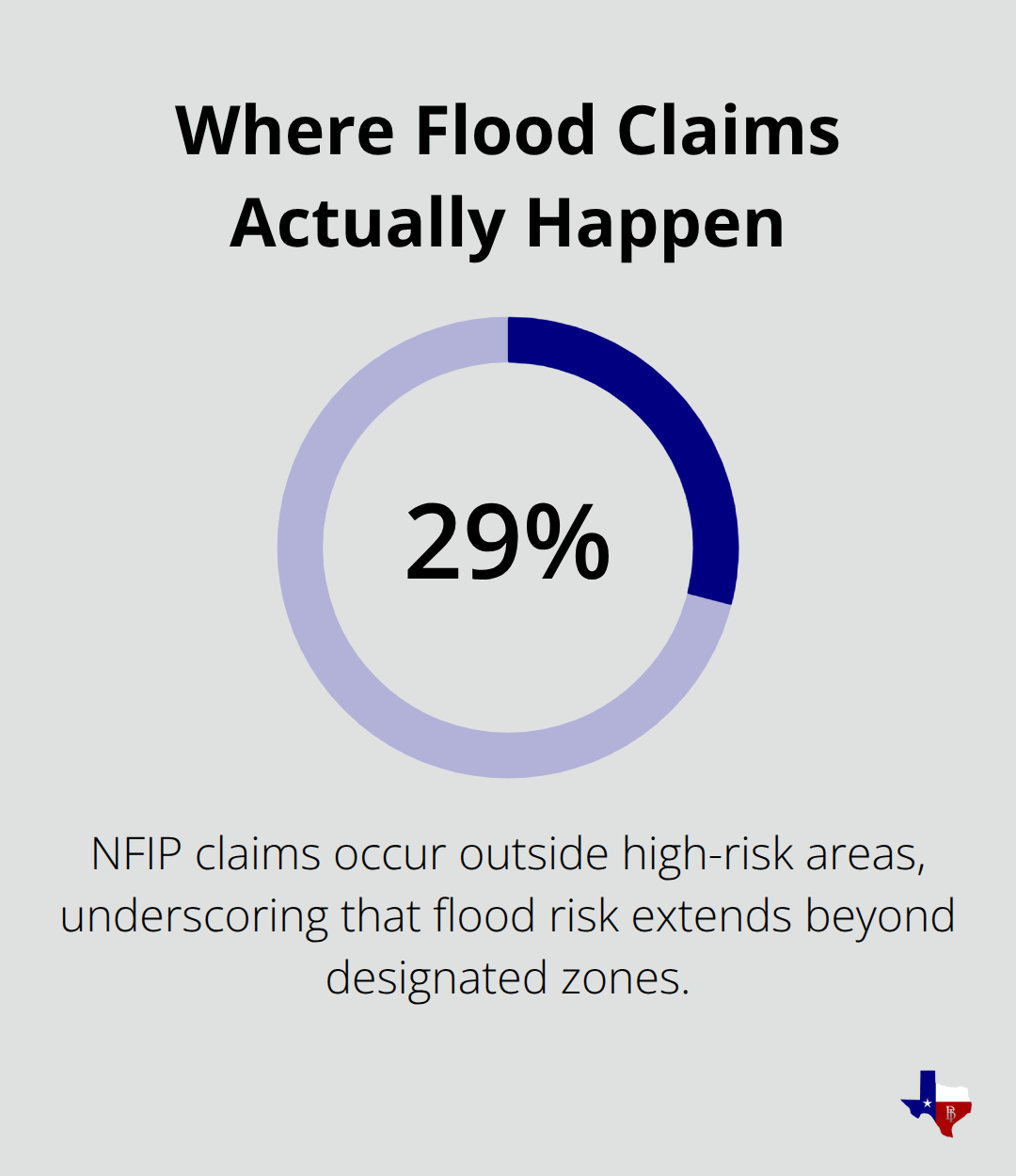
Your flood zone determines whether you must carry flood insurance and influences your premium rates. FEMA’s flood maps categorize properties into high-risk zones, moderate-risk zones, and low-risk zones based on historical flooding data and elevation. You can look up your property’s flood zone free through the FEMA Flood Map Service Center by entering your address. High-risk areas-marked as V, VE, or V1-V30 zones for coastal properties-require flood insurance if you have a mortgage with a federally backed lender. Even in moderate and low-risk zones, about 29% of NFIP claims occur outside high-risk areas, which means flooding happens where people don’t expect it. The elevation of your home relative to the base flood elevation in your area directly affects your premium, so understanding your specific zone and elevation is the first step toward accurate pricing and appropriate coverage limits.
What happens when you compare your actual options
Comparing flood insurance options reveals significant differences in coverage limits, pricing, and protection features. NFIP policies offer standardized coverage across all providers, while private insurers can tailor policies to match your specific property value and risk profile. A homeowner with a $400,000 replacement cost home faces a coverage gap with NFIP’s $250,000 limit, but private flood insurance fills that gap without forcing you to accept underinsurance. Premium costs vary based on your flood zone, elevation, and the insurer’s underwriting criteria (not all private carriers operate in all Texas markets). You should obtain quotes from multiple providers to see which option delivers the protection you actually need at a price that fits your budget.
How Coverage Limits and Costs Actually Compare
NFIP caps versus private insurance limits
The gap between NFIP and private flood insurance becomes crystal clear when you examine real coverage limits and pricing side by side. NFIP building coverage caps at $250,000, which leaves homeowners with properties valued above that amount significantly underinsured. Private flood insurers eliminate this ceiling-carriers like Beyond Floods and Neptune Flood offer limits reaching $800,000 for similar annual premiums to NFIP. A $400,000 home with only $250,000 in NFIP coverage exposes you to $150,000 in potential losses. The premium difference between NFIP and private options depends entirely on your flood zone and elevation, not on coverage limits. A property in a lower-risk zone might find private flood insurance cheaper than NFIP, while a high-risk coastal property could see the opposite.
Getting quotes reveals your true costs
You need actual quotes, not assumptions, to determine which option saves money for your specific address. Deductible choices shift the equation significantly-NFIP typically offers $1,000, $2,500, $5,000, and $10,000 deductible options, while private carriers may provide greater flexibility or lower deductible choices. Higher deductibles reduce your premium but increase your out-of-pocket cost when you file a claim. Choose your deductible based on your emergency fund capacity, not just the lowest monthly payment.
Riders and enhancements that NFIP doesn’t offer
Private flood insurers frequently include riders and enhancements that NFIP policies don’t offer. Some carriers cover basement contents separately, which NFIP generally excludes (making this rider valuable if you store belongings below grade). Sump pump failure coverage and water backup protection appear in private policies more often than in NFIP offerings. Replacement cost coverage versus actual cash value matters significantly-replacement cost pays what it costs to rebuild or replace items today, while actual cash value deducts depreciation. NFIP offers replacement cost for buildings in most cases, but contents coverage may be actual cash value depending on your policy. Private insurers frequently provide replacement cost for both building and contents, which means less depreciation penalty when you file a claim.
Mitigation programs that lower your premiums
If you own a home built before 2009, you might qualify for NFIP’s Hazard Mitigation Grant Program, which can lower premiums if you elevate your foundation or install flood vents. These enhancements exist because different properties face different flood risks-a home with a basement needs different protection than one on a raised foundation. Shopping around reveals which carrier aligns with your actual property characteristics and risk profile, and understanding what each insurer covers (or excludes) helps you avoid costly gaps in protection.
Picking the Right Coverage for Your Home’s Real Value
Determine your actual replacement cost
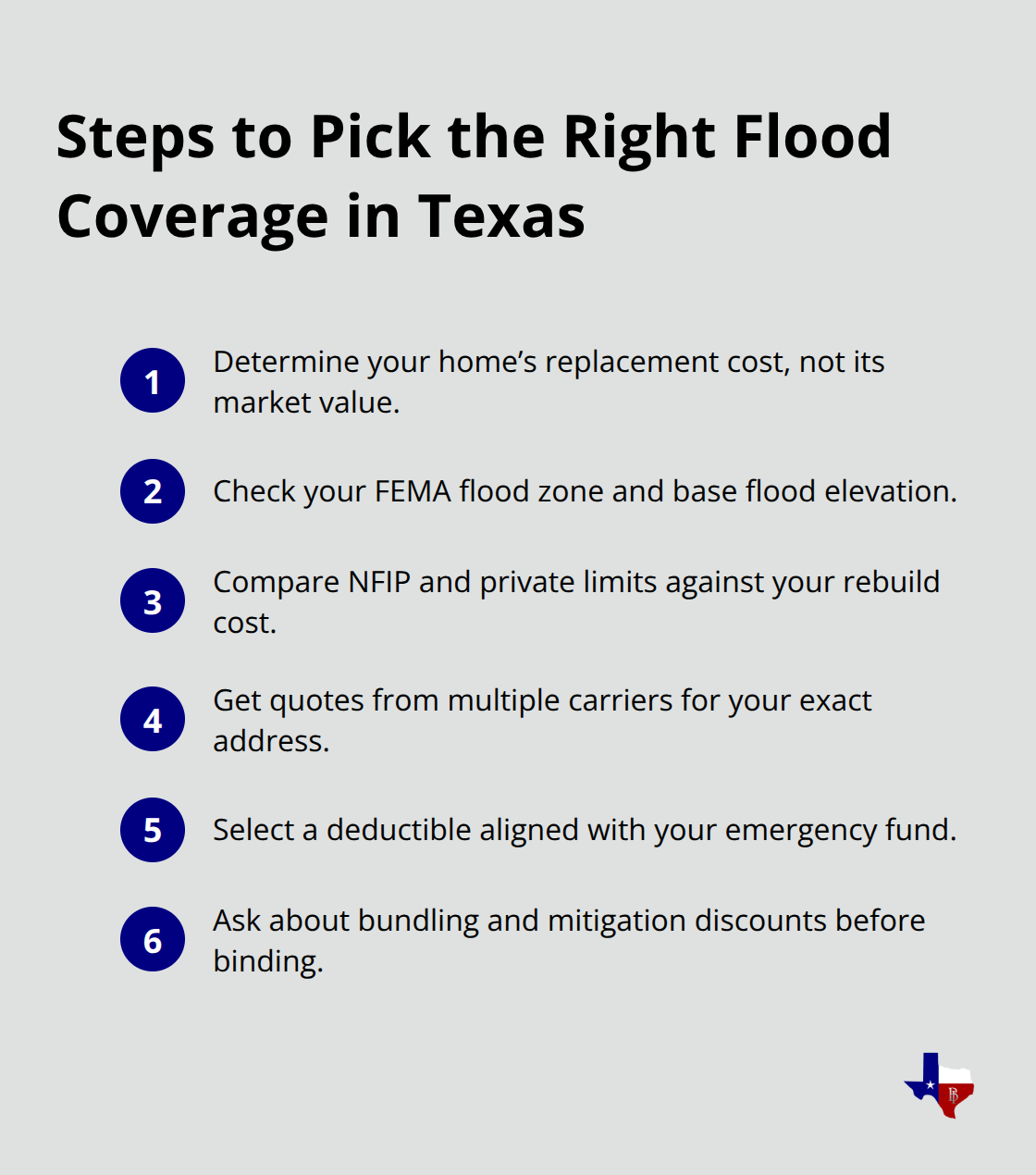
Start with your property’s replacement cost, not its market value. Market value and replacement cost diverge significantly in Texas-a home worth $350,000 on the market might cost $400,000 to rebuild from scratch due to labor, materials, and local building codes. Contact a local contractor or use a replacement cost calculator to estimate a realistic rebuild figure for your specific home size, age, and construction type. Once you know this number, compare it against your flood insurance options.
An NFIP policy maxes out at $250,000 in building coverage, which leaves a $150,000 gap if your replacement cost reaches $400,000. Private flood insurers offering $800,000 limits eliminate this exposure entirely. The goal isn’t to insure every dollar-it’s to cover enough that a flood doesn’t financially devastate you. If your replacement cost exceeds $250,000, private flood insurance becomes necessary, not optional.
Compare quotes from multiple carriers
Obtain quotes from both NFIP and private carriers using your actual address and replacement cost figure. You’ll see immediate differences in what each option covers and costs. A property in a lower-risk flood zone might qualify for NFIP rates around $500 annually, while private coverage for the same home could run $700 but deliver three times the coverage limit.
Select a deductible that matches your finances
Your deductible choice directly impacts both your monthly premium and your out-of-pocket exposure during a claim. NFIP offers $1,000, $2,500, $5,000, and $10,000 deductible options. However, this savings only makes sense if you have sufficient emergency reserves to cover that deductible immediately after a flood.
Most Texas homeowners can comfortably absorb a $2,500 or $5,000 deductible without financial hardship, which balances reasonable monthly costs against manageable claim expenses. Choose your deductible based on your emergency fund capacity, not just the lowest monthly payment.
Combine policies and pursue mitigation discounts
Bundle your flood insurance with your homeowners policy when possible-many private insurers offer package discounts of 5 to 10 percent when you combine coverage. The savings compound when you’re protecting multiple assets. Additionally, inquire about mitigation discounts. If you’ve elevated your home’s mechanical systems above the base flood elevation or installed flood vents in your foundation, some insurers reduce premiums by 5 to 15 percent.
These concrete improvements demonstrate reduced risk, and carriers reward property owners who take action. Document any mitigation work with photos and contractor invoices, then provide this documentation during the quote process so discounts apply from day one of your policy.
Final Thoughts
Comparing flood insurance in Texas comes down to three concrete factors: your property’s actual replacement cost, your flood zone designation, and the coverage limits each option provides. NFIP policies max out at $250,000 in building coverage, which works for modest homes but leaves owners of higher-value properties significantly underinsured. Private flood insurers eliminate this ceiling, offering limits up to $800,000 for comparable annual premiums.
Look up your flood zone through FEMA’s Flood Map Service Center, then obtain quotes from both NFIP and private carriers using your actual address and replacement cost figure. Compare the coverage limits, deductible options, and premium costs side by side. Pay attention to what each policy covers beyond basic building protection-riders for basement contents, sump pump failure coverage, and replacement cost versus actual cash value make meaningful differences when you file a claim.
We at Brooks Insurance help Texas homeowners navigate these decisions with personalized guidance based on your specific property and risk profile. As an independent agency, we represent multiple top-rated insurance companies, which means you have access to a larger selection of coverage options and pricing than you’d find working with a single carrier. Contact us at brooksinstx.com to discuss your flood insurance needs and get quotes tailored to your home’s actual value and location.
Disclaimer: The information provided in this blog is for general informational purposes only and does not constitute legal, financial, or insurance advice. Coverage options, terms, and availability may vary. Please consult with a licensed professional for advice specific to your situation