

One slip-up on a job site can cost thousands in medical bills and legal fees. Contractors in Texas face real liability risks every single day, from worker injuries to accidental property damage.
At Brooks Insurance, we know that contractor general liability coverage isn’t optional-it’s the foundation of a protected business. This guide walks you through what you actually need to know to stay covered.
What General Liability Actually Covers
General liability insurance protects your business when someone gets hurt or property gets damaged because of your work. Contractors in Texas often underestimate what this coverage includes, which leaves them exposed to serious financial risk. The policy covers three main areas: bodily injury claims when a client or bystander is injured on your job site, property damage when your work accidentally damages a client’s building or belongings, and medical payments plus legal defense costs if a claim is filed against you.
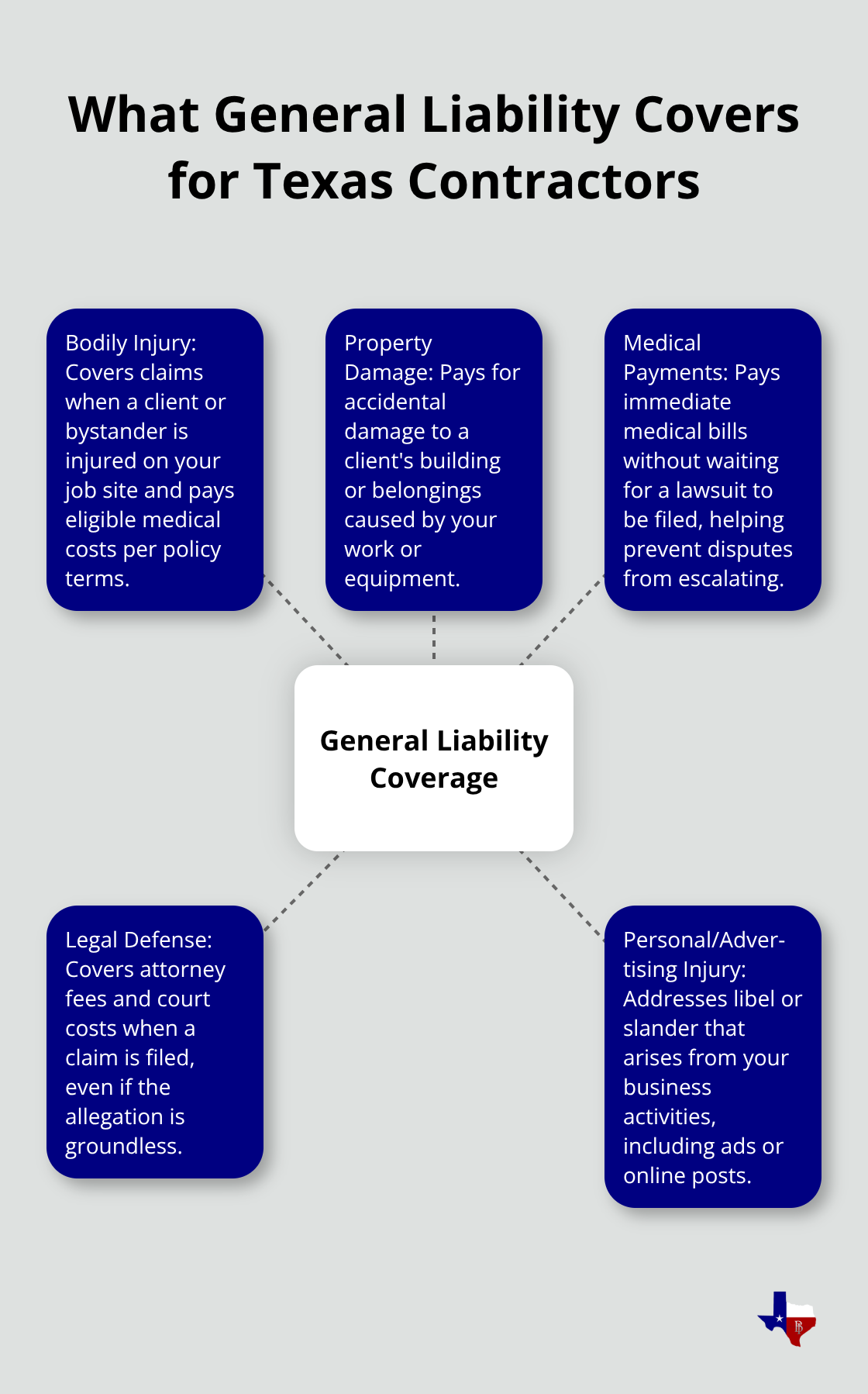
General liability also covers personal injury claims like libel or slander that arise from your business activities-a real concern if you run ads or post content online about your work.
Medical Payments Cover Immediate Costs
Medical payments coverage within your general liability policy pays for injuries on the spot, without waiting for a lawsuit. If a homeowner slips on your wet floor and needs an ambulance, this part of your policy covers the bill up front. This isn’t about admitting fault; it’s about stopping small incidents from becoming big legal battles. Legal defense costs are separate and critical: if someone sues you, your insurer pays the attorney fees and court costs even if the claim is groundless.
Property Damage Means Your Tools and Mistakes Count Too
Property damage coverage applies when your equipment or actions harm someone else’s property. Drop a tool through a client’s skylight, damage their driveway with heavy machinery, or accidentally rupture a water line-this coverage handles it. Many Texas contractors mistakenly think this only applies to major accidents, but it covers accidental damage from daily work.
Understanding Your Coverage Limits Matters
Typical general liability limits run from $300,000 to $1,000,000 per occurrence, with aggregate limits of $300,000 to $2,000,000. Larger projects or higher-risk work demand higher limits. When you negotiate contracts with clients, you must confirm upfront what coverage limits they require and what additional insured endorsements they need added to your policy. These requirements vary significantly across projects, which is why the next section walks you through the actual claims contractors face most often.
Common Claims Contractors Face on Job Sites
Slip and Fall Accidents Happen Constantly
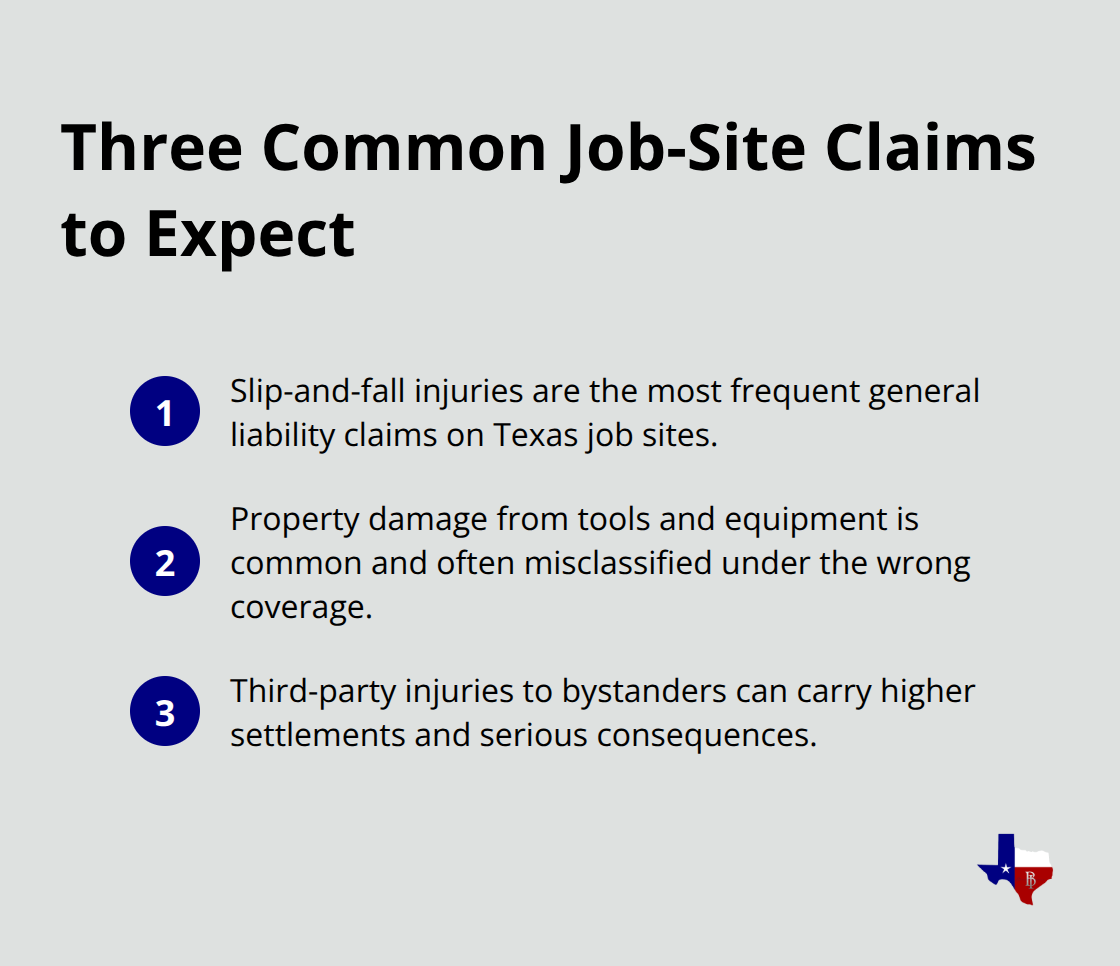
Slip and fall accidents remain the most frequent general liability claim contractors face in Texas. A homeowner steps on wet concrete you just poured, or a client slips on debris scattered across their property during your work-these incidents happen constantly and cost money fast. Medical payments coverage handles the immediate hospital bill, but if the injury is severe, the lawsuit follows. Settlement amounts for slip and fall injuries can range from $5,000 to over $1 million depending on documentation of injuries and medical expenses.
Job sites are inherently hazardous environments, and your general liability policy must cover these frequent occurrences without question.
Property Damage from Tools and Equipment Gets Misclassified
Property damage claims from tools and equipment are equally common and often overlooked by contractors who assume they only need tools and equipment insurance. When you drop a power drill through a client’s ceiling, accidentally puncture drywall with scaffolding, or damage flooring while moving heavy equipment across a finished room, your general liability policy covers it-not your inland marine policy. This distinction matters because many contractors carry the wrong coverage type for the wrong risk. A typical property damage claim from a contractor’s negligence ranges from $2,000 to $25,000 depending on what structure or item gets damaged.
Third-Party Injuries Carry Serious Consequences
Third-party injuries extend beyond slip-and-fall incidents to include bystanders hurt by your work activities, such as a neighbor injured by flying debris from your demolition project or a pedestrian struck by materials falling from scaffolding. These claims are more serious and carry higher settlement amounts because they often involve permanent injury or disability. General liability policies with per-occurrence limits of $300,000 to $1,000,000 handle most of these claims, but if you work on larger commercial projects or multi-unit buildings, you may need higher limits or an umbrella policy.
Why Adequate Coverage Protects Your Business
These claims are not theoretical-they happen regularly to contractors across Texas. Skipping general liability coverage or carrying inadequate limits exposes your entire business to catastrophic financial loss that no contractor can absorb out-of-pocket. The next section walks you through how to select the right coverage limits for your specific operation and client requirements.
How to Choose the Right Coverage Limits
Most Texas contractors pick coverage limits based on what sounds reasonable rather than what their actual business demands. The industry standard of $300,000 per occurrence works fine for small residential jobs, but it falls apart fast when you land a commercial project or handle multiple concurrent jobs.
Match Your Limits to Your Contract History
Start by examining your contract history from the past year. Pull out every client agreement you signed and list what coverage limits each one required. You’ll spot patterns immediately. Residential clients rarely demand more than $500,000 per occurrence, while commercial developers and property management companies often require $1,000,000 or higher. If you consistently land jobs requiring $1,000,000 limits, carrying only $500,000 means you either turn down work or operate uninsured on the excess. That’s a terrible position.
Calculate Limits Based on Revenue and Project Size
The Hartford reports that the average general liability cost for construction businesses runs about $113 per month, but this figure covers baseline $300,000 limits on smaller operations. Upgrading to $1,000,000 per occurrence typically costs between $150 and $250 monthly depending on your trade, claims history, and the specific risks you carry. That additional $40 to $140 per month is cheap insurance against losing your business to a single claim that exceeds your limits. Assess your revenue and project size too. Contractors pulling in $500,000 annually doing residential work can justify $500,000 to $750,000 limits, while those hitting $2 million in revenue should carry $1,000,000 minimum. Standard general liability policies use split limits: $1 million per occurrence with a $2 million aggregate annual limit.
Don’t Overlook Your Aggregate Limits
Beyond per-occurrence limits, aggregate limits matter just as much and contractors overlook them constantly. Your aggregate is the maximum your policy pays across all claims in a year. A $2,000,000 aggregate with $1,000,000 per-occurrence limits means two major claims exhaust your coverage for the entire year. If you work year-round on multiple projects, that’s a real risk.
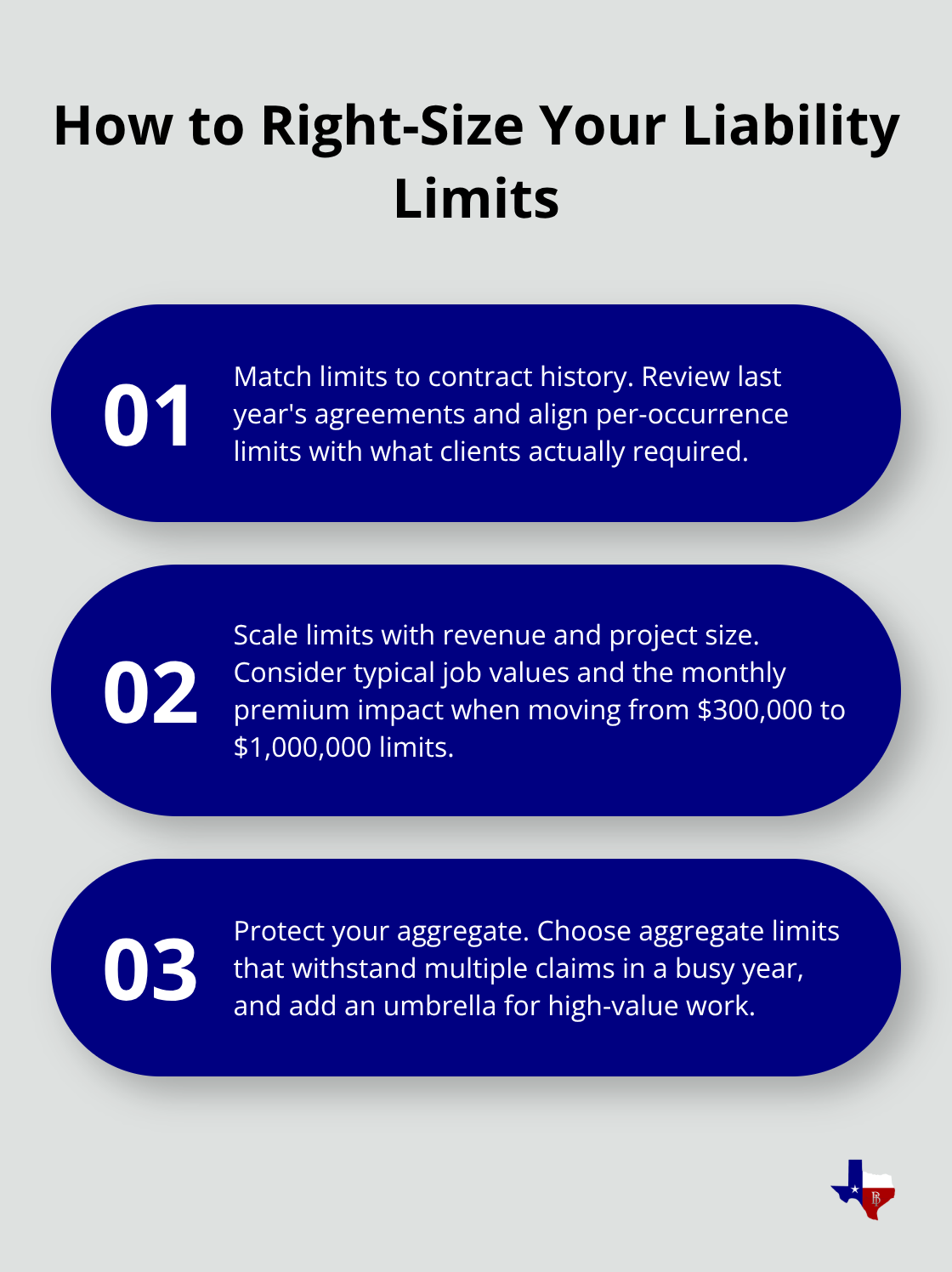
Commercial contractors managing several jobs simultaneously should carry $2,000,000 to $5,000,000 aggregate limits.
Confirm Client Requirements Before You Sign
When you negotiate with clients, request their insurance requirements in writing before signing anything. Many contractors discover mid-project that they need additional insured endorsements or higher limits than their current policy provides, creating delays and forcing emergency policy amendments. Get your certificate of insurance template ready and know exactly what limits you carry before any client conversation happens. If a major client requires limits beyond what your base policy provides, an umbrella policy extending coverage by $1,000,000 to $5,000,000 typically costs $300 to $600 annually and solves the problem without forcing you to increase your primary limits across every policy. This approach keeps premiums manageable while protecting you on high-value work.
Final Thoughts
Contractor general liability coverage protects your business when slip and fall accidents, equipment damage, or third-party injuries happen on job sites-and they will happen. The three core protections (bodily injury claims, property damage coverage, and legal defense costs) form the backbone of a business that survives a lawsuit without collapsing. Your coverage limits must match your actual contracts, not industry averages, so pull your client agreements and calculate what you truly need before selecting a policy.
Confirm client requirements before you sign anything, and request insurance specifications in writing to prevent mid-project scrambling. An umbrella policy costs surprisingly little and fills gaps when you land bigger work without forcing you to overpay on baseline coverage year-round. Your certificate of insurance details and additional insured endorsements matter just as much as your core limits, so understand these requirements cold.
We at Brooks Insurance work with Texas contractors to build contractor general liability coverage that actually fits your operations. Contact Brooks Insurance and let our licensed agents answer your questions directly-no automated systems, no runaround.
Disclaimer: The information provided in this blog is for general informational purposes only and does not constitute legal, financial, or insurance advice. Coverage options, terms, and availability may vary. Please consult with a licensed professional for advice specific to your situation