
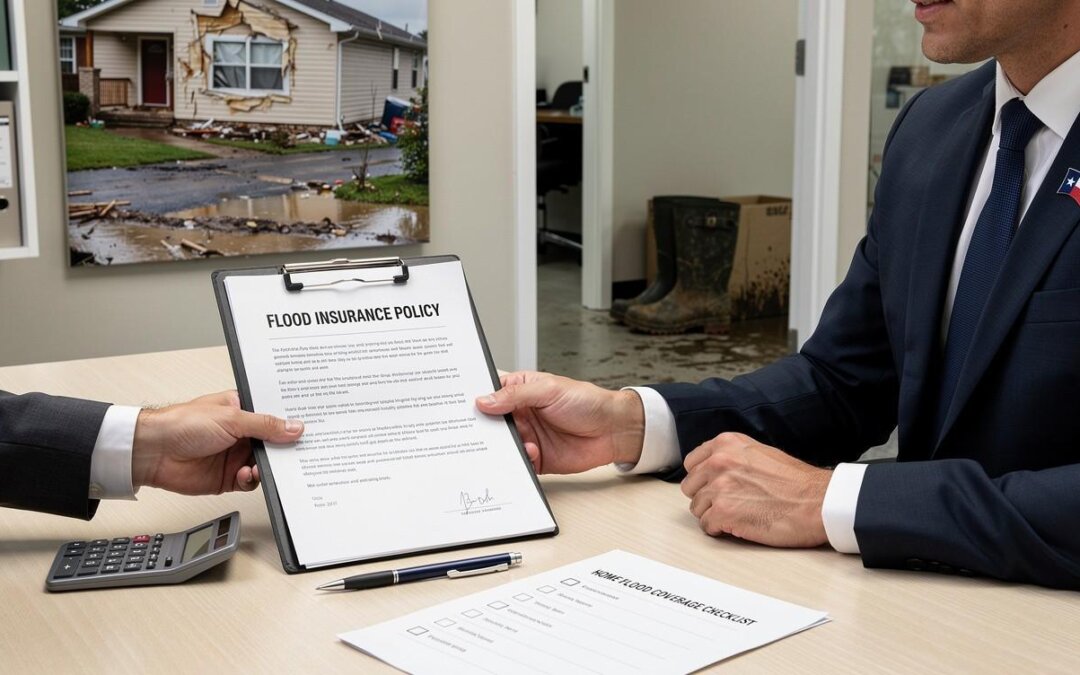
Flooding is Texas’s most frequent natural disaster, affecting thousands of homeowners every year. Standard homeowners insurance won’t cover flood damage, leaving many Texans financially vulnerable when water strikes.
At Brooks Insurance, we’ve helped countless residents understand that flood insurance for Texans isn’t optional-it’s essential protection. This guide walks you through your coverage options and how to find the right policy for your property.
Why Flood Insurance Matters in Texas
Texas Experiences Flooding Year-Round
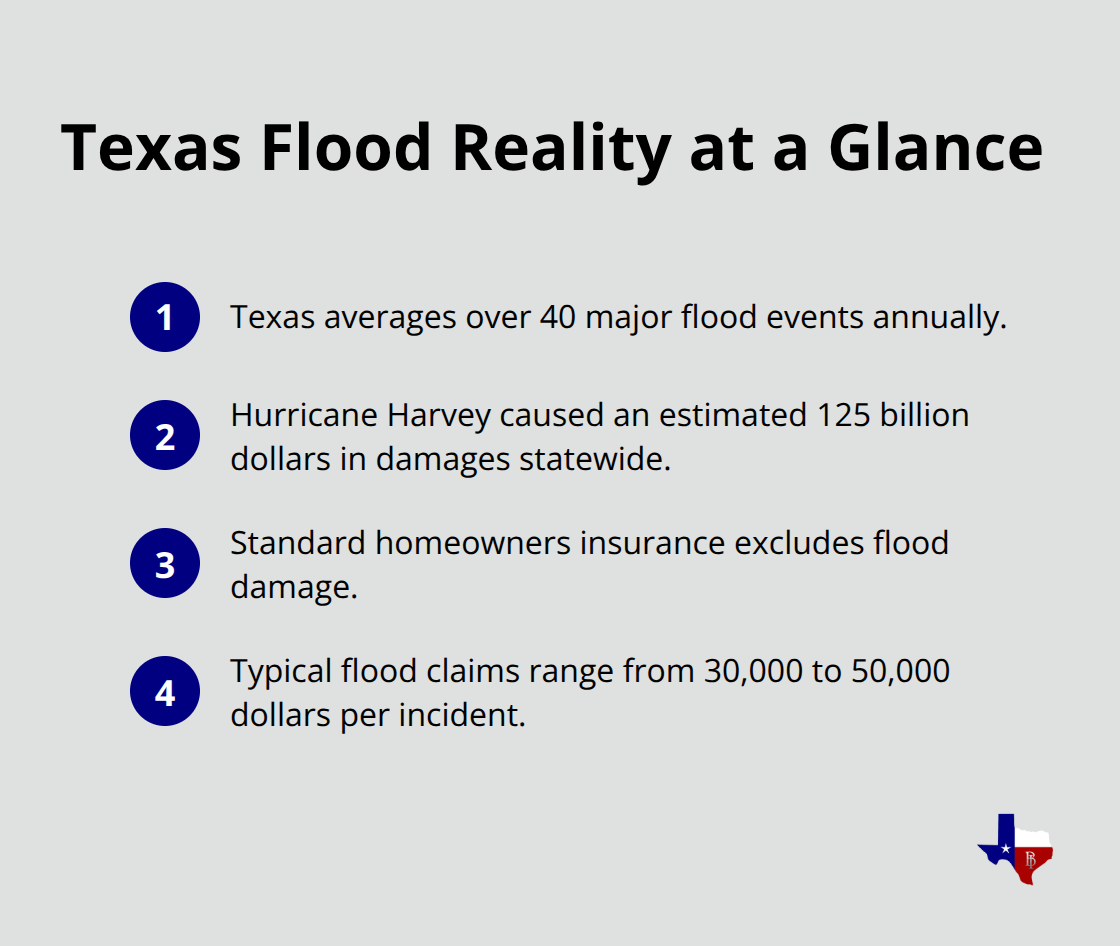
Flooding ranks as Texas’s most frequent natural disaster, with the state averaging over 40 major flood events annually according to the National Weather Service. Hurricane season amplifies this risk, but water damage in Texas extends far beyond tropical storms-heavy rainfall, overflowing rivers, and inadequate drainage systems create hazardous conditions throughout the year. The 2017 Hurricane Harvey caused an estimated 125 billion dollars in damages across Texas, with water damage accounting for the majority of losses. These aren’t isolated incidents; they represent predictable patterns that affect property values and insurance costs across the state.
Standard Homeowners Policies Leave You Exposed
Standard homeowners insurance policies explicitly exclude flood damage, a gap that catches thousands of Texans off guard annually. Your homeowners policy covers wind damage, hail, and fire, but water that rises from external sources-whether from heavy rain, storm surge, or overflowing waterways-falls outside standard coverage. This means you personally absorb every dollar of flood-related repairs without a separate flood insurance policy. Flood claims average between 30,000 and 50,000 dollars per claim according to FEMA data, and the financial impact extends beyond immediate repairs. Flood damage depreciates property values and creates long-term complications when you sell your home.
Lenders Require Protection in High-Risk Areas
If your property sits in a high-risk flood zone and you have a mortgage, your lender requires you to carry flood insurance. This requirement removes the choice from your hands if you’re financing your property. Lenders understand that uninsured flood losses can lead to foreclosure, so they mandate this protection as a condition of the loan.
Flood Insurance Costs Less Than You Expect
The cost of flood insurance typically ranges from 400 to 1,200 dollars annually for standard NFIP policies (depending on your location and coverage level). This price is substantially cheaper than absorbing flood damage out of pocket or facing the consequences of uninsured losses. Understanding your coverage options and flood risk helps you select the right policy at the right price.
Understanding Flood Insurance Coverage Options
The National Flood Insurance Program Dominates Texas
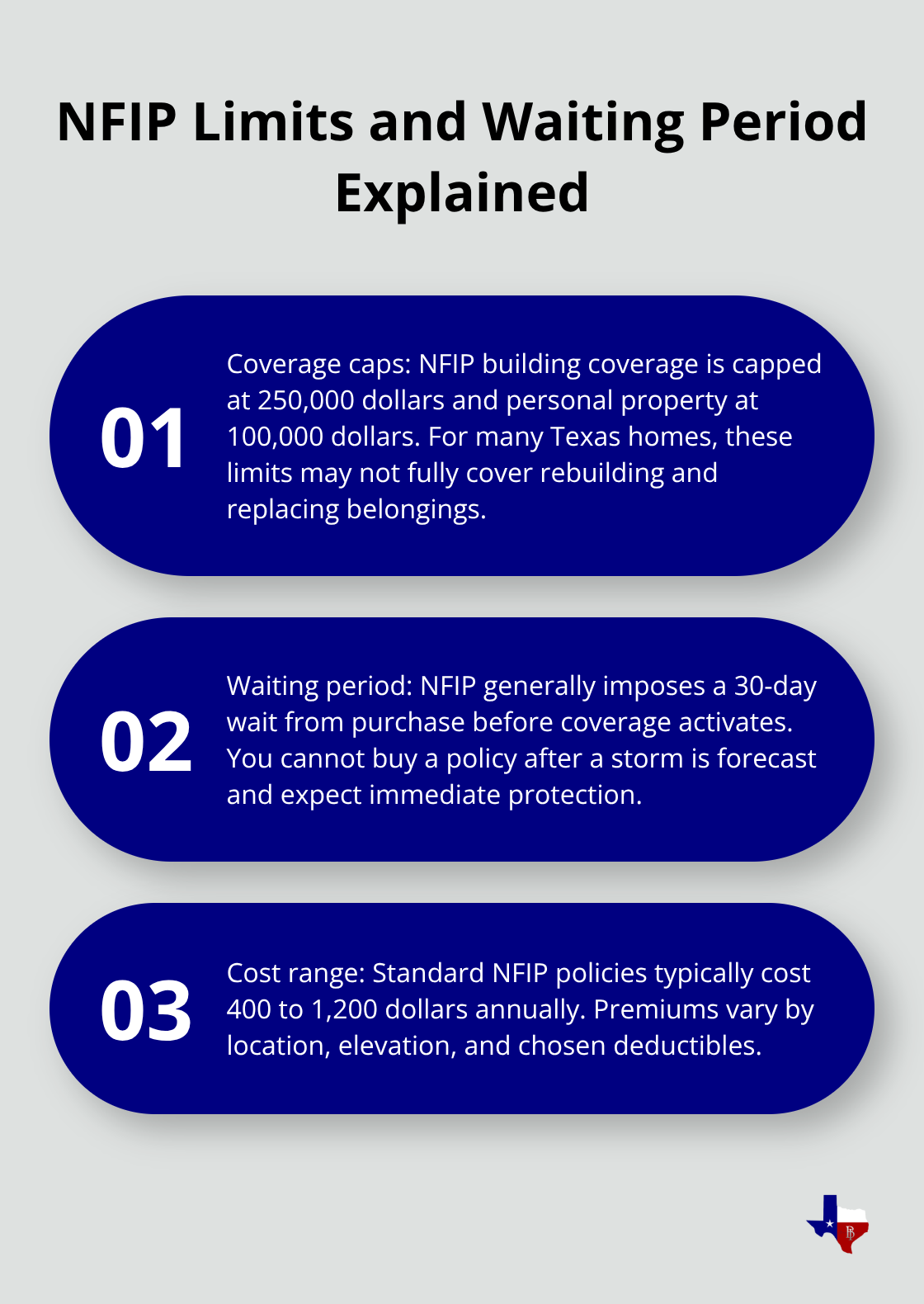
The National Flood Insurance Program (NFIP) covers approximately 5.2 million policies nationwide, with over 600,000 active in Texas alone. NFIP policies cost between 400 and 1,200 dollars annually for standard coverage, making them accessible for most homeowners. However, NFIP carries significant limitations that affect your protection level. The program caps building coverage at 250,000 dollars and personal property coverage at 100,000 dollars-a restriction that falls short for many Texas homes. NFIP also imposes a 30-day waiting period from purchase date before coverage activates, meaning you cannot obtain protection retroactively after flooding occurs.
If you live in a high-risk flood zone and carry a mortgage, your lender mandates NFIP if no private alternative exists. This requirement removes your choice and locks you into the federal program’s restrictions.
Private Flood Insurance Offers Greater Flexibility
Private flood insurance provides an escape route from NFIP constraints. Private insurers compete on price and coverage limits, often providing higher limits and lower premiums than the federal program. Some private policies activate immediately without waiting periods-a critical advantage if you anticipate imminent weather threats. Private insurers also underwrite policies more flexibly, sometimes covering properties NFIP considers uninsurable.
The trade-off is availability. Private flood insurance remains concentrated in lower-risk zones, leaving high-risk properties dependent on NFIP. As an independent agency, we represent multiple top-rated insurance companies, which means you have a larger selection of coverage, pricing, and payment options when exploring private flood insurance alternatives.
Deductibles and Coverage Limits Shape Your Protection
Coverage limits and deductible structures determine how much protection you actually receive when floodwaters damage your home. NFIP offers standard deductibles of 1,000 or 5,000 dollars, with higher deductibles reducing your annual premium. Choosing a 5,000 dollar deductible instead of 1,000 dollars typically saves 100 to 150 dollars yearly on NFIP policies. However, this savings only makes sense if you can absorb that larger deductible from personal funds.
Most Texas homeowners underestimate flood damage severity. Repairs average 30,000 to 50,000 dollars according to FEMA data, meaning your deductible represents only a fraction of total costs. Building coverage and contents coverage operate separately under flood insurance, requiring you to purchase both if you want protection for your structure and belongings.
Contents Coverage Protects Your Possessions
Contents coverage protects furniture, electronics, and personal items, while building coverage handles structural damage and permanent fixtures. Many homeowners skip contents coverage to save money, then face devastating losses when flooding destroys their possessions. Try selecting coverage limits that approach your property’s replacement cost rather than settling for minimum protection.
The right coverage combination depends on your specific property, location, and financial situation. Understanding these options prepares you to assess your actual flood risk and determine what level of protection makes sense for your Texas home.
Determining Your Flood Risk and Coverage Needs
Check Your FEMA Flood Zone Designation
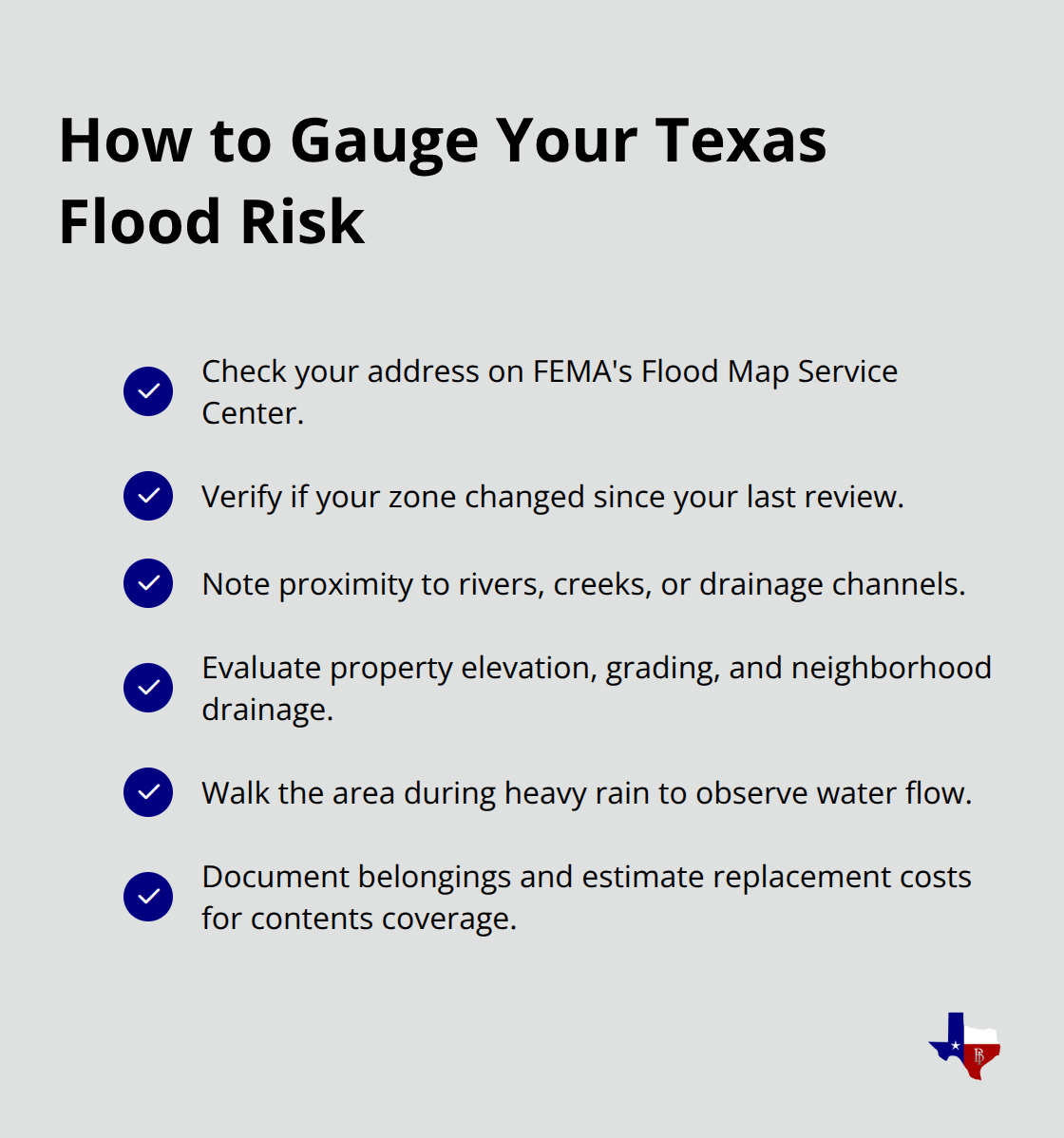
Start with the FEMA Flood Map Service Center website to identify your property’s flood zone designation. This free tool shows whether your home sits in a high-risk zone (Special Flood Hazard Area), moderate-risk zone, or low-risk zone. Your flood zone directly determines your insurance requirements and premium costs. High-risk properties require flood insurance if you carry a mortgage, while moderate and low-risk properties remain optional but still worthwhile. FEMA updates these maps regularly as communities experience flooding patterns, so verify your designation even if you’ve owned your home for years.
Properties that moved from low-risk to moderate-risk zones often face premium increases when owners renew policies, making current zone verification essential before purchasing coverage.
Assess Physical Risk Factors Beyond Your Flood Zone
Several physical factors increase your actual flood risk regardless of FEMA’s designation. Properties within 500 feet of a river, creek, or drainage channel face substantially higher water damage risk than homes further away. Elevation matters tremendously in Texas-homes built below street level or in low-lying areas absorb water from heavy rainfall that higher properties shed naturally. Inadequate drainage systems, poor grading, and aging stormwater infrastructure multiply risk in older Texas neighborhoods. If your property sits downhill from commercial areas or upstream from detention ponds, water flows toward your home during storms. Walk your neighborhood during heavy rain to observe water movement patterns and your property’s elevation relative to surrounding land and nearby waterways. Properties with basements or crawl spaces face higher damage costs than slab foundations because water penetration reaches more valuable components. These local factors often matter more than your flood zone when determining adequate coverage levels.
Calculate Your Home’s Replacement Cost
Assess your home’s replacement cost, not its market value, to determine adequate coverage. A home might require building coverage that exceeds its market value to fully replace structural damage after major flooding, since reconstruction costs exceed pre-disaster prices. Request a professional home appraisal that specifically notes replacement cost rather than market value-many homeowners dramatically underestimate this figure. Contents coverage should reflect what you actually own: add up furniture, electronics, clothing, and household items to determine realistic protection needs. Most homeowners carry insufficient contents coverage, then face devastating losses when floods destroy possessions. Document your belongings with photos and receipts before purchasing contents coverage-this documentation simplifies claims processing if water damage occurs.
Understand Coverage Limits for Your Property Value
NFIP’s building and contents limits prove insufficient for many Texas properties, making private flood insurance worth exploring for higher-value homes or those with substantial personal property. Try selecting coverage limits that approach your property’s replacement cost rather than settling for minimum protection. The right coverage combination depends on your specific property, location, and financial situation. Understanding these options prepares you to assess your actual flood risk and determine what level of protection makes sense for your Texas home.
Final Thoughts
Flood insurance for Texans protects your home and finances when water damage strikes, making it a practical necessity rather than a luxury. Texas experiences over 40 major flood events annually, and standard homeowners policies won’t cover these losses, leaving you personally responsible for repair costs that average 30,000 to 50,000 dollars. Whether you live in a high-risk flood zone or a moderate-risk area, understanding your coverage options and actual flood risk determines whether you’re adequately protected when floodwaters arrive.
The National Flood Insurance Program covers most Texas homeowners with affordable premiums between 400 and 1,200 dollars annually, though NFIP’s coverage limits cap at 250,000 dollars for building damage and 100,000 dollars for personal property. Private flood insurance offers an alternative with higher limits and sometimes lower costs, though availability remains concentrated in lower-risk zones. Your flood risk depends on multiple factors beyond your FEMA flood zone designation-check the FEMA Flood Map Service Center to identify your zone, then assess physical risk factors like proximity to waterways, property elevation, and drainage patterns.
We at Brooks Insurance represent multiple top-rated insurance companies, giving you access to a larger selection of coverage options, pricing, and payment plans than you’d find working directly with a single insurer. Contact brooksinstx.com to request a flood insurance quote tailored to your Texas home, and our licensed agents will review your flood risk and help you select the right policy for your specific property.
Disclaimer: The information provided in this blog is for general informational purposes only and does not constitute legal, financial, or insurance advice. Coverage options, terms, and availability may vary. Please consult with a licensed professional for advice specific to your situation