

A general liability policy in Texas isn’t optional-it’s a business necessity. Whether you operate a small contractor business, run a retail shop, or manage a service company, one accident or injury claim can drain your finances fast.
At Brooks Insurance, we’ve seen too many Texas business owners operate without adequate coverage, only to face devastating losses when something goes wrong. This guide walks you through what you actually need to know about protecting your business.
What Your General Liability Policy Actually Covers
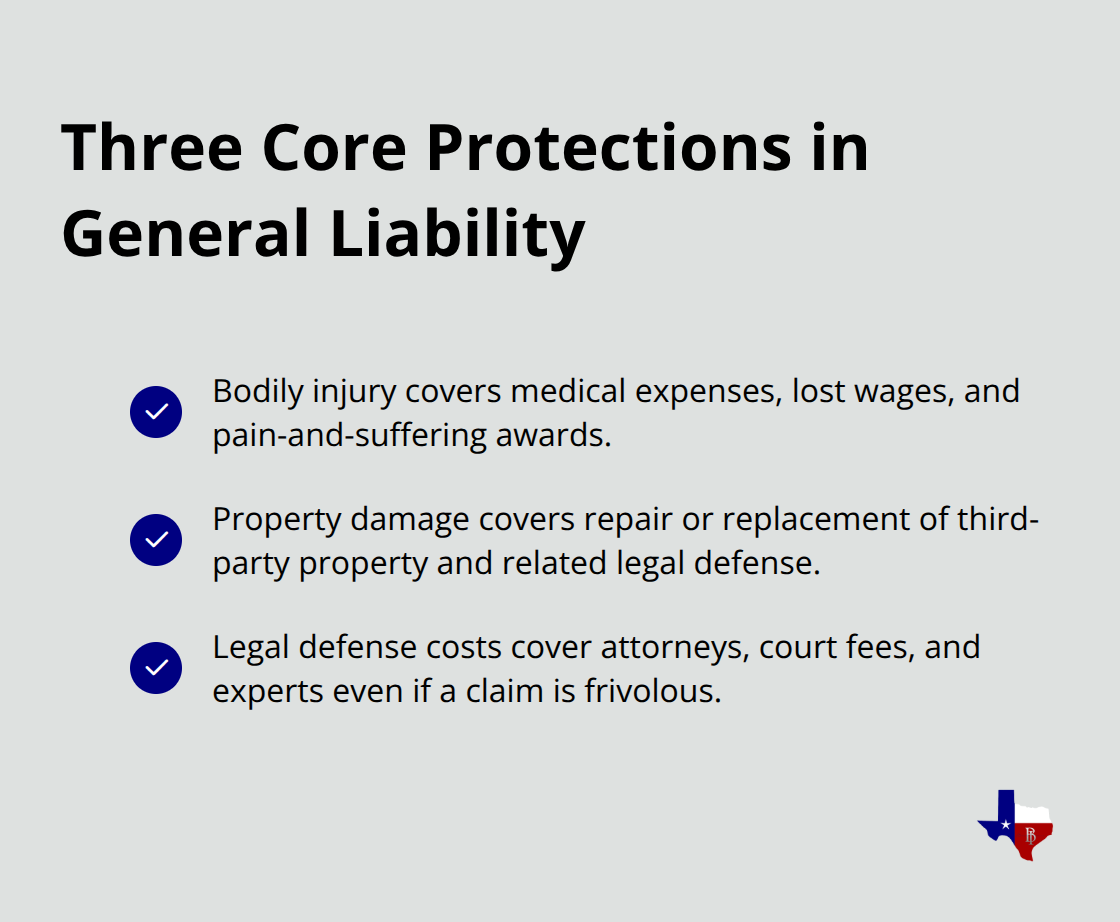
General liability coverage protects your Texas business from three main financial threats, and understanding exactly what each covers matters more than you might think. Medical bills from a customer’s slip-and-fall accident, damage your crew accidentally causes to a client’s property, and the legal fees to defend yourself in court-these situations happen constantly in Texas businesses, and one uninsured incident can cost tens of thousands of dollars. The average liability claim exceeds $30,000, which is money most small and mid-sized Texas businesses simply don’t have sitting in reserves.
Bodily Injury Claims Hit Your Bottom Line Fast
When someone gets hurt on your business property or because of your operations, your general liability policy covers their medical expenses, lost wages, and pain-and-suffering awards up to your policy limits. A construction worker falls off scaffolding at a jobsite, a salon client has an allergic reaction to a product, or a customer trips in your retail store-these scenarios generate immediate medical bills and often lead to lawsuits. Your policy covers both the medical treatment costs and the legal judgment if a court sides with the injured party.
Without this coverage, you face personal liability for every penny, which can force business closure faster than almost any other financial crisis.
Property Damage Coverage Protects You From Third-Party Claims
Your business activities can damage someone else’s property-your delivery truck hits a parked car, your equipment damages a client’s building, or your operations cause structural damage to a neighboring business. General liability covers the repair or replacement costs for that third-party property, plus the legal expenses if the property owner sues. In Texas’s urban and commercial areas, property damage claims frequently reach significant amounts when involving commercial structures or equipment. This coverage applies whether the damage happens at your location or at a client’s site, making it essential for contractors, service providers, and any business operating in multiple locations. The policy also covers your legal defense costs if the property owner disputes liability or your assessment of damages.
Legal Defense Costs Stand Separate From Your Settlement Payout
Many Texas business owners overlook this critical aspect: your policy covers legal defense costs separately from the actual settlement or judgment amount. When someone files a lawsuit against your business, your insurance company provides an attorney and covers court fees, expert witness expenses, and all litigation costs. This defense coverage applies even if the claim is completely frivolous-you avoid spending thousands on legal fees just to prove the lawsuit has no merit. Legal defense costs can easily exceed the actual settlement in complex cases, making this protection genuinely valuable for business owners. Understanding these three coverage areas sets the foundation for selecting the right policy limits and deductibles that match your specific business operations.
Why General Liability Coverage Matters for Texas Businesses
Legal Requirements Force Your Hand
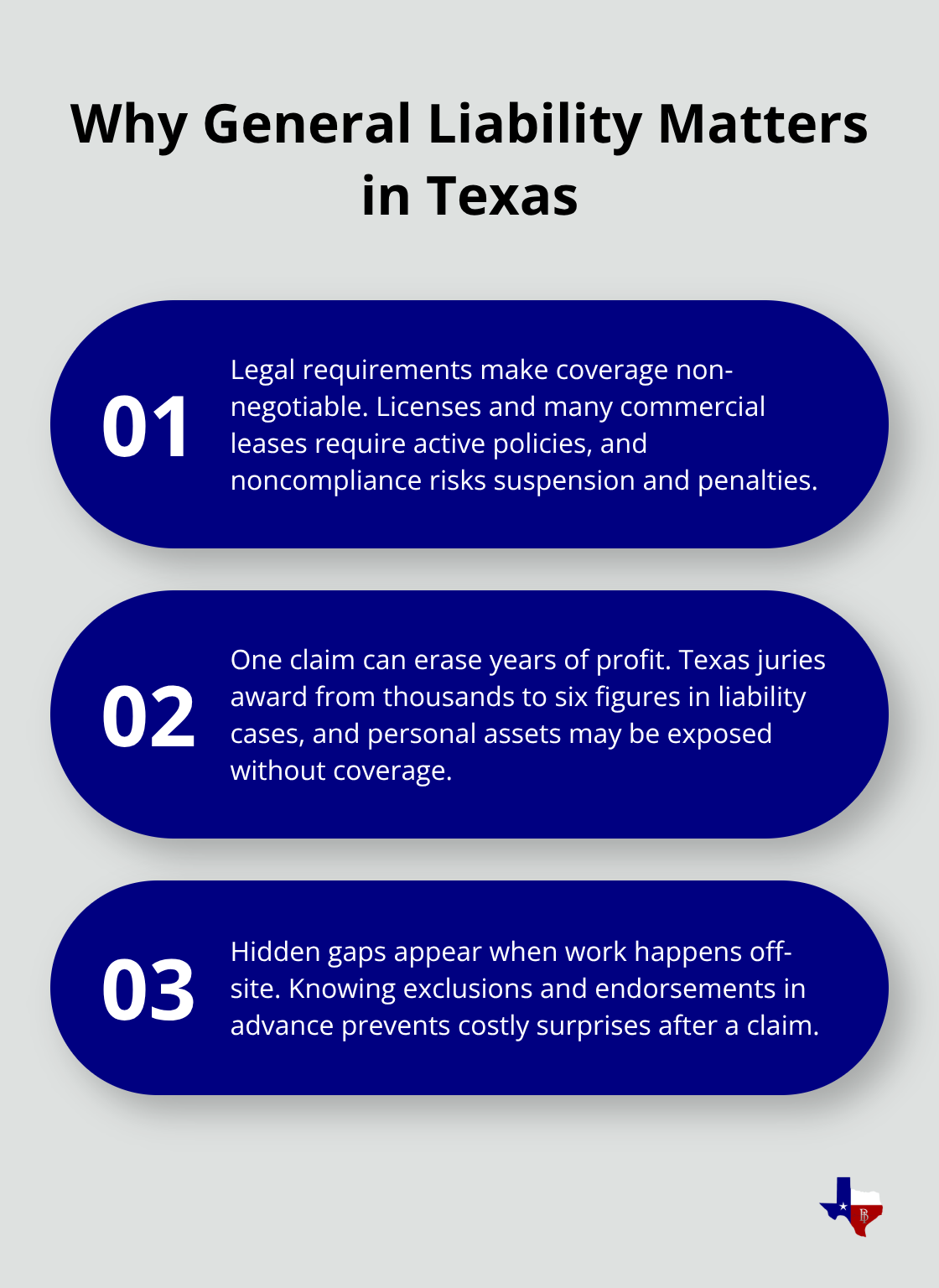
Skipping general liability insurance isn’t a cost-saving strategy-it’s financial recklessness. Texas business owners operate in a litigious environment where lawsuits happen regularly, and the financial consequences of an uninsured claim can destroy a company that took years to build. If you hold a construction license in Texas, you must carry general liability coverage to maintain your license and bid on contracts-the Texas Department of Licensing and Regulation enforces this requirement strictly. Contractors, electricians, plumbers, and HVAC specialists who operate without proper coverage face license suspension and legal penalties that compound the original problem.
Beyond licensing mandates, commercial leases frequently require tenants to maintain minimum coverage limits before occupying space. Property owners demand proof of insurance before allowing your business operations on their premises, and without it, you simply cannot access many business locations or opportunities.
One Claim Wipes Out Years of Profit
A customer hospitalization from food poisoning at your restaurant, a worker’s serious injury at your client’s facility, or structural damage your crew causes during a renovation project generates medical bills, legal fees, and court judgments that accumulate rapidly. Texas juries award significant damages in liability cases, with typical settlements ranging from $5,000 for minor accidents to $100,000 or more for serious injuries requiring surgery or long-term care. Your personal assets become vulnerable when your business carries no coverage, allowing creditors to pursue your home, savings, and retirement accounts to satisfy a judgment.
Many Texas business owners discover too late that their homeowner’s insurance explicitly excludes business-related liabilities, leaving them completely exposed. A single incident transforms your personal finances into collateral for your business obligations.
Coverage Gaps Create Hidden Exposure
Coverage gaps appear frequently when business operations extend beyond your primary location-your staff working at client sites, equipment operating in different areas, or temporary work assignments create liability exposure that standard policies sometimes exclude. Your assumptions about what’s covered often diverge sharply from what your actual policy protects. These blind spots (the ones you don’t know exist) cause far more damage than the risks you actively manage.
Understanding where your current coverage falls short matters before a claim forces you to learn the hard way. The next section walks you through how to assess your specific industry risks and select coverage limits that actually match your operations.
Selecting Coverage Limits That Match Your Texas Business
Picking the right coverage limits feels overwhelming because insurance companies offer so many options, but the process becomes straightforward once you stop guessing and start calculating based on your actual operations. Most Texas business owners either under-insure dramatically or pay for coverage they’ll never need, and both mistakes cost money.
Calculate Your Exposure Based on Industry Risk
Your industry determines baseline exposure differently than your competitor’s industry, so a contractor’s risk profile diverges sharply from a consulting firm’s risk profile. Start by documenting what could realistically happen in your specific operations: if you run a plumbing service, your crew regularly works inside client homes where property damage claims and injury claims occur frequently; if you operate a digital marketing agency, your liability exposure centers on contract disputes and professional negligence rather than physical accidents.
The National Association of Insurance Commissioners reports that small businesses with fewer than 50 employees average general liability claims of $25,000 to $50,000, though this varies significantly by industry. Construction and trades businesses face higher average claims around $75,000 or more due to injury severity, while service-based businesses typically experience lower claim amounts.
Match Coverage Limits to Your Business Type
Texas contractors should carry minimum coverage limits of $1 million per occurrence and $2 million aggregate as a baseline standard, though larger projects or specialized work often demand $2 million per occurrence. Retail operations generally operate safely with $500,000 per occurrence and $1 million aggregate unless your location experiences high foot traffic or you sell products with known injury risks.
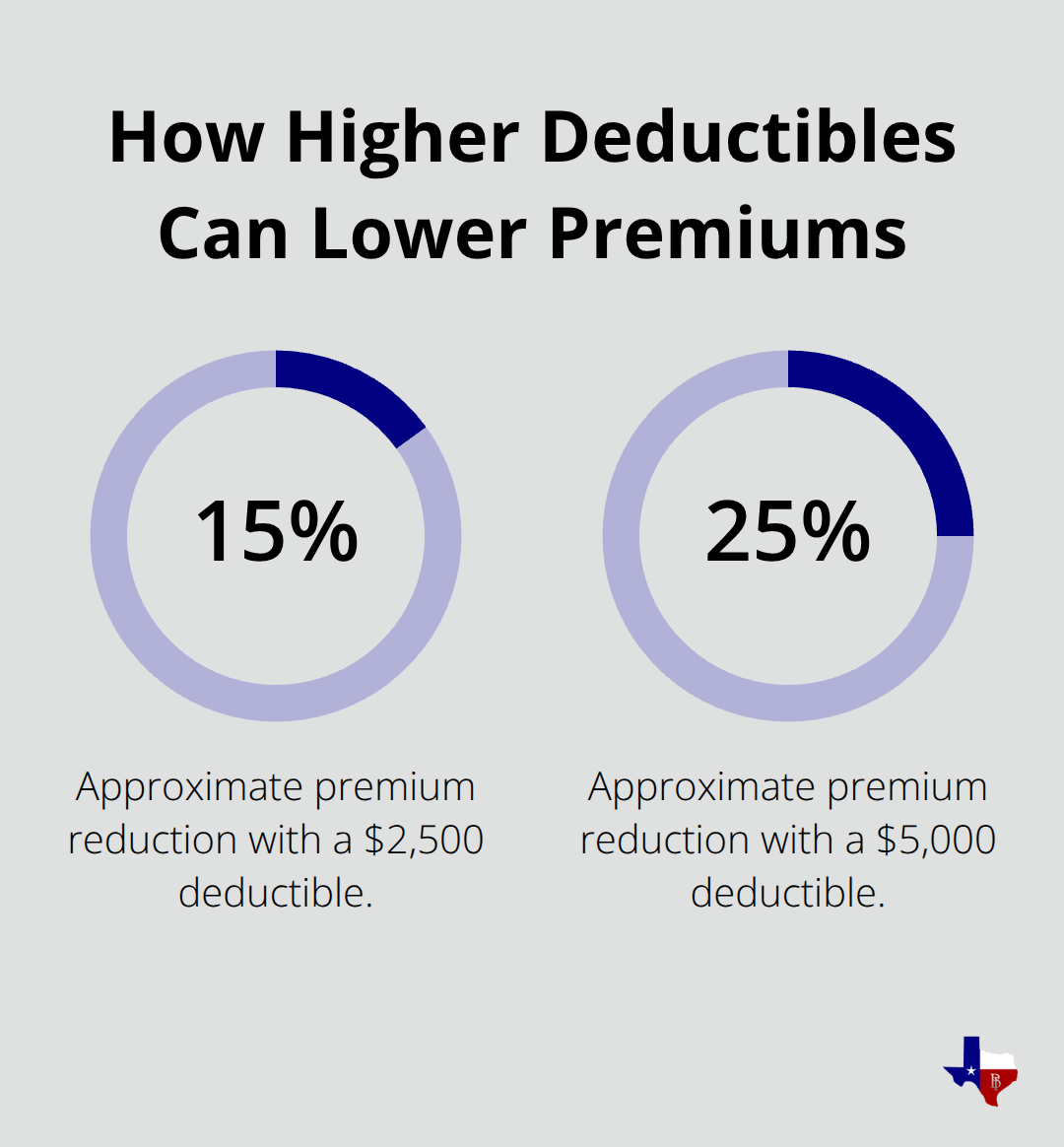
Your deductible selection creates a direct trade-off: higher deductibles reduce your premium significantly but mean you pay more out-of-pocket when a claim occurs. Most Texas businesses choose $1,000 deductibles as a reasonable balance, though contractors frequently select $2,500 or $5,000 deductibles to lower their annual premiums by 15% to 25%.
Compare Quotes Across Multiple Carriers
Independent insurance agents provide genuine value here because they access multiple carriers simultaneously rather than steering you toward one company’s products. Request quotes from at least three agencies using identical coverage specifications so you can compare apples-to-apples pricing rather than getting confused by different recommendations.
When comparing quotes, ignore premium price initially and focus on whether each quote includes the same coverage limits, deductibles, and policy features you specified. A lower premium from one carrier sometimes reflects cheaper coverage rather than better pricing on identical protection.
Identify Industry-Specific Coverage Gaps
Ask each agent specifically whether your industry requires specialized endorsements or coverage modifications that standard policies exclude, and demand they explain any gaps between what you think you need and what they’re recommending. Some Texas industries like roofing contractors or pool service operators face automatic exclusions on standard policies that require additional endorsements costing $500 to $2,000 annually.
Identifying these requirements before purchasing prevents discovering coverage gaps after an incident occurs. Your agent should walk you through actual claim scenarios relevant to your business and explain exactly how your proposed policy handles each situation, not just hand you a policy document and expect you to interpret the fine print yourself.
Final Thoughts
General liability policy Texas coverage protects your business from the financial devastation that follows accidents, injuries, and property damage claims. Operating without adequate protection isn’t a gamble you can afford to take, and the cost of a policy is trivial compared to the expenses a single uninsured claim creates. Texas businesses face constant liability exposure, and your competitors who carry proper coverage have already made this decision.
At Brooks Insurance, we work with Texas business owners across every industry to build coverage that matches their actual operations rather than forcing them into generic policies that miss critical gaps. Our independent agency represents multiple top-rated insurance companies, which means we find you competitive rates and broader coverage options than you’d get working with a single carrier (we’ve spent over 50 years helping Texas businesses protect themselves). Our licensed agents understand the specific risks your industry faces.
Contact us at brooksinstx.com to discuss your business operations and get quotes from multiple carriers simultaneously. Stop guessing about your coverage limits and deductibles, and start working with agents who actually understand Texas business liability. Your business took years to build, and protecting it takes one conversation.
Disclaimer: The information provided in this blog is for general informational purposes only and does not constitute legal, financial, or insurance advice. Coverage options, terms, and availability may vary. Please consult with a licensed professional for advice specific to your situation