

Choosing the right insurance partner in Texas matters more than most people realize. An independent agent comparison reveals why working with a local agent often beats going direct-you get access to multiple carriers, personalized advice, and someone who actually knows Texas insurance needs.
At Brooks Insurance, we’ve seen firsthand how the right agent relationship transforms how Texans protect what matters most. This guide walks you through what makes independent agents different and how to find one that fits your situation.
Why Independent Agents Get You Better Coverage
Independent agents in Texas represent multiple insurance carriers, which means you avoid being locked into one company’s offerings or pricing. When you work with an independent agent, you access dozens of carriers instead of just one, and that competition works directly in your favor. A captive agent sells policies from only a single insurer, which limits your options regardless of your specific needs. This difference matters enormously when you try to find the right balance between coverage and cost. Our clients at Brooks Insurance aren’t forced to accept whatever one carrier decides to offer them.
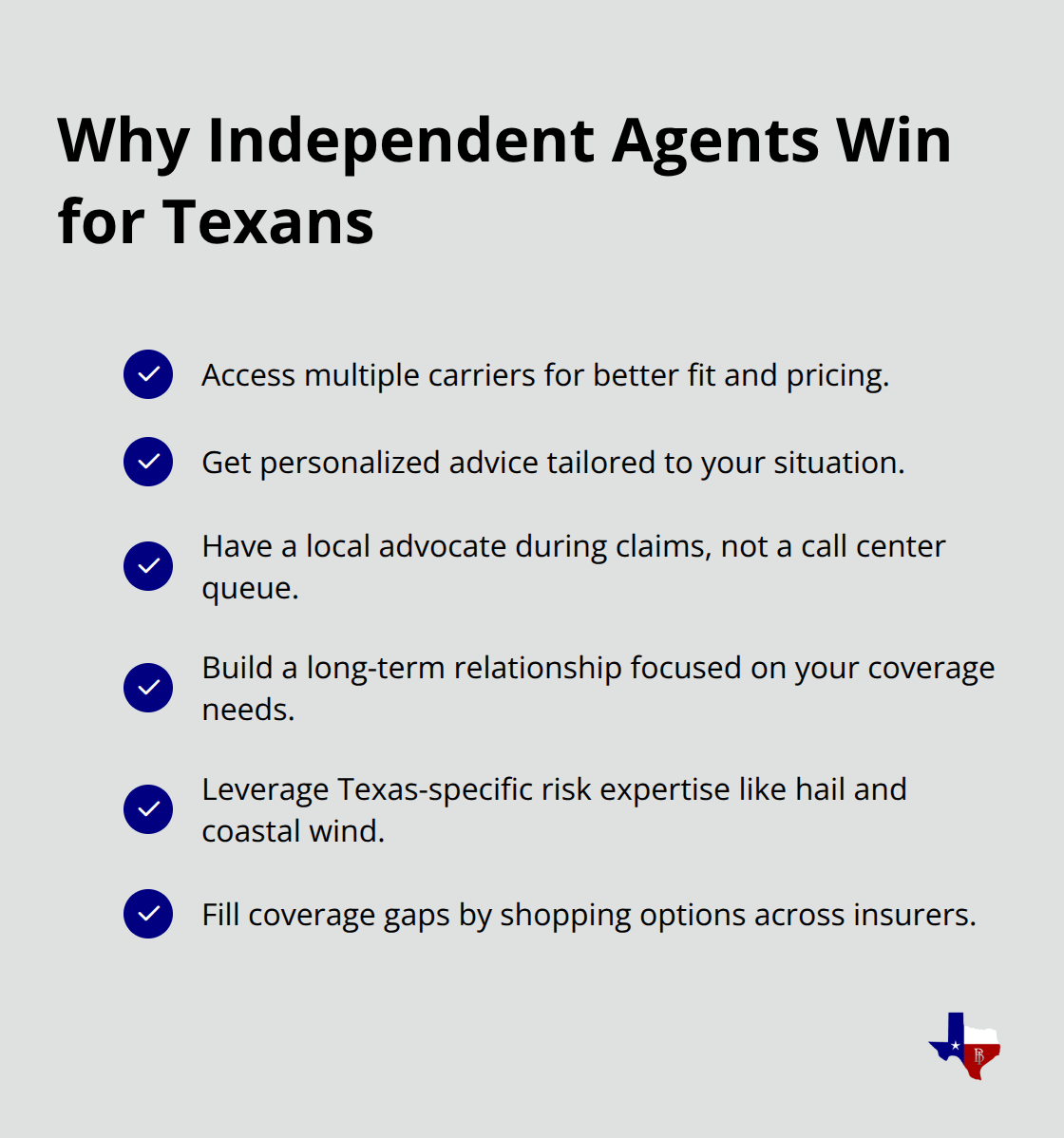
You receive a larger selection of coverage, pricing, and payment options tailored to your actual situation rather than what fits one company’s product line.
How Multiple Carriers Save You Real Money
Texas homeowners and business owners who shop with independent agents typically pay less than those who stick with one insurer. The reason is straightforward: independent agents compare quotes from competing carriers on your behalf, and insurers know they compete directly against each other for your business. When you go direct to a single company or work with a captive agent, that competitive pressure vanishes entirely. Independent agents understand Texas-specific risks like hail damage and coastal wind exposure, so they match you with carriers that actually price for your specific location and risk profile rather than using generic national rates. This local expertise means your quote reflects what you actually need to protect, not what some algorithm thinks Texans in general should pay.
Verification and Local Support Matter
The Texas Department of Insurance Help Line at 800-252-3439 can help you verify that any agent you’re considering holds proper licensing. However, the real advantage of working with an independent agent extends far beyond verification-you gain access to someone who understands your local market and can advocate for your coverage needs across multiple carriers.
Your Agent Stays With You, Not Just Your Policy
Independent agents maintain long-term relationships with their clients because their business depends on serving you well year after year. When you call with a coverage question or file a claim, your independent agent helps you navigate the process, not a phone tree at a national call center. This matters significantly during claims, when you need someone local who understands Texas property values, replacement costs, and how quickly insurers in this market respond. Direct insurers and captive agents have no incentive to maintain that relationship after they sell you a policy, but independent agents know that keeping you as a client for decades builds sustainable businesses.
What Sets Independent Agents Apart
The agent-client relationship in Texas insurance works best when your agent has real skin in the game. Independent agents earn their reputation through consistent service and results, which means they take your coverage seriously and stay accessible when you need them most. This foundation of accountability and local presence shapes how independent agents approach every client interaction-from initial quote through claims resolution and beyond.
Why Independent Agents Beat Direct Insurers on Coverage and Support
Coverage Options That Fit Your Actual Needs
When you buy insurance directly from a company’s website or through their phone line, you accept whatever that single insurer decides to offer. Direct insurers design their products around their own business model, which means coverage options, deductibles, and endorsements fit their priorities, not yours. Independent agents work differently because they represent multiple carriers and customize policies around your actual needs. If one carrier doesn’t offer the flood protection you need for your Houston property or the commercial liability limits your business requires, an independent agent moves to the next carrier in their network. This flexibility matters enormously in Texas, where coastal properties face different risks than inland properties, ranches have different needs than retail businesses, and family situations vary dramatically. Direct insurers offer a take-it-or-leave-it approach that forces you to accept gaps in coverage or pay for protection you don’t need. An independent agent fills those gaps by shopping multiple carriers instead of asking you to compromise.
How Independent Agents Navigate Claims Better Than Direct Insurers
Support during claims reveals the real difference between independent agents and direct insurers. When you file a claim with a direct insurer, you navigate their automated system and speak to representatives who handle hundreds of claims daily and have no relationship with you beyond that transaction. Independent agents maintain ongoing relationships with their clients, which means when you call about a claim, you reach someone who knows your property, understands your coverage, and can advocate for you with the carrier.
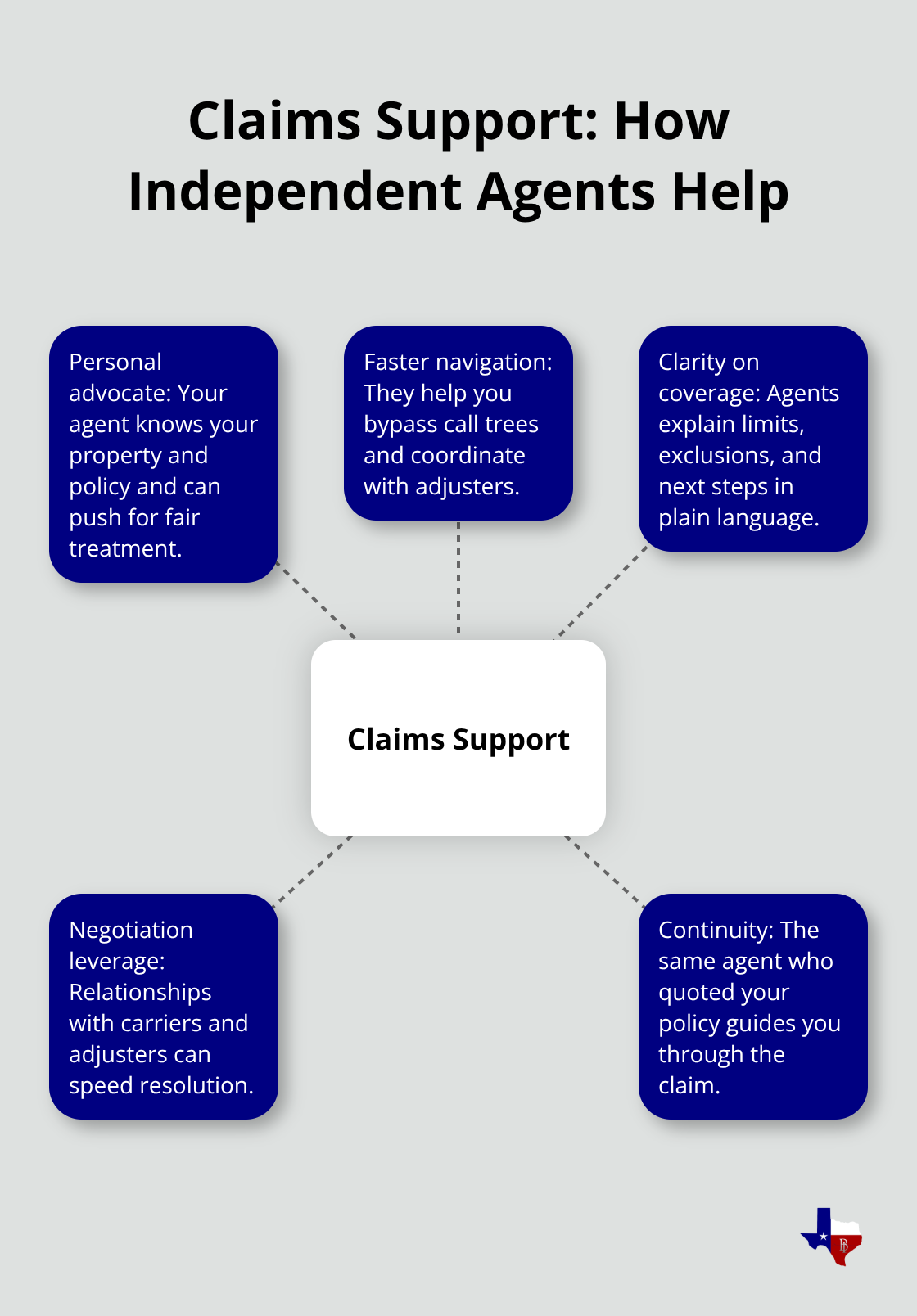
This matters because claims involve negotiations about replacement costs, coverage interpretation, and timeline expectations, and having an agent in your corner who knows both you and the insurer’s practices accelerates resolution.
The Texas Department of Insurance tracks complaint data by carrier and agent. Independent agents with strong track records typically resolve claims faster because they’ve built relationships with adjusters and claims managers over years of business. Direct insurers have no incentive to maintain this service relationship after they collect your premium, so you become just a claim number in their system.
Local Knowledge Shapes Better Coverage Decisions
Independent agents understand Texas-specific risks like hail damage and coastal wind exposure, so they match you with carriers that actually price for your specific location and risk profile rather than using generic national rates. This local expertise means your quote reflects what you actually need to protect, not what some algorithm thinks Texans in general should pay. An independent agent fills coverage gaps by leveraging relationships with multiple carriers, each of which specializes in different risk profiles and geographic areas. When you work with an independent agent, you gain access to someone who understands your local market and can advocate for your coverage needs across multiple carriers.
Finding an Agent Who Stays Committed to Your Coverage
The agent-client relationship in Texas insurance works best when your agent has real skin in the game. Independent agents earn their reputation through consistent service and results, which means they take your coverage seriously and stay accessible when you need them most. This foundation of accountability and local presence shapes how independent agents approach every client interaction, from initial quote through claims resolution and beyond. Your independent agent maintains long-term relationships with clients because their business depends on serving you well year after year. When you need someone local who understands Texas property values, replacement costs, and how quickly insurers in this market respond, your agent delivers that support.
The difference between independent agents and direct insurers becomes clearest when you need more than just a policy-you need someone who advocates for your interests and knows how to navigate the Texas insurance market on your behalf. This foundation of personalized support and local expertise shapes what you should look for when selecting an agent who truly fits your situation.
Finding an Agent You Can Trust
Start with licensing verification through the Texas Department of Insurance at 800-252-3439 or the NAIC Consumer Information Source. This step eliminates agents operating without proper credentials, but it’s only the beginning. Ask potential agents about their professional designations like CIC (Certified Insurance Counselor), CISR (Certified Insurance Service Representative), or CSRM (Certified Specialist in Risk Management). These credentials require ongoing education and demonstrate commitment to staying current with Texas insurance law and coverage standards. An agent with these designations has invested time and money into professional development, which signals they take client service seriously.
Assess Carrier Access and Texas Experience
Contact independent agents and ask how many carriers they represent across personal and commercial lines. Agents representing 15 or fewer carriers may lack the breadth to find truly competitive options for your specific situation. Those with access to 25 or more carriers can compare pricing and coverage across a wider range of options, which matters significantly when you have specific needs like flood protection in coastal areas or specialized commercial liability coverage. Request the agent’s experience specifically in Texas rather than their national tenure. An agent with 8 years in Texas markets understands local claim patterns, regional insurer preferences, and how different carriers price for Houston hail risk or San Antonio wildfire exposure better than someone with 20 years of national experience but only 2 years in your state.
Check Real Complaint Data and Resolution Patterns
The Texas Department of Insurance complaint ratios tell you how many complaints an agent or company receives relative to their market share. Higher complaint ratios indicate service problems or coverage misunderstandings that should raise red flags. The Better Business Bureau also tracks complaint patterns, though price-related complaints often reveal nothing about agent quality. Instead, focus on complaints about claim handling, coverage explanations, or responsiveness.
Read online reviews on Google, Trustpilot, and industry-specific platforms, but weight recent reviews more heavily than older ones since agent service quality can improve or decline over time. Look specifically for reviews mentioning claims support, quote accuracy, and how quickly the agent responded to questions. An agent with 50 reviews averaging 4.7 stars likely delivers more consistent service than one with 12 reviews and 5 stars, since larger sample sizes show real patterns rather than outliers.
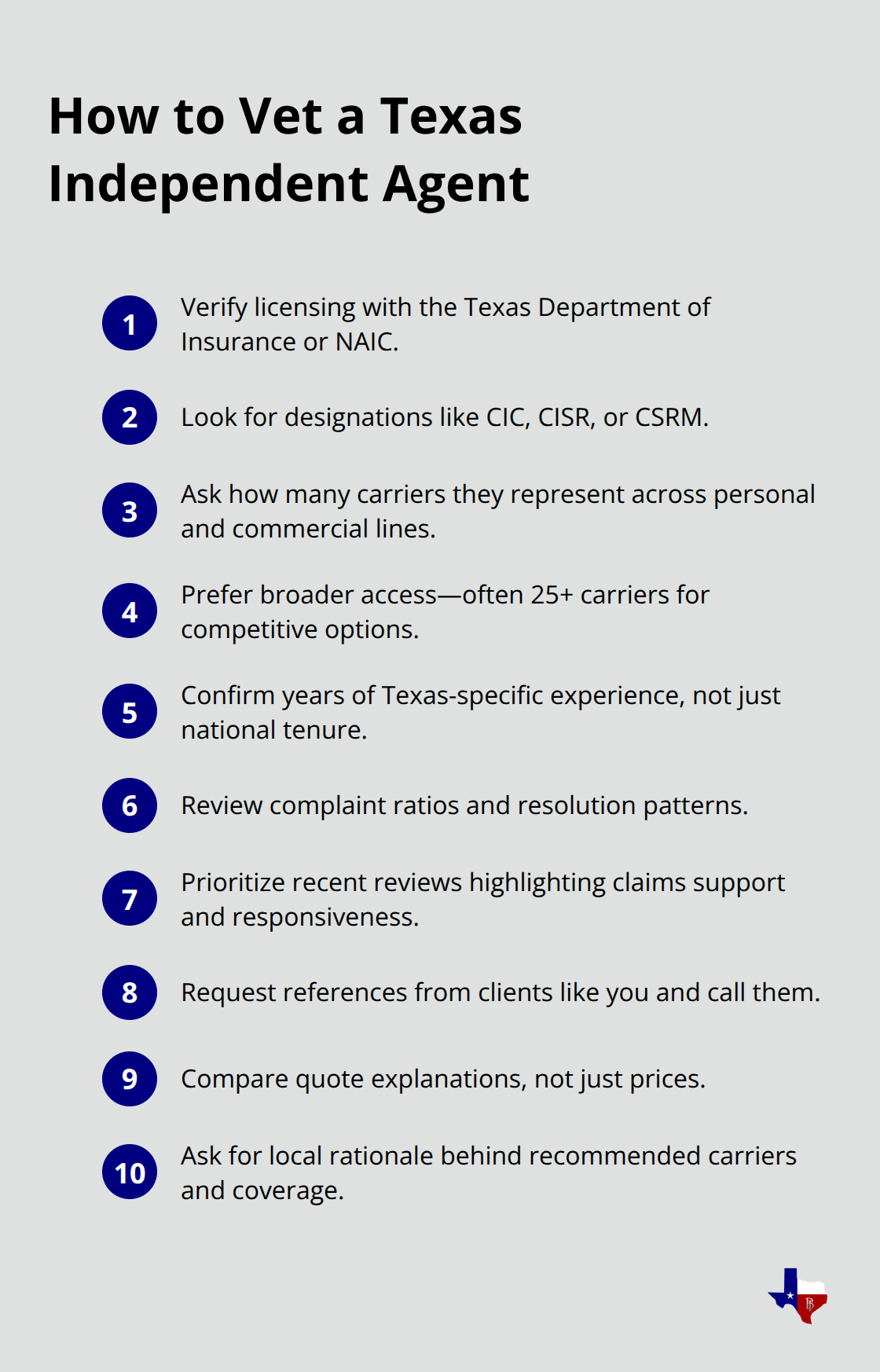
Ask prospective agents to provide references from clients in your situation, whether that’s homeowners in your neighborhood, ranch owners, or business owners in your industry. Speaking directly to current clients reveals how the agent actually handles policy changes, claims, and questions over time. This step takes more effort than reading reviews, but it provides the clearest picture of what working with that agent actually looks like.
Evaluate How an Agent Communicates About Coverage
Contact three or four independent agents in your area and request quotes for your specific situation. Provide identical information to each agent and pay attention to how they explain the quotes and coverage options. An agent who merely quotes a price without explaining deductible trade-offs, coverage limits, or exclusions isn’t serving your interests. An agent who asks clarifying questions about your situation before quoting demonstrates they understand that coverage needs vary dramatically.
When comparing quotes, look for agents who highlight differences in coverage between carriers, not just price differences. If one quote is significantly lower than others, ask the agent to explain what coverage gaps might exist. Agents willing to have that conversation show they prioritize your protection over the commission. Agents who push you toward the cheapest option without discussing trade-offs are prioritizing their sale over your actual needs.
Look for Local Knowledge in Agent Recommendations
An agent should explain why they recommend specific carriers and coverage levels for your Texas location and risk profile. This recommendation should reflect local knowledge about coastal wind exposure, hail damage patterns in your area, or commercial liability gaps common in your industry. An agent who provides this context demonstrates they’ve thought through your situation rather than running a generic quote engine. The agent’s willingness to discuss these specifics (rather than simply presenting the lowest price) separates those who truly understand Texas insurance from those who simply process applications.
Final Thoughts
Independent agents in Texas deliver what direct insurers cannot: access to multiple carriers, personalized service tailored to your actual needs, and someone who stays committed to your coverage long after the sale closes. An independent agent comparison in Texas reveals that working with an agent who represents dozens of carriers beats accepting whatever one company decides to offer. You gain flexibility in coverage options, real support during claims, and pricing that reflects actual competition rather than a single insurer’s margins.
Finding the right agent requires more than checking a license through the Texas Department of Insurance at 800-252-3439. Assess how many carriers an agent represents, read recent reviews that specifically mention claims support and responsiveness, and request quotes from multiple agents to see which ones explain coverage trade-offs rather than simply pushing the lowest price. Ask for references from clients in your situation and speak directly with them about their experience over time-an agent who asks clarifying questions about your specific needs before quoting demonstrates they understand that coverage requirements vary dramatically across Texas properties and businesses.
The agent you select becomes your advocate in the Texas insurance market, someone who navigates claims on your behalf and adjusts your coverage as your situation changes. Contact Brooks Insurance to discuss your insurance needs with an agent who understands Texas risks and remains committed to your protection.
Disclaimer: The information provided in this blog is for general informational purposes only and does not constitute legal, financial, or insurance advice. Coverage options, terms, and availability may vary. Please consult with a licensed professional for advice specific to your situation