
A Texas general liability policy is one of the most important investments your business can make. Without it, a single accident or lawsuit could drain your finances and threaten your operations.
At Brooks Insurance, we’ve helped countless Texas business owners understand what coverage they actually need. This guide walks you through the protections available, why they matter for your specific situation, and how to select the right limits for your company.
What Your General Liability Policy Actually Protects
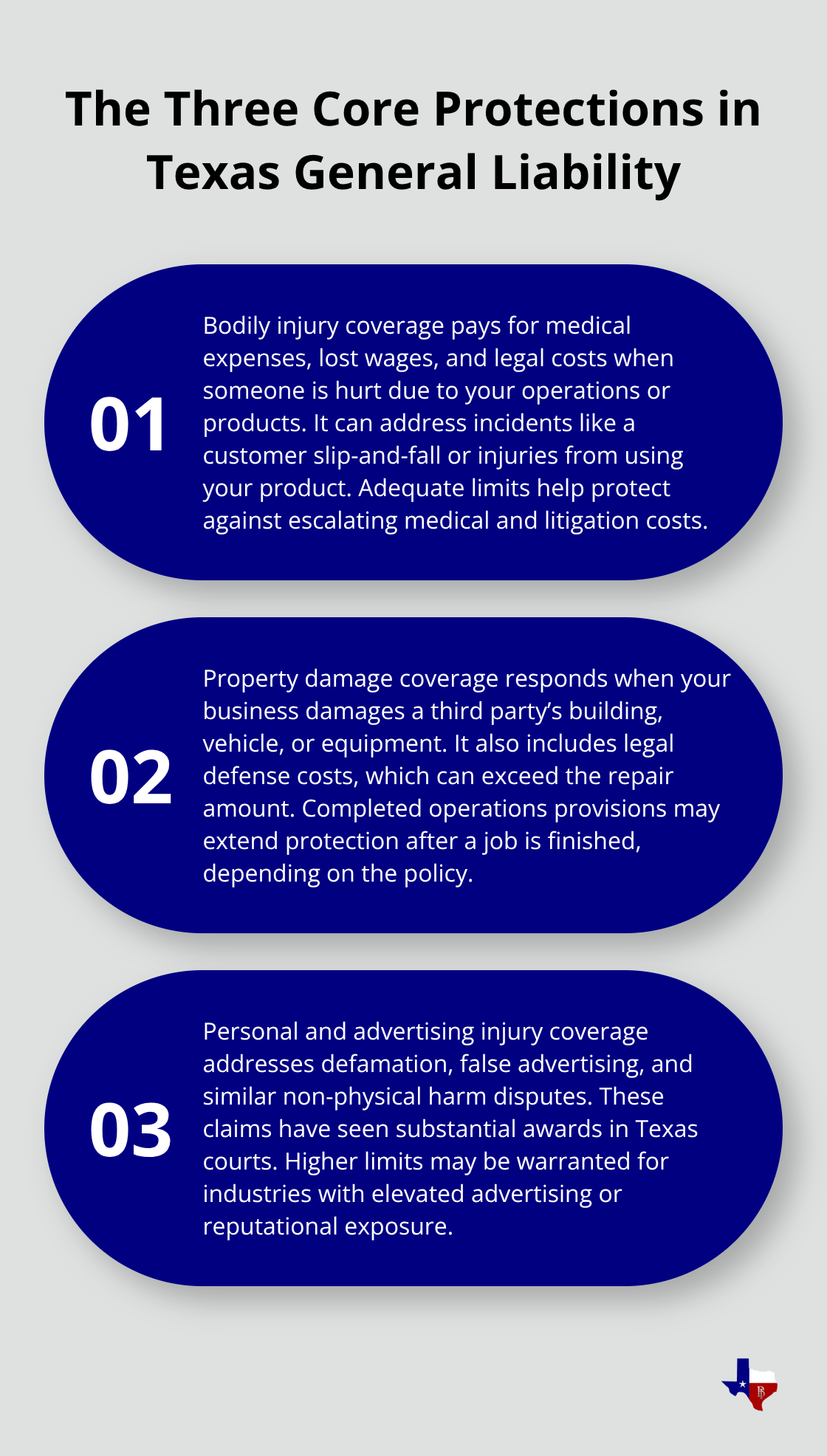
General liability insurance covers three major categories of claims that can cripple your Texas business if left uninsured. The first is bodily injury, which pays medical expenses, lost wages, and legal costs when someone suffers an injury because of your business operations or products. If a customer slips on your premises or gets hurt using your product, your policy covers their medical bills and any lawsuit that follows. The second category is property damage, which handles claims when your business damages someone else’s property, whether that’s a client’s vehicle, their building, or their equipment. The third is personal and advertising injury, covering defamation claims, false advertising, and similar disputes that don’t involve physical harm. Courts in Texas have awarded substantial damages in these cases, so adequate coverage limits matter more than ever.
Medical Expenses and Bodily Injury Claims
Your general liability policy typically covers medical payments for injured third parties without requiring them to prove fault, which is a critical distinction. This means if someone gets hurt on your property or because of your work, your insurer pays their immediate medical costs, and this often prevents lawsuits from escalating. CBIZ reported in February 2025 that rising litigation costs fueled by third-party litigation funding and aggressive attorney advertising have pushed claim costs higher, making fast medical payment settlements increasingly valuable. Nuclear verdicts exceeding $10 million have become more common, particularly in construction, hospitality, and service industries across Texas. Your policy limits should reflect your actual risk; a small retail business might carry one million dollars in coverage, while contractors and manufacturers typically need two to five million dollars depending on project scope and injury potential.
Property Damage and Legal Defense
Property damage coverage protects your business when you accidentally damage a client’s or third party’s property, and this includes legal defense costs even if the claim is groundless. Texas courts have seen sharp increases in property damage claims related to work quality and completed operations, making this coverage essential for service businesses and contractors. Your insurer pays for repairs or replacement of damaged property and covers attorney fees, investigator costs, and court expenses, which can exceed the property damage amount itself. Many Texas businesses underestimate their property damage exposure because they assume their work won’t cause problems after completion, but completed operations coverage extends protection for years after you finish a job in some policies. This is why you should review your policy’s completed operations section with your agent-gaps here can leave expensive claims uninsured.
Product Liability and Advertising Injury Protection
If your business manufactures, distributes, or sells products, your general liability policy should include product liability coverage that protects against injury or property damage caused by those products. This coverage applies even after the product leaves your control, which is why it extends beyond your immediate operations. Advertising injury coverage handles claims that your marketing materials defamed someone, violated their privacy rights, or infringed on intellectual property, and these claims have grown as digital marketing expands. The Insurance Services Office updated general liability exclusions in recent years to address biometric data privacy risks, so if your business collects fingerprints, facial recognition data, or similar information, your policy may have limitations or require special endorsements. Standard policies don’t cover damage to your own work, contractual liability you’ve assumed, or product recalls unless you add those endorsements specifically.
What Your Policy Excludes Matters
Understanding what your policy excludes is just as important as knowing what it covers. Most standard general liability policies contain gaps that leave your business exposed to significant financial risk. Your agent can help you identify these gaps and recommend endorsements that fill them, transforming a basic policy into one that truly matches your operations and risk profile.
Why Your Texas Business Needs General Liability Coverage
General liability insurance isn’t optional for Texas businesses-it’s the foundation that separates those who survive a lawsuit from those who don’t. Without it, a single slip-and-fall claim or property damage incident can force you to pay thousands or even millions out of pocket, potentially bankrupting your company. Texas courts award substantial damages in third-party injury cases, and nuclear verdicts exceeding $10 million have become increasingly common, particularly in construction, hospitality, and service industries across the state. The reality is that most Texas business owners face genuine legal exposure regardless of industry or company size.
Legal Exposure Hits Every Texas Business
If someone gets injured on your premises, uses your product and suffers harm, or your work damages their property, they can sue you personally and your business. General liability coverage shifts that financial risk to your insurer, meaning they pay defense costs, settlements, and judgments up to your policy limits rather than your personal assets. This protection applies whether the injury occurs at your location, at a client’s site, or somewhere else entirely.
Defense Costs Add Up Fast
The cost of defending a lawsuit alone justifies having this coverage. Even if you win a case and the claim is found groundless, your insurer covers all attorney fees, court costs, and investigator expenses-expenses that frequently exceed $50,000 before trial even begins.
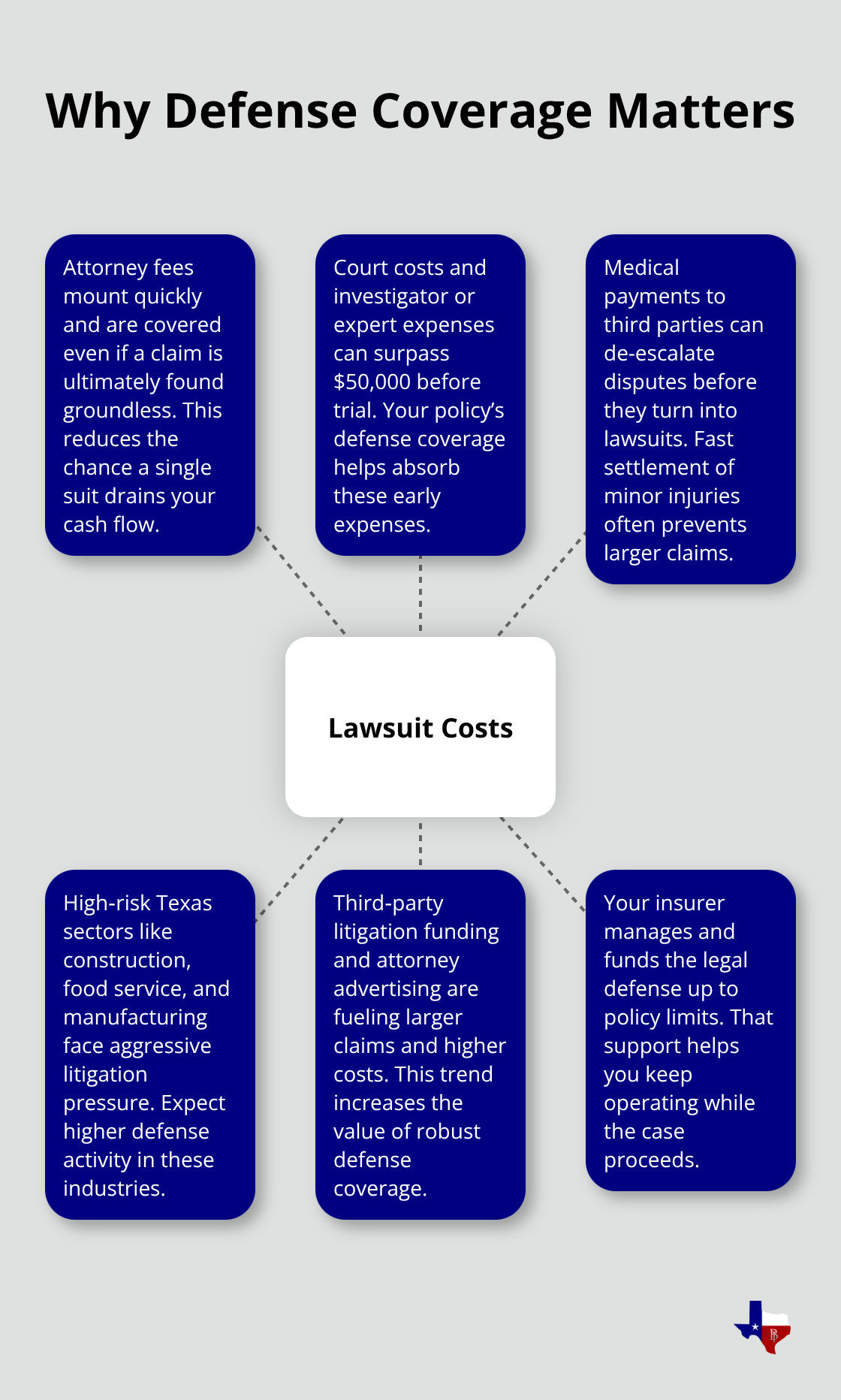
Texas businesses in high-risk sectors like construction, food service, and manufacturing face particularly aggressive litigation pressure driven by third-party litigation funding and attorney advertising campaigns. Your general liability policy also covers medical expenses for injured third parties without requiring them to prove your fault, which often prevents minor incidents from escalating into expensive lawsuits.
Setting Coverage Limits That Match Your Risk
Many Texas contractors and service providers discover too late that their coverage limits are inadequate for their actual risk exposure, leaving them personally liable for damages exceeding their policy limits. The solution is straightforward: work with an experienced agent to assess your specific industry risks, review comparable claims in your sector, and set coverage limits that reflect your actual exposure rather than guessing at a round number. Your agent can help you understand what limits competitors in your field carry and what Texas courts typically award in cases similar to your business operations.
Understanding your exposure is only the first step-the next critical decision involves selecting the right policy limits and comparing options from multiple insurers to find coverage that truly protects your business.
How to Choose the Right General Liability Policy
Match Your Coverage Limits to Your Industry Risk
Your industry determines your baseline exposure, and Texas businesses in different sectors face dramatically different claim frequencies and severity. Construction contractors regularly handle property damage claims exceeding one million dollars, while a small consulting firm might never face claims above $250,000. CBIZ reported in February 2025 that high-risk sectors including construction, affordable housing, and hospitality continue to face elevated rate pressure and underwriting scrutiny, signaling that insurers expect larger claims in these fields. Start by researching what comparable businesses in your exact industry typically carry. If you run a roofing company, contact three other roofing contractors and ask what limits they maintain. If you operate a salon, speak with salon owners about their coverage. This conversation reveals what the market actually expects and what courts in Texas typically award when claims arise in your sector. Your agent can also pull loss runs showing what claims have actually occurred in your industry over the past five years, providing concrete data rather than guesses.
Account for Project Size and Business Growth
Your business growth and project scope directly impact your limits. A contractor handling a $50,000 kitchen remodel needs different coverage than one managing a $2 million commercial build-out. Nuclear verdicts exceeding $10 million have become increasingly common in Texas, particularly in construction and service industries, meaning your limits must account for worst-case scenarios rather than average claims. Review your largest contracts and projects, then set your bodily injury and property damage limits high enough to cover potential exposure from those specific engagements. Many Texas businesses carry one million dollars per occurrence and two million dollars aggregate as a baseline, but contractors, manufacturers, and service providers should seriously consider two to five million dollars depending on project scale (your agent can help you assess the right amount for your specific operations). If your limits fall below what competitors carry or what your largest projects justify, you face personal liability for any damages exceeding your policy limits.
Compare Quotes with Identical Coverage Terms
When comparing quotes from different insurers, verify that you are actually comparing identical coverage limits, deductibles, and exclusions. A quote for $800 annually at one million dollars coverage is meaningless if you compare it to a $1,200 quote at three million dollars coverage.
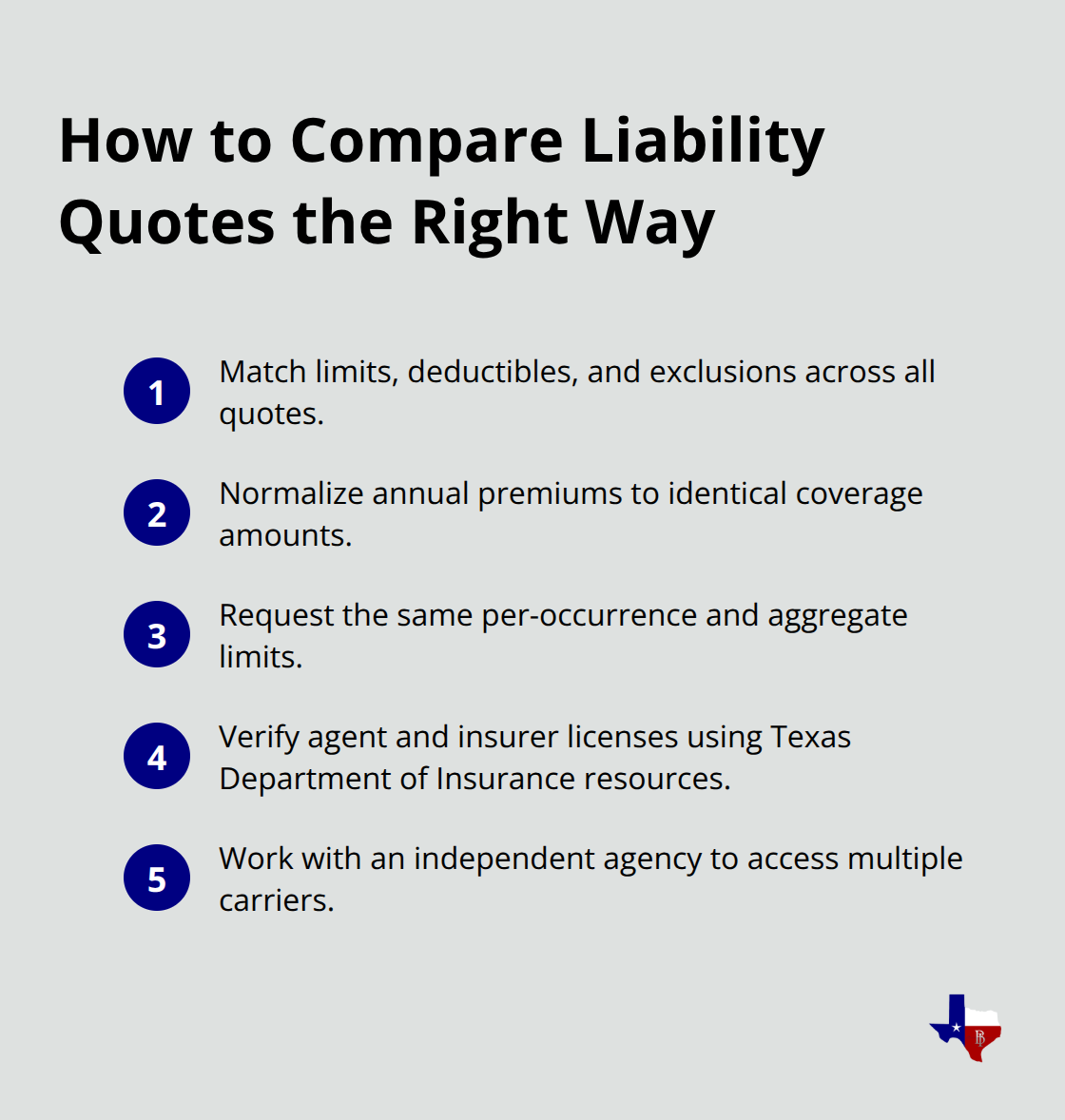
Request quotes with the same limits across all insurers so you can accurately identify which company offers the best rate for your actual risk profile. Texas Department of Insurance resources can help you verify that agents and insurers are properly licensed before you commit to any policy. An independent agency represents multiple top-rated insurance companies, which means you have a larger selection of coverage, pricing, and payment options when you shop for your policy.
Final Thoughts
A Texas general liability policy stands between your business and financial ruin. The protections we’ve outlined-bodily injury coverage, property damage defense, and advertising injury protection-form the foundation that allows you to operate without fear that a single accident will destroy everything you’ve built. Texas courts award substantial damages in third-party claims, and the litigation environment continues to grow more aggressive, making adequate coverage essential for any business owner.
Review your current coverage limits against your industry’s actual risk exposure today. If you’re uncertain whether your limits match your operations, that uncertainty signals you need professional guidance to assess your specific exposure and compare options from multiple insurers. Many Texas business owners carry inadequate coverage simply because they never evaluated their actual risk or explored what competitors in their field maintain.
At Brooks Insurance, we’ve spent over 50 years helping Texas business owners secure the right protection at the right price. Our licensed agents understand Texas business risks and can help you identify gaps in your current policy, recommend appropriate coverage limits for your industry, and find quotes that actually protect your operations. Contact Brooks Insurance today to discuss your general liability needs and receive personalized guidance for your specific business situation.
Disclaimer: The information provided in this blog is for general informational purposes only and does not constitute legal, financial, or insurance advice. Coverage options, terms, and availability may vary. Please consult with a licensed professional for advice specific to your situation