
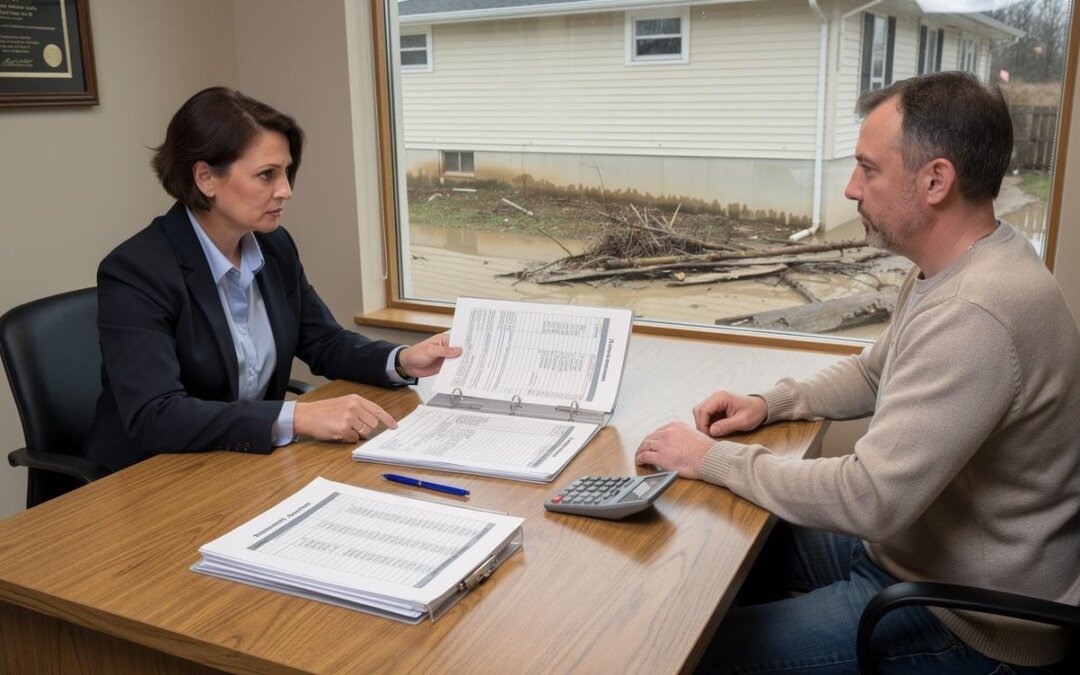
Flooding is the most common natural disaster in Texas, yet most homeowners remain dangerously underinsured. Standard homeowners policies simply don’t cover flood damage, leaving thousands of Texans vulnerable to devastating financial losses.
At Brooks Insurance, we help homeowners navigate Texas flood policy options and find coverage that actually protects their homes. This guide walks you through your choices so you can make an informed decision.
Why Your Homeowners Policy Leaves You Exposed to Flood Damage
Standard Policies Exclude Flood Damage Entirely
Standard homeowners insurance policies exclude flood damage entirely. Your coverage stops the moment water rises. This isn’t an oversight or a gap you can negotiate around-it’s a deliberate underwriting decision made by insurers across the industry. Flood damage comes from rising water, storm surge, heavy rainfall that overwhelms drainage systems, and overflowing rivers. These events fall outside the scope of standard homeowner protection, which covers wind, fire, theft, and weather-related incidents like hail.
Who Gets Hit Hardest by Flood Claims
FEMA data reveals that nearly one in three flood claims come from properties outside high-risk zones. This means homeowners in moderate and low-risk areas often assume they don’t need coverage, then face catastrophic losses when a flood occurs anyway. The financial impact is staggering: a single flood event can cost $30,000 to $100,000 or more in structural damage, depending on water depth and duration. Most homeowners lack the savings to absorb these costs, and their mortgage lenders won’t forgive the debt just because insurance didn’t cover the damage.

Texas Flooding Extends Far Beyond Coastal Areas
Texas experiences flooding across virtually every region, not just coastal areas prone to hurricanes. The 2025 Hill Country floods demonstrated that inland communities far from the Gulf face serious risk, while southeastern Texas remains vulnerable to storm surge and tropical systems. NFIP statistics show the median Texas flood insurance premium sits around $779 per year, but your actual cost depends on your property’s elevation relative to base flood elevation, home age and construction materials, coverage limits, and deductible choices.
How Elevation Affects Your Premium and Protection
If your home sits below the base flood elevation for your area, premiums climb significantly. An elevation certificate-a document measuring your building’s height relative to expected flood levels-can lower your premium by demonstrating lower risk. Without flood insurance, a single weather event wipes out years of equity in your home. With coverage, you pay a manageable annual premium and transfer that catastrophic risk to an insurer.
Coverage Limits Determine Your Financial Recovery
The choice between NFIP policies, which cap dwelling coverage at $250,000, and private flood insurance, which often offers $1 million or higher limits, depends entirely on your home’s value and what you need to replace if flooding occurs. Understanding these two main options helps you select the right protection for your situation.
Your Two Main Flood Insurance Paths in Texas
Understanding NFIP Coverage and Limitations
Texas offers two fundamentally different approaches to flood coverage, and your choice depends on your home’s value, risk level, and how quickly you need protection. The National Flood Insurance Program provides a government-backed baseline with consistent pricing across the state, while private flood insurers compete on coverage limits, deductibles, and speed of activation.
The National Flood Insurance Program caps dwelling coverage at $250,000 and contents at $100,000, with a standard 30-day waiting period before coverage activates. NFIP policies apply depreciation to personal belongings, meaning if your five-year-old furniture floods, you receive the depreciated value rather than replacement cost. The median Texas NFIP premium runs around $779 annually, though your actual cost reflects your elevation certificate data, home age, construction materials, and chosen deductible.

NFIP serves homeowners who need affordable baseline coverage or those with federally backed mortgages in high-risk zones, where lenders require flood insurance. However, if your home exceeds $250,000 in dwelling value or you want higher contents limits, NFIP alone leaves you underinsured.
Why Private Flood Insurance Offers More Flexibility
Private flood insurance operates differently and typically offers higher building limits exceeding $1 million, replacement-cost payouts for personal belongings instead of depreciated values, and loss-of-use coverage for temporary housing during repairs. Private carriers vary their waiting periods, with some offering faster activation than NFIP’s standard 30 days-a critical advantage if you need immediate protection before storm season arrives.
Premiums compete more aggressively in private markets, and an elevation certificate showing your home sits well above base flood elevation can produce significant savings with private insurers. The trade-off is complexity: private policies vary by carrier, requiring careful comparison of deductible options, coverage exclusions, and claim procedures.
Comparing Your Options Side by Side
Your elevation certificate becomes your most valuable tool when shopping for private coverage. This document measures your building’s height relative to expected flood levels and directly influences what you pay. A home that sits substantially above base flood elevation qualifies for lower rates with private carriers, while a property near or below that threshold faces higher premiums across both NFIP and private options.
The decision between NFIP and private coverage ultimately hinges on three factors: your home’s replacement value, the speed at which you need protection, and whether replacement-cost coverage for belongings matters to your financial recovery plan. As an independent agency, we represent multiple top-rated insurance companies, which means you have a larger selection of coverage, pricing, and payment options to compare. Your next step involves assessing your property’s specific flood risk level and gathering quotes that reflect your actual situation.
Selecting the Right Coverage for Your Home
Obtain Your Elevation Certificate First
Start with your elevation certificate before you gather any quotes. This document costs between $75 and $300 and measures your home’s height relative to base flood elevation, directly determining what you’ll pay for flood insurance. Without it, insurers estimate your elevation, which often results in higher premiums than necessary. Contact your local flood plain administrator or a surveyor to request one, then use that data when shopping for coverage.

Homeowners who skip this step routinely overpay by hundreds of dollars annually. Your elevation certificate also reveals whether your property sits substantially above base flood elevation, which opens access to lower rates with private insurers who reward minimal risk. Once you have this document, you’re equipped to compare quotes accurately across both NFIP and private carriers.
Gather Multiple Quotes and Compare Key Details
Collect at least three quotes to understand your market options, comparing dwelling limits, contents coverage, deductibles, and loss-of-use protection. NFIP quotes run straightforward since pricing follows federal formulas based on zone, elevation, and home characteristics, but private quotes vary significantly by carrier. A property with an elevation certificate showing 4 feet above base flood elevation might qualify for substantially lower premiums with private insurers than a similar home without that documentation.
Request quotes with multiple deductible options, typically ranging from $500 to $5,000, since higher deductibles reduce your annual premium but increase what you pay when filing a claim. A homeowner with $10,000 in savings might choose a $1,000 deductible to keep premiums manageable, while someone with greater financial cushion might select $5,000 to reduce annual costs. This calculation depends entirely on your household’s ability to cover out-of-pocket expenses immediately after a flood occurs.
Evaluate Coverage Limits Against Your Home’s Value
Coverage limits matter more than most homeowners realize. NFIP dwelling coverage limits cap at $250,000 for homes and $100,000 for personal property, leaving homeowners with properties exceeding those values significantly underinsured. If your home’s replacement value reaches $350,000, NFIP leaves you $100,000 short on dwelling coverage alone. Private flood insurance solves this problem by offering limits exceeding $1 million, protecting your full equity.
Contents coverage presents another critical distinction: NFIP applies depreciation to personal belongings, meaning a ten-year-old kitchen destroyed by flooding receives replacement cost minus ten years of wear, while private policies often pay replacement cost without depreciation. This difference amounts to thousands of dollars when flooding destroys furniture, appliances, and household goods.
Consider Loss-of-Use Coverage and Activation Speed
Loss-of-use coverage reimburses temporary housing expenses during repairs, a feature that appears in many private policies but not in standard NFIP coverage. A homeowner facing three months of repairs might spend $15,000 renting temporary housing, a cost that loss-of-use coverage addresses directly. Compare activation periods carefully: NFIP enforces a standard 30-day waiting period before coverage begins (except for lender-required purchases and FEMA map changes), while private carriers vary their waiting periods from immediate to 30 days.
If you’re shopping before storm season and need protection quickly, private policies with shorter waiting periods provide faster peace of mind. Your decision ultimately requires balancing three competing priorities: annual premium cost, coverage limits relative to your home’s value, and speed of activation. Properties in moderate-risk areas often find private flood insurance worth the higher premium because replacement-cost contents coverage and higher dwelling limits provide substantially better financial protection than NFIP’s capped benefits. Properties in very low-risk zones with modest values might find NFIP’s lower premiums adequate. The only way to know which option suits your situation is comparing actual quotes with your elevation certificate data in hand.
Final Thoughts
Selecting the right flood coverage requires three concrete actions: obtain your elevation certificate, gather quotes from multiple carriers, and compare coverage limits against your home’s actual replacement value. Your elevation certificate transforms the quoting process from guesswork into precision, directly lowering premiums with private insurers and helping you pay fairly across both NFIP and private options. Without this document, you overpay for protection you don’t fully understand.
Texas flood policy options break down into two paths, and neither is universally superior. NFIP provides affordable baseline coverage with consistent federal pricing, making it ideal for homeowners with modest property values or those required by lenders to carry flood insurance, while private flood insurance delivers higher limits, replacement-cost contents coverage, and faster activation periods for homes exceeding $250,000 in value. The only way to determine which option fits your situation is comparing actual quotes side by side.
Contact Brooks Insurance to request quotes that reflect your elevation certificate data and your home’s actual replacement value, and we’ll walk you through your options without pushing you toward any single product. Flood season arrives every year, and waiting until storm warnings appear leaves you scrambling for coverage with limited options. Act now while you have time to evaluate your choices carefully.
Disclaimer: The information provided in this blog is for general informational purposes only and does not constitute legal, financial, or insurance advice. Coverage options, terms, and availability may vary. Please consult with a licensed professional for advice specific to your situation