

One lawsuit can drain your business savings fast. At Brooks Insurance, we see small business owners underestimate their liability exposure every day.
Small business general liability insurance protects you when customers get hurt on your property or your work damages their belongings. Without the right coverage limits, a single claim could force you to close your doors.
What General Liability Actually Protects
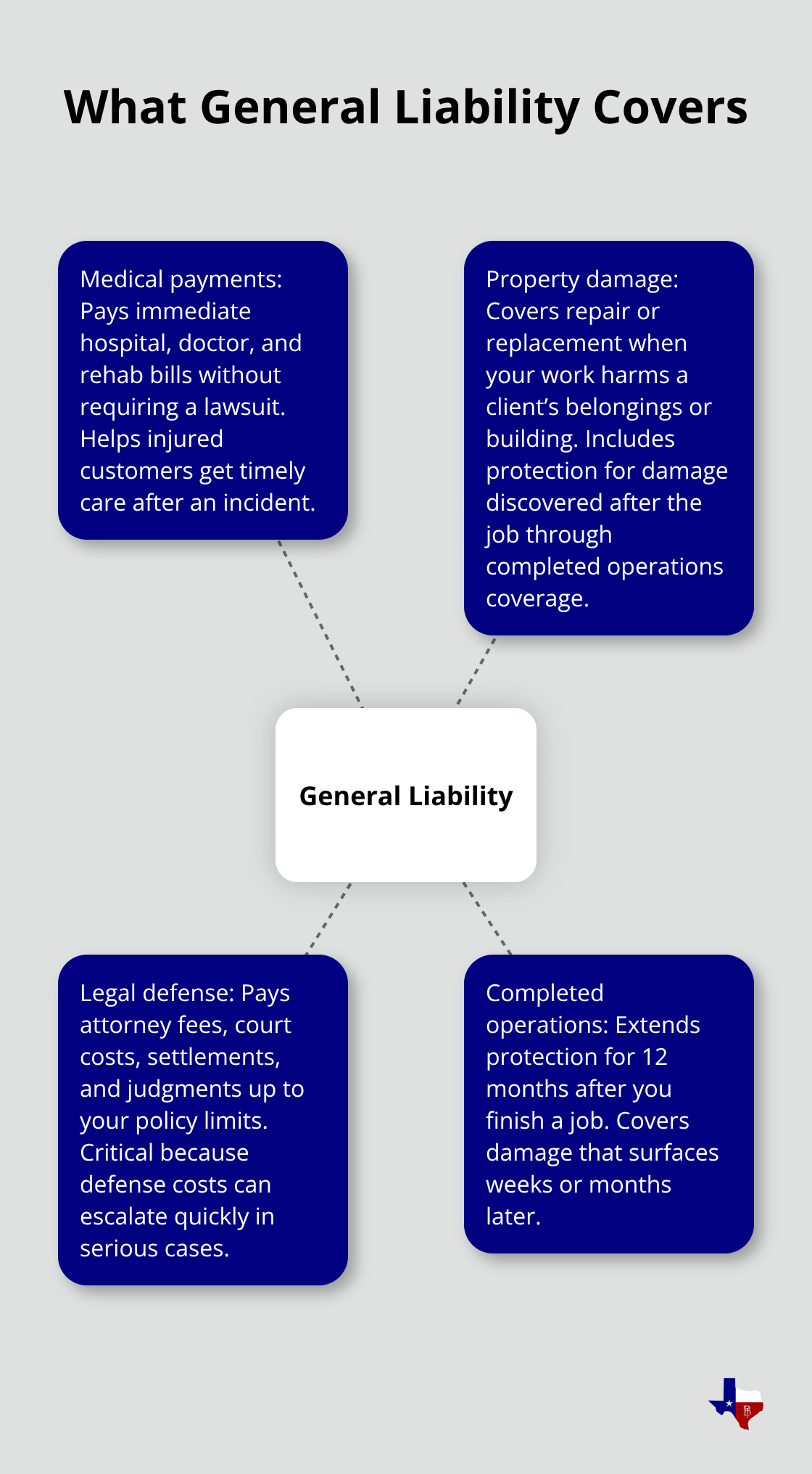
General liability insurance covers three distinct areas that hit small business owners hardest: medical bills when someone gets hurt, repair costs when your work damages property, and your legal fees when customers sue. Most Texas small business owners misunderstand what their policy actually pays for, which leads them to carry either too little coverage or the wrong type entirely. When a customer slips on your wet floor and breaks their arm, general liability helps pay for medical costs and legal fees, protecting you from premises liability claims. If that same customer sues you for lost wages and pain and suffering, the policy covers your attorney fees, court costs, and any settlement or judgment up to your per-occurrence limit, commonly $1 million. This legal defense component matters because defense costs alone in a serious injury case can reach $50,000 to $100,000 before trial even begins.
Medical Bills and Legal Defense
Your policy pays two separate things when a customer gets hurt. First, medical payments coverage handles immediate hospital bills, doctor visits, and rehabilitation costs without requiring the injured person to file a lawsuit. Second, liability coverage kicks in if the customer sues you, covering your attorney fees and any judgment or settlement. This distinction matters because many small business owners think one payment covers both situations. The medical payments portion typically ranges from $50,000 to $100,000 per incident, while your liability limit (often $1 million per occurrence) protects you from larger lawsuits. A customer who trips at your business and breaks their leg receives immediate medical coverage, but if they later sue for lost wages and pain and suffering, your liability coverage handles the legal battle.
When Your Work Damages Client Property
Property damage coverage activates when your business operations harm someone else’s belongings or building. A landscaper damages a client’s irrigation system, a contractor’s equipment punctures a roof, or a plumber’s tools scratch expensive flooring-all fall under this coverage. The policy pays for repairs or replacement without forcing you to pull money from your operating account. Completed operations coverage extends this protection for 12 months after you finish a job, meaning if your work causes damage weeks or months later, you remain covered. This matters because many claims arise not during the work itself but after the customer discovers hidden damage.
Products Liability Protection
Products liability, included in most general liability policies, protects you if something you sold or gave to a customer causes injury or property damage. A salon product causes a client’s allergic reaction, food from your catering event makes guests sick, or a retail item breaks and injures someone-the policy responds to these claims too. This coverage applies whether you manufactured the product yourself or simply sold it to the customer. Your policy covers medical expenses, property damage, and legal defense costs related to product claims. Understanding this protection matters because many business owners don’t realize their general liability extends beyond services they provide to products they sell.
What Really Causes Claims for Texas Small Businesses
Slip and Fall Incidents Lead the Claim List
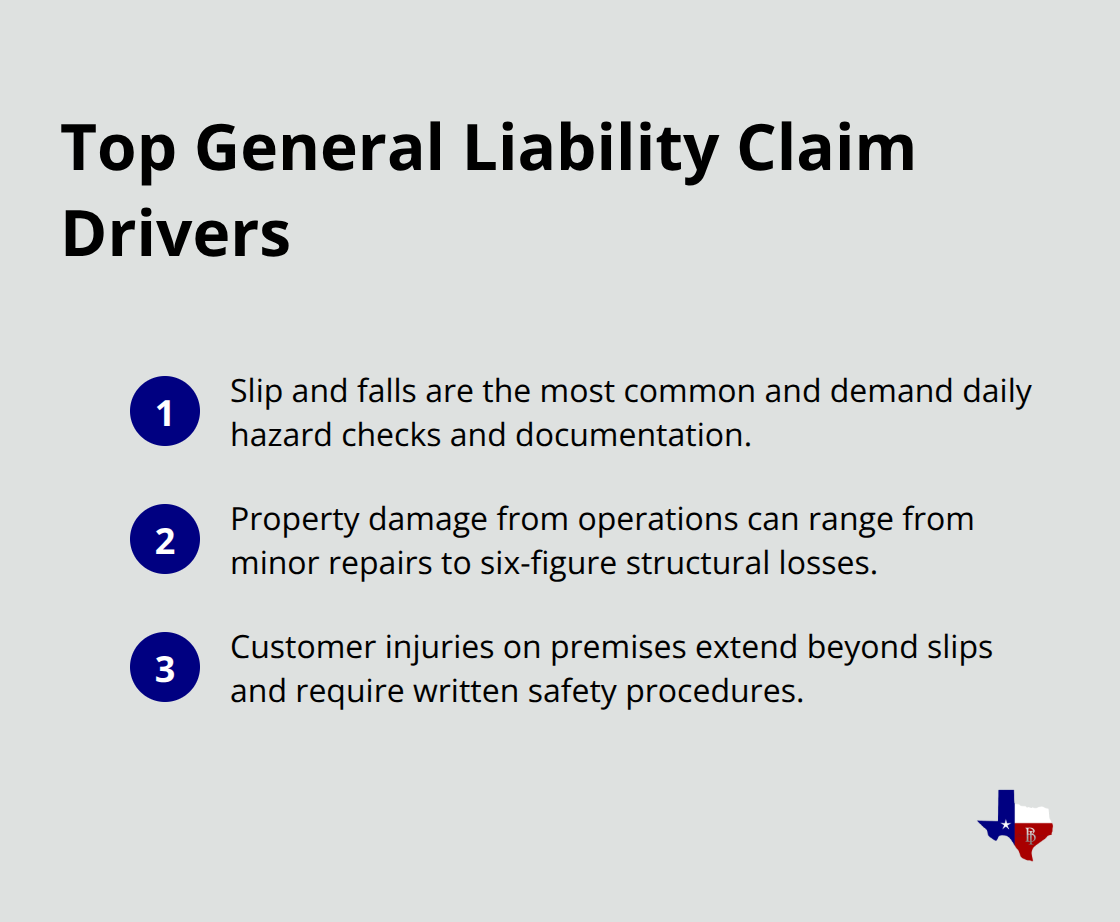
Slip and fall incidents top the list of general liability claims, and they happen in ways business owners never anticipate. A customer steps on a wet floor at your retail shop, trips on uneven pavement outside your office, or slips on ice during winter weather-these common scenarios generate significant liability exposure. Your general liability policy covers the immediate medical expenses and any lawsuit that follows, but prevention starts with documented maintenance.
Walk your property daily and fix hazards immediately. Post warning signs for wet floors, maintain landscaping to prevent trip hazards, and photograph conditions regularly. Keep records showing when you addressed problems. Texas businesses in high-traffic areas face elevated slip and fall risk because more foot traffic means more exposure. If you operate a restaurant, retail store, salon, or gym, this exposure demands serious attention-these industries generate slip and fall claims at rates two to three times higher than office-based businesses.
Property Damage from Your Operations
Property damage from your operations creates a second major claim category that catches many business owners off guard. Contractors accidentally damage client properties during renovation work, landscapers hit underground utilities with equipment, plumbers crack tiles while installing fixtures, and HVAC technicians dent expensive customer belongings. These claims range from $5,000 for minor damage to $100,000+ for structural harm or destroyed systems.
Your completed operations coverage protects you for 12 months after finishing work, which matters because damage often surfaces weeks later when customers discover cracks, leaks, or system failures. Document every job with photos before and after work completion. Create detailed scope-of-work agreements that specify what you will and won’t be responsible for, and require customers to sign acknowledgments of existing conditions. General contractors in Texas average 15 to 20 property damage claims annually across their customer base, making this risk impossible to ignore.
Customer Injuries on Your Premises
The third exposure-customer injuries on your premises-extends beyond slip and falls to include injuries from equipment, events, or activities your business hosts. A gym member gets injured using equipment, a salon client has an allergic reaction to products, or a customer at your event suffers heat exhaustion-your liability coverage handles medical costs and legal defense. These claims often involve questions about whether you maintained safe conditions and properly warned customers of risks, so written safety procedures and incident documentation become critical evidence.
Keep detailed records of any injuries reported and photograph the scene. Collect witness statements and preserve all equipment maintenance logs. Texas businesses that host events, operate fitness facilities, or use equipment in their operations face heightened exposure and should verify their coverage limits reflect this reality. Understanding these three claim categories helps you identify gaps in your current protection and take action before an incident occurs.
Picking Coverage Limits That Match Your Real Risk
Your industry determines how much liability exposure you actually face, and this number should drive your coverage decision more than price shopping ever will. A tax accountant working from a home office faces dramatically different risks than a contractor managing job sites across Texas, yet many business owners apply the same $1 million per occurrence limit regardless of their actual exposure. The pattern is clear: underestimating exposure costs far more than paying slightly higher premiums upfront.
High-risk industries like general contracting, landscaping, food service, and fitness facilities generate 8 to 12 times more liability claims than low-contact service businesses. If you operate a restaurant, your slip and fall exposure alone justifies higher limits because foot traffic, wet floors, and food-related injuries create constant risk. A contractor’s exposure multiplies when you consider property damage from your work, injuries to on-site workers and visitors, and completed operations claims extending 12 months after project completion.
Match Your Industry Risk to Coverage Limits
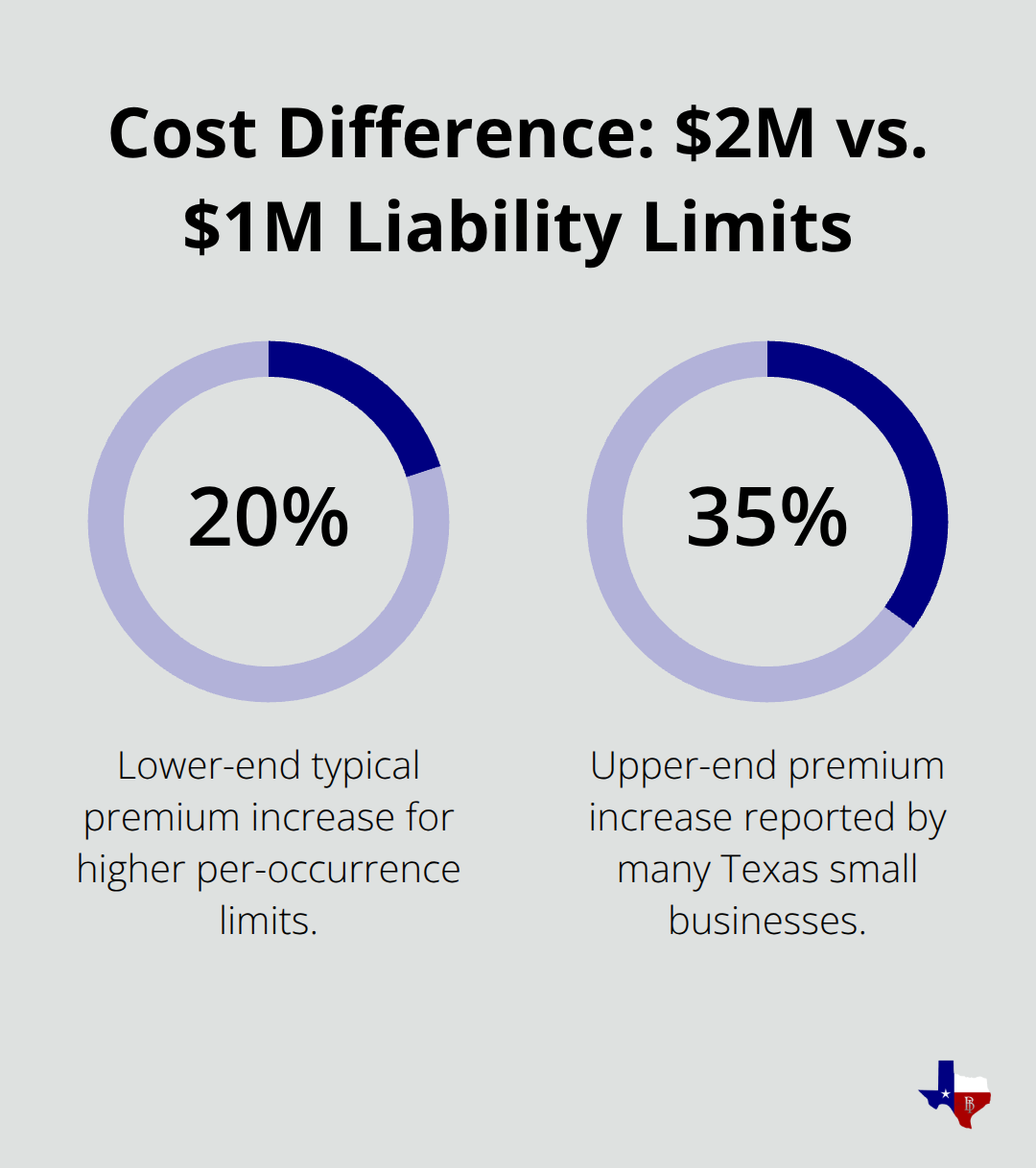
Lower-risk businesses like accounting, consulting, or virtual services may adequately protect themselves with $1 million per occurrence. Restaurants, gyms, construction companies, and retail operations should seriously consider $2 million per occurrence limits. The cost difference between these two tiers often surprises business owners-most Texas small businesses discover that the price difference costs only 20 to 35 percent more in annual premiums, making the upgrade financially reasonable for moderate-risk operations.
Calculate Your Personal Financial Exposure
Your revenue and total assets matter for a different reason: they determine your personal financial exposure if a claim exceeds your policy limits. A business generating $500,000 annually with $200,000 in equipment and inventory faces different loss potential than a $5 million operation with substantial assets. Calculate your largest potential loss-the total amount you could lose if someone sued you and won a judgment beyond your policy limits.
If a jury awarded $3 million in damages and your policy only covered $1 million, you would personally owe the remaining $2 million from business income and personal assets. This scenario isn’t theoretical: Texas juries award damages exceeding $1 million in serious injury cases.
Request Quotes Using Identical Specifications
The solution isn’t guessing; it’s requesting quotes from at least three different insurers using identical coverage specifications so you can match your coverage to your actual business risk. When you call for quotes, specify your industry, annual revenue, number of employees, your largest single project or transaction value, and your desired coverage limits. This standardization reveals real price differences between carriers rather than confusion created by different coverage options.
Bundle Coverage for Better Value
Higher limits become affordable when you bundle general liability with commercial property and business income coverage through a Business Owners Policy, which typically costs $1,000 to $3,000 annually for small businesses. This approach provides better value than purchasing coverages separately. As an independent agency, we represent multiple top-rated insurance companies, which means you have a larger selection of coverage, pricing, and payment options to find the right fit for your operation.
Final Thoughts
General liability insurance protects your Texas business from the three most expensive scenarios: customer injuries, property damage from your work, and product-related harm. Without adequate limits, a single lawsuit drains your operating capital and forces difficult choices about your company’s future. Small business general liability coverage starting at $1 million per occurrence provides baseline protection, but your actual risk determines whether you need higher limits.
The challenge most business owners face isn’t understanding what coverage does-it’s matching that coverage to their specific operation. A contractor’s exposure differs dramatically from a consultant’s exposure, yet many Texas business owners apply generic limits without calculating their real financial risk. This mistake costs money twice: either through underinsurance that leaves you exposed, or through overpaying for coverage you don’t need. Request quotes from at least three carriers using identical specifications for your industry, revenue, and desired limits so you can see real price differences and understand what different coverage levels actually cost.
Your coverage needs change as your business grows, so review your policy annually and after major changes like adding employees, expanding locations, or increasing revenue. What protected your business last year may leave gaps this year. Contact us at brooksinstx.com to discuss your specific situation with an agent who knows Texas business risks inside and out.
Disclaimer: The information provided in this blog is for general informational purposes only and does not constitute legal, financial, or insurance advice. Coverage options, terms, and availability may vary. Please consult with a licensed professional for advice specific to your situation