
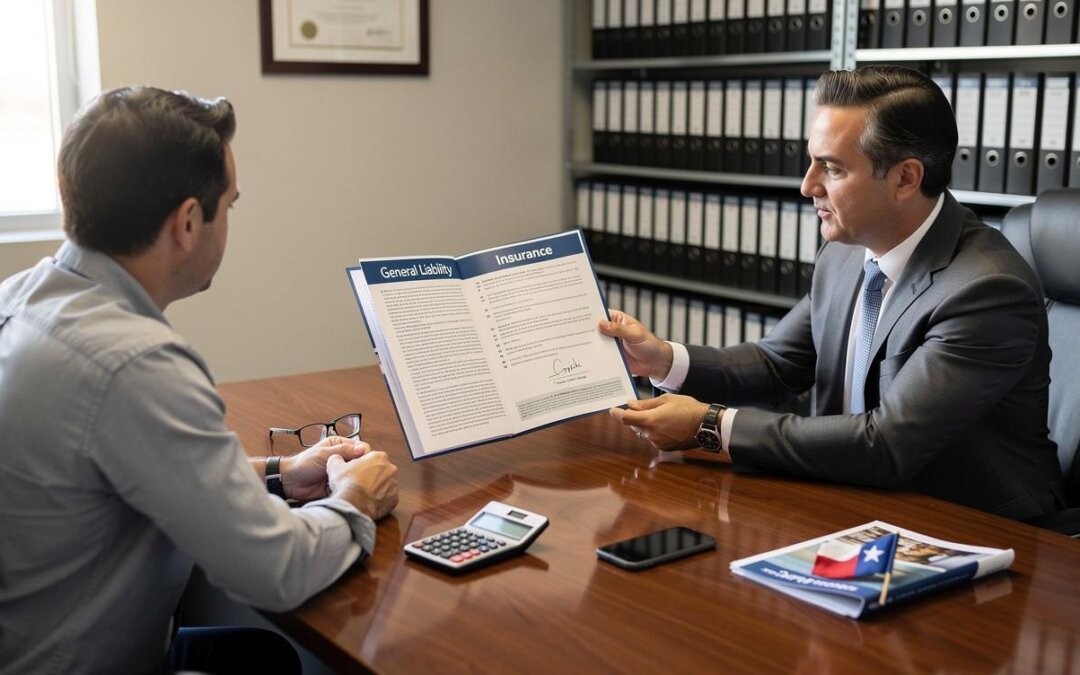
One accident can derail your business finances. That’s why Texas general liability insurance exists-to protect you when a customer gets hurt on your property or you accidentally damage someone else’s belongings.
At Brooks Insurance, we’ve helped countless Texas business owners understand what this coverage actually does and why it matters for their bottom line. This guide walks you through the protection you need.
What Your General Liability Policy Actually Protects
The Three Core Coverage Areas
General liability insurance protects you against three main categories of risk that occur during normal business operations. Understanding each one tells you exactly what you’re paying for and where your protection applies.

Bodily injury liability covers medical expenses and legal costs when someone gets hurt because of your business activities. A customer slips in your retail store, a client trips over equipment at your job site, or a passerby suffers injury from something your business did-this coverage handles the financial fallout. Property damage liability pays when you accidentally damage someone else’s property. You break a client’s window during installation work, damage a tenant’s belongings while servicing their space, or cause harm to a neighboring business’s equipment. Personal and advertising injury covers claims like defamation, copyright infringement, false advertising, or privacy violations-situations where your marketing or business practices harm someone’s reputation or rights.
According to the Texas Department of Insurance, these three components form the core of commercial general liability coverage and address the most common third-party claims Texas businesses face.
What General Liability Does Not Cover
General liability has clear boundaries. It does not cover damage to your own property, injuries to your employees, professional mistakes in service delivery, or theft of your own inventory. If you need protection for your building, equipment, or employee injuries, you’ll need separate policies or endorsements to fill those gaps.
Understanding Your Costs and Deductibles
The Hartford reports that the average annual cost of general liability insurance for small businesses is about $810, though Texas pricing varies significantly by industry and location. Restaurants average $1,352 annually, while photographers average $421, and retail stores fall around $712. Your actual cost depends on your specific business type, location within Texas, number of employees, claims history, and the coverage limits you select.
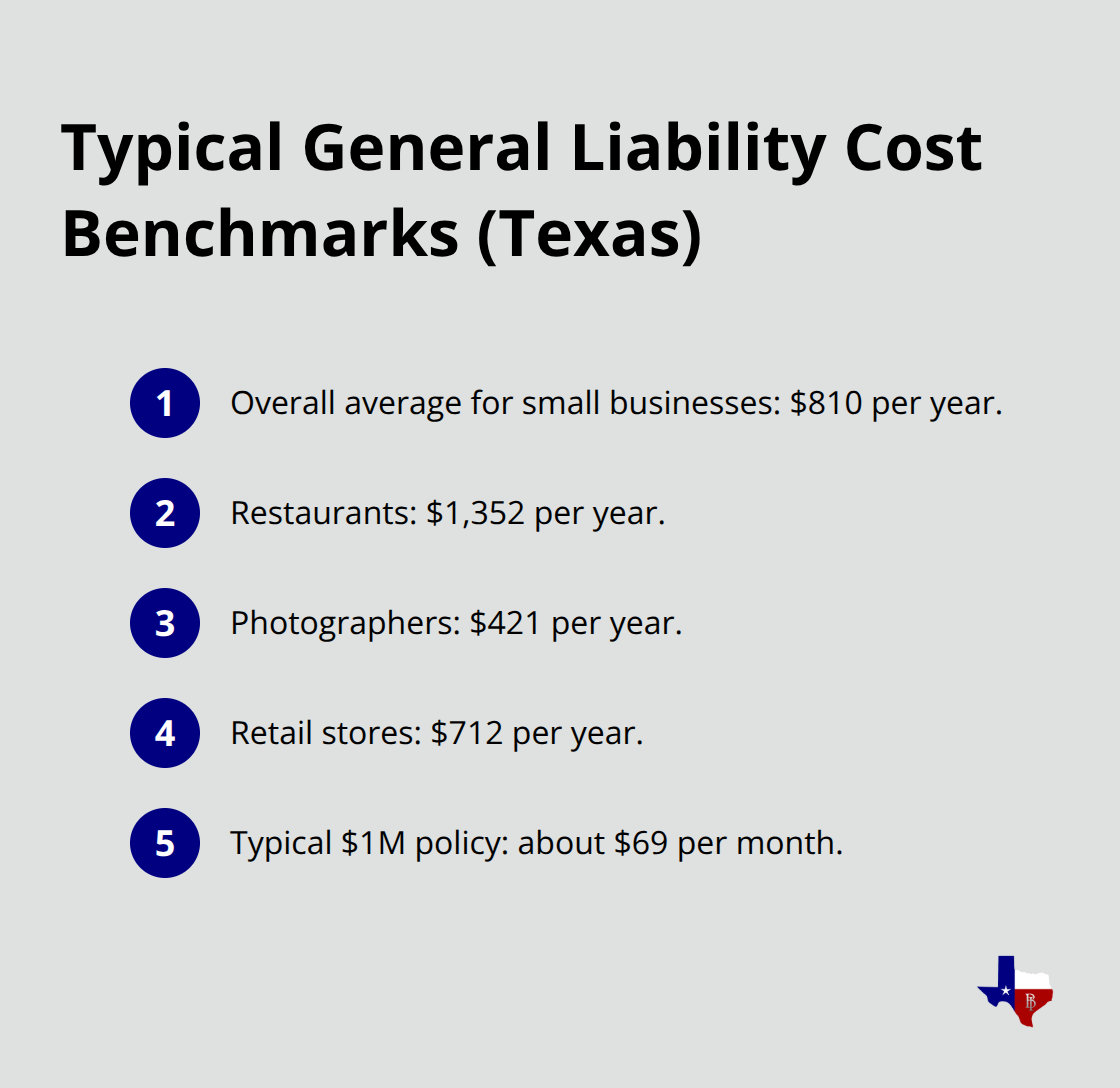
A $1 million policy typically costs around $69 per month for Hartford customers. Higher deductibles lower your premium but increase what you pay out of pocket when a claim happens. Many Texas business owners find that a $1,000 deductible balances affordability with reasonable protection. As your business grows and your risk exposure changes, your coverage needs will shift as well-which is why selecting the right limits and deductibles now matters for your long-term financial security.
Why Your Texas Business Needs This Coverage
The Real Cost of Operating Without Coverage
General liability insurance isn’t optional for most Texas businesses, even though Texas law doesn’t universally mandate it. What makes it essential is the financial reality of operating a business. The real cost of a slip-and-fall claim in Texas typically ranges from $15,000 to $45,000 based on injuries. Without coverage, you pay these costs personally, which can bankrupt a small operation. Most contracts, leases, and client agreements require proof of general liability before you can start work. According to the Texas Department of Insurance, many landlords, vendors, and clients won’t sign with you unless you carry active coverage with a Certificate of Insurance in hand. This means general liability isn’t just protection-it’s a business requirement that directly affects your ability to land contracts and retain customers.
Industry-Specific Coverage Demands
If you operate in construction, contracting, retail, landscaping, or any service-based industry, you’ll face constant requests for proof of coverage. Without it, you lose deals. Contractors especially encounter this barrier at nearly every project bid. Restaurants, manufacturers, and retailers all experience similar pressure from property owners and business partners who won’t proceed without documented liability protection. The Texas Department of Insurance confirms that these coverage requests appear across virtually every major industry sector in the state.
Why the Premium Argument Fails
The cost argument against carrying coverage doesn’t hold up. The Hartford reports that average general liability premiums for small Texas businesses run about $810 annually-roughly $68 per month. For specific industries like retail stores (averaging $712 per year) or accountants (averaging $604 annually), the monthly cost is negligible compared to a single claim. A restaurant averages $1,352 per year in premiums, still far less than one serious food-borne illness claim or slip-and-fall incident. The Texas Department of Insurance notes that claims-made policies with higher deductibles reduce your premium further, allowing you to customize coverage to match your risk level and budget. Operating without coverage to save $50 to $100 monthly exposes you to liability that could exceed $1 million.
Finding Coverage That Fits Your Budget
The right policy doesn’t have to strain your finances. As an independent insurance agency with over 50 years of experience, we represent multiple top-rated insurance companies, which means you have a larger selection of coverage, pricing, and payment options. Our licensed agents work with Texas business owners to find policies that fit their actual budget while protecting their assets. The next step involves understanding how to select the right coverage limits and deductibles for your specific situation.
How to Choose the Right General Liability Policy
Assess Your Business Risk Exposure
Start by identifying what your business actually exposes you to, not what sounds safe in theory. A retail store with foot traffic faces different risks than a contractor working on client properties. The Texas Department of Insurance confirms that premises operations coverage applies to injuries or damage occurring on your business location or during your ongoing work, while products and completed operations coverage addresses harm caused by your finished work or products after they leave your premises.
If you operate a restaurant, your primary exposure involves customer injuries on-site and food-related claims. If you’re a contractor, your exposure spans job site injuries, property damage during installation, and liability from completed work discovered months later. Audit your actual operations for the past two years. What types of claims have you heard about in your industry? What does your lease require? What do your biggest clients demand in their contracts?
Your coverage limit should feel appropriate for your actual exposure level, not just the industry standard.
Compare Coverage Limits and Deductibles
Many Texas business owners select $1 million because it’s common, then discover during a claim that they needed $2 million based on their specific operations. A $2 million policy costs only marginally more than $1 million, typically 15 to 25 percent higher in premium, yet doubles your protection ceiling. Compare this modest increase against the financial devastation of a $1.5 million claim hitting your $1 million limit.
Deductible selection requires honest assessment of your cash reserves and risk tolerance. You must actually be able to pay that deductible when a claim occurs. If you choose a $5,000 deductible to save $200 annually but lack $5,000 in emergency funds, you’ve created a different problem.
A $1,000 deductible typically represents the practical floor for small Texas businesses, balancing meaningful premium savings against manageable out-of-pocket exposure. A $2,500 deductible saves roughly 10 to 15 percent on premium, while a $5,000 deductible can save 20 to 30 percent, according to typical carrier pricing structures.
Review Policy Terms and Exclusions
Exclusions matter as much as deductibles. Common exclusions include damage to your own work, contractual liability, product recall, and pollution-related claims. If your business involves any contractual liability obligations, verify that your policy addresses this through endorsement or separate coverage.

Pollution exclusions particularly affect manufacturers, automotive shops, and any operation handling hazardous materials. Request your insurer explain every exclusion in plain language and ask whether endorsements can modify coverage gaps. Licensed agents work with Texas business owners to clarify these technical terms so you understand exactly what your premium actually protects and what gaps require additional policies.
Final Thoughts
Texas general liability insurance protects your business from the financial devastation of third-party claims, but only if you actually carry it. The coverage addresses bodily injury, property damage, and personal advertising injury-the three exposures that affect nearly every business operation. Without it, you face uninsured claims that can exceed $100,000, lose contracts because clients require proof of coverage, and operate in violation of most lease and vendor agreements.
Your next step is straightforward: obtain quotes from multiple carriers and compare policies with similar coverage limits and deductibles. Don’t assume that the cheapest option provides adequate protection-a lower price often means reduced limits or higher deductibles that leave you exposed. Instead, match your coverage to your actual business risk, select limits that reflect your potential liability exposure, and choose a deductible you can genuinely afford to pay when a claim occurs.
Texas general liability insurance costs roughly $68 monthly for small businesses on average, yet protects you against claims that could bankrupt your operation. The investment is minimal compared to the financial risk of operating uninsured. Contact us today to discuss your coverage needs and receive a quote tailored to your business.
Disclaimer: The information provided in this blog is for general informational purposes only and does not constitute legal, financial, or insurance advice. Coverage options, terms, and availability may vary. Please consult with a licensed professional for advice specific to your situation